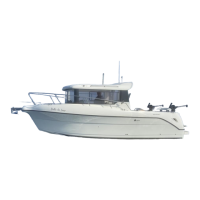
This document is the Owner's Manual for the Quicksilver® 805PH boat, providing comprehensive information on its features, operation, and maintenance.
The Quicksilver® 805PH is a recreational outboard engine boat with a design category of C (Inshore).
- Dimensions:
- Length of Hull (LH): 6.99m
- Length Overall (LMAX): 7.15m (7.72m with optional extension)
- Beam of Hull (BH): 2.82m
- Beam Max (BMAX): 2.89m
- Draft of Hull (TH): 0.60m
- Draft Max (TMAX): 1.09m
- Overall Height (Ha): 2.80m
- Weight Capacities:
- Light Craft Mass (MLCC): 2942kg
- Maximum Load (mMTL): 1271kg
- Fully Loaded Mass (MLDM): 4213kg
- Trailerable Mass (m): 3265kg (includes engine, fuel, water, batteries, and options)
- Fluid Capacities:
- Fuel Tank Capacity: 350L (Petrol, minimum 87AKI octane rating)
- Water Tank Capacity: 80L
- Waste Tank Capacity: 45L
- Engine: Propelled by a single or twin Mercury outboard engines, with a maximum total propulsion power rating of 257 kW.
- Passenger Capacity: Maximum recommended number of persons is 9.
Deck Layout (Standard Equipment)
The standard deck layout includes:
- Bow Area: Bow roller, anchor line hatch, navigation lights (P&S), bow cleat (P&S), bow rail (P&S), cup holder (P&S), fender storage (P&S), port deck trail, portlight, and a bow seat.
- Hardtop: Hardtop, hardtop rail (P&S), midship cleat (P&S), fender hook (P&S), water fill, all-around light.
- Cockpit: Center cockpit storage hatch, rod holder (P&S), port fishwell, cockpit door (P&S), stern cleat (P&S), port aft transom storage hatch, motorwell drain (P&S), fish station, motorwell access (P&S), rigging tube, transom ladder, starboard aft transom storage hatch, fuel fill, starboard fishwell/storage, starboard cockpit access door, starboard deck trail.
- Horn: Located on the hardtop.
Deck Layout (Optional Equipment)
Optional equipment includes:
- Bow Area: Secure eye, bollard, spotlight, hardtop slider hatch, hardtop rack, 3G radar dome, DAB radio antenna, hardtop rod holders, bow windlass.
- Stern Area: Cockpit table, transom shower, port swim platform extension, stern windlass roller, raw water washdown, starboard swim platform extension, livewell, VHF antenna, stern windlass, exterior helm, shore power inlet.
Interior Layouts
- Salon Layout: Features galley storage, galley sink, salon light switches, cup holder, helm seat, USB outlet, helm footrest, starboard salon door, helm, and a diesel heat defrost vent (optional). The starboard side of the salon is consistent across 2-door and 3-door configurations.
- 2-Door Configuration: Interior dinette with a forward movable seat base, fixed aft seat base, and a removable dinette table. Storage is available under both seat bases and the raised dinette floor. The forward seat base articulates, and the removable backrest allows for multiple seating configurations. Includes sliding window, forward dinette seat cushion, forward dinette seat backrest, and port storage.
- 3-Door Configuration: Interior cabin table with an "L" shaped table base leg and a circular table. Includes interior table, 230V AC distribution panel, port aft passenger seat, refrigerator, and dinette table.
- Lower Liner Layout: Includes center forward berth storage, port berth storage, center aft berth storage, starboard berth storage, forward bilge access, interior step, enclosed head/storage, starboard mattress, port mattress, filler board/mattress, enclosed head/storage door, sink access panel, tank level monitor, sink, portlight (P&S), dash access panel, enclosed head/storage light, and interior berth light. LED lights do not have replacement bulbs.
System & Component Overview and Operation
- Fuel System: Consists of a 350L crosslink polyethylene fuel tank, fuel fill, vent fitting, anti-siphon valve(s), sending unit, fuel filter(s), and engine fuel supply line(s). An extra fuel port is available for an optional pickup. Minimum octane rating is 87AKI. Ethanol-blended fuels up to 10% ethanol (E-10) are compatible.
- Maintenance: Periodically inspect for water in the fuel tank. Drain and dry the tank completely before refilling if water is found. For storage, remove all fuel or maintain a full tank with fuel stabilizer.
- Fresh Water System: 80L water tank, pump, and plumbing to galley, optional head sink, and optional transom shower. Fill with potable water only.
- Maintenance: Check fittings and hoses for leaks. Disinfect the system seasonally or after long periods of non-use. Drain completely before winter.
- Black Water System: Waste containment/disposal system with an electric flush toilet, 45L holding tank, macerator, discharge seacock, and dockside pump-out connection.
- Operation: Open toilet water pickup valve. Press and hold flush switch until the bowl is rinsed. For macerator, open seacock, press and hold macerator switch until empty, then close seacock.
- Maintenance: Check fittings and hoses for leaks. Winterize by emptying, rinsing, and flushing with environmentally safe antifreeze.
- Bilge Pumps: Two 500 GPH bilge pumps, one aft and one forward, activated automatically by float switches or manually at the console. A secondary manual bilge pump (19L @ 45 strokes/min) is also provided.
- Maintenance: Inspect intakes for debris. Clean pump strainer by depressing lock tabs and lifting the motor.
- Livewell/Raw Water Washdown (optional): 21L livewell on the starboard side of the fish station, and raw water washdown on the port side of the motorwell. Circulates seawater to keep baitfish alive.
- Operation: Open raw water pickup valve. For livewell, press "BAITWELL AERATOR" switch. For washdown, connect hose and sprayer, press "RAW WATER WASHDOWN" switch.
- Maintenance: Check fittings and hoses for leaks. Clean in-line strainer. Drain all hoses before winter.
- Fish Boxes: Two large fish boxes in the cockpit with drain plugs. Starboard fish box has an optional electric pump-out system and recirculating water system.
- Operation: For pump-out, press "FISHWELL PUMPOUT" switch. For recirculating water, open water pickup valve, press "FISHWELL AERATOR" switch.
- Fire Prevention: Boat is equipped with a portable fire extinguisher (Rating 13A 89B C) located under the helm seat.
- Maintenance: Check equipment at intervals, replace expired/discharged extinguishers, ensure accessibility, inform crew of locations and operation, keep bilges clean, and check for fuel/gas leaks.
- Carbon Monoxide Monitor: Electronic CO monitors in the cabin and enclosed berths. Alerts with a DANGER light and alarm if CO accumulates.
- Maintenance: Test regularly. Replace unit after approximately 7 years (End Of Life signal). Ensure good ventilation throughout the boat.
- Bow Anchor Windlass (optional): Automatically raises and lowers the anchor, operated from the helm.
- Operation: Turn windlass breaker ON. Push switch down to lower, up to raise. Manual operation possible with emergency handle.
- Stern Anchor Windlass (optional): Assists with stern anchoring, operated from the helm or by a handheld remote. Features an auto-stop function.
- Operation: Turn windlass breaker ON. Push switch down to lower, up to raise.
- Bow Thruster (optional): Electric thruster for maneuvering, controlled from the helm.
- Operation: Turn thruster battery switch ON. Press on/off switch on control panel (lights stop flashing and become solid). Push left button for port direction, right button for starboard.
- Steering: Hydraulic steering system. Single engine boats have a steering wheel, hydraulic tilt helm pump, steering cylinder, and hoses. Mercury Verado® engines include an electric power-assisted steering pump. Twin engine boats add a tie bar.
- Maintenance: Rarely needs refilling after bleeding. Refer to manufacturer's manual for fluid addition.
- Engine Controls: Mechanical gear shift/throttle control unit or "drive by wire" Digital Throttle and Shift (DTS®) control unit.
- Operation: Start engine in NEUTRAL. "Throttle-Only" button allows throttle operation without propeller spinning. Power trim & tilt adjusts engine angle for performance and trailering.
- Emergency Engine Shutdown Switch: Located at the helm, near engine keys. Lanyard connected to the operator, pulls to shut off engine(s) in an emergency.
- SmartCraft™ System Gauges: Tachometer and speedometer multi-gauge system. Displays vital information. Optional factory-installed GPS with Mercury's Vessel Link system can display engine data.
- Active Trim (optional): Automatically adjusts engine trim based on boat speed for optimal performance and fuel economy. Keypad on the starboard dash.
- Zipwake Interceptors (optional): Dynamic trim control system for automatic or manual pitch and roll control. Two interceptors on the transom level the boat. Controlled by a panel at the helm.
- Exterior Helm (optional): Allows low-speed operation from the cockpit. Includes steering wheel, hydraulic helm pump, remote control, engine stop switch with lanyard, and bow thruster control pad.
- Operation: Engine started from main helm. Control can be transferred to exterior helm via "Transfer" button.
- Diesel Heat (optional): 2kW heater, 10L diesel tank, and control panel. Heater on starboard salon side, tank in starboard bilge.
- Operation: Fill tank outside the boat. Control panel allows automatic or manual temperature/blower speed.
- Stereo (optional): AM/FM stereo with Bluetooth®. Located on the dash. Can be controlled via GPS if installed. DAB antenna for digital radio. Four speakers on the hardtop.
- Windshield Wipers: Dual-speed system. Switch at the helm.
- Operation: Press once for slow, again for fast, full down for park. Optional windshield washer system with 1.5L reservoir in lower liner bilge.
- Cockpit Flip Seats (optional): Two flip seats on the starboard cockpit side, in front of the fish station. Pull rail out and down to deploy.
- Cockpit Table (optional): Fiberglass table. Stores in bilge when not in use.
- Cockpit Sunshade (optional): Rail in hardtop and canvas. Provides sun protection.
- Operation: Pull pin to slide rail out. Attach canvas with zippers and straps.
- Canvas (optional): Canopy with frame for shade, or full enclosure with vinyl panels.
- Maintenance: Rinse with fresh water after each use. Clean regularly with mild soap. Lubricate zippers. For vinyl windows, use compatible cleaners, avoid abrasives and solvents.
- DC Electrical System: Powered by two batteries (engine and house) charged by engine alternator or battery charger.
- Maintenance: Disconnect batteries before working on the system. Never turn off switches or disconnect cables while engines are running.
- Batteries: Quicksilver® recommends AGM type starting or deep cycle batteries.
- Maintenance: Ensure batteries meet engine manufacturer's minimum capacity. Secure batteries in boxes.
- Battery Selector Switches: Control DC power delivery. Located on the starboard side of the fish station.
- Operation: Rotate clockwise 90 degrees to ON. Push in and rotate 45 degrees for emergency starting (combines banks).
- Fuses and Breakers: Protect the DC electrical system. Located at the helm breaker panel and battery switch panel.
- Maintenance: Replace with fuses/breakers of the same amperage rating.
- AC Electrical System (optional): Allows use of 230V appliances when docked and connected to shore power. Includes battery charger and electrical outlets.
- Operation: Shore power receptacle on aft port deckhouse, AC main panel on port interior pilaster. Connect shore power cable, turn on dock breaker, then equipment breakers.
- Maintenance: Keep shore power cord and plugs clean and dry.
Maintenance
Routine inspection, service, and maintenance are crucial for safety and longevity.
- Hull & Deck Surfaces: Clean algae/slime with a coarse towel or soft brush. Use compounding for stubborn stains. Wax gel coat surfaces at least twice a year. Use wide fan nozzle for pressure washing, avoid direct spray on helm.
- Stainless Steel: Wash with mild soap and cold/lukewarm water after each use. Apply cleaning wax for added protection. Clean crevice corrosion with marine polish.
- Cushions: Clean with mild soap and water. Dry with a soft, lint-free cloth. Use rubbing alcohol for difficult stains. Ensure cushions are dry to prevent mildew.
- Canvas: Rinse with fresh cold water after each use. Clean regularly with mild soap. For stubborn stains, use a mild bleach solution. Retreat fabric for water repellency.
- Zippers & Hardware: Lubricate periodically with silicone spray or wax.
- Vinyl Windows: Clean with compatible cleaners and a mild soap and water solution. Avoid abrasives, harsh chemicals, petroleum-based products, or alcohol. Store flat or rolled with soft cloth.
- Tempered Glass Windshield: Clean with commercially available glass cleaners or a mixture of fresh water and vinegar.
- Acrylic Windscreens & Windows: Use polycarbonate protective cleaner/restorer. Clean with bare hand and plenty of water to dislodge dirt, then mild soap and water solution.
Safety Labels
Various safety labels are located throughout the boat, including:
- DANGER: Immediate hazards resulting in severe personal injury or death. Examples: "Be aware of your footing while the boat is underway," "No smoking. Petrol vapors may explode," "To avoid risk of serious injury, do not climb upon or store equipment on hardtop."
- WARNING: Hazards or unsafe practices that may result in severe personal injury or death. Examples: "Gelcoat surfaces are slippery when wet," "Rotating propeller may cause serious injury or death," "Visibility from this helm station is limited," "Do not attempt to boat in severe weather conditions," "Attach shut down switch lanyard to qualified operator," "Carbon monoxide (CO) can cause brain damage or death," "Do not exceed the maximum recommended number of persons," "When loading the craft, never exceed the maximum recommended load," "The rotating propeller may cause a serious injury or death. Do not use the swim ladder while the boat engine is running," "Do NOT test the bow thruster while the boat is out of the water," "Exhaust gas is HOT," "Never operate the vessel with the canvas enclosure unless there is ventilation throughout the boat," "Never work on the electrical system while the system is energized," "Wear the lanyard at all times when operating the boat."
- CAUTION: Hazards or unsafe practices that could result in minor injury, product or property damage. Examples: "The use of improper gasoline or additives can damage your fuel system," "Always tow or be towed at a slow speed," "E85 fuels could seriously damage your engine," "The use of fuels containing ethanol higher than 10 percent (E-10) can damage your engine," "If 2 control panels are installed at separate helms, never operate the bow thruster from both panels simultaneously," "Under normal conditions, the zincs on the boat should last at least one year," "The toilet water pickup valve should always be in the closed position when not in use."
- NOTICE: Important information for proper operation or maintenance, not hazard-related. Examples: "Recommended battery location - installation requirements," "Do not store any equipment containing petrol in the anchor line storage, fishwells or in the fish station," "Be sure to fill the water tank from a source known to provide safe, pure drinking water," "If you do not use the freshwater system for long periods of time, or only use it seasonally, it is recommended that you disinfect the system before using," "LED lights do not have replacement light bulbs," "The deck drains provide self-bailing capabilities," "Depending on the type of boat, you may have underwater fittings that need drain plugs," "Make sure that the storage tub / livewell is empty prior to rotating the fish station forward," "The fish station must be rotated forward prior to trimming the engine(s) to trail position," "Avoid inadvertent discharge of the black water system," "The dockside pumpout deck plate does not have a chain connecting the cap to the deck plate," "Before operating the windlass, make sure that the safely lanyard is removed from the anchor," "Never operate or turn off the battery switch when the engine is running," "The bilge pumps still draw power from the batteries, even if the switches are set to OFF," "Refer to the individual manufacturer's manuals," "Waxing of the exterior surfaces is recommended," "DO NOT use petroleum based products on the zippers or fasteners," "Never use regular window cleaners, detergents, abrasives, petroleum based products, or alcohol to clean your vinyl windows," "DO NOT use abrasives, harsh chemicals, or metal scrapers on glass," "Never use a dry cloth or duster or glass cleaning solutions on acrylic."
The manual emphasizes the owner's responsibility to safely operate the boat, take boating safety courses, understand "Rules of the Road," and register the boat. It also stresses the importance of keeping the Owner's Packet and OEM manuals aboard at all times.

 Need help?
 General

 To Next Page