Need help?
Do you have a question about the Rae MultiRAE Plus PGM-50/4 and is the answer not in the manual?
Safety precautions for battery packs, computer interface, static hazards, calibration, and readings.
Information on monitors capable of storing datalog data in non-volatile memory.
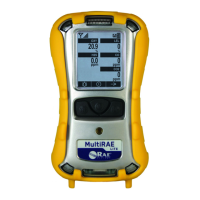
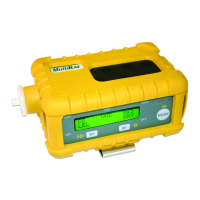
Detailed identification of the monitor's components and their locations.
Procedure for powering the MultiRAE Plus monitor on and off.
Description of the three user modes: Text, Display, and Advanced, and their access levels.
Procedure to enter Program Mode for calibration, including password entry.
Covers Fresh Air, Span Gas, Multiple Sensor, PID, and Single Sensor calibration steps.
Recommendations for storing the MultiRAE Plus monitor when not in use.
Procedure for testing the atmosphere in a confined space before entry.
Information on what happens when gas alarms are detected in confined spaces.
Actions and considerations when no gas alarms are present in a confined space.
Steps to follow after using the MultiRAE Plus monitor.
Description of the default alarm setting where signals reset automatically.
Description of alarm signals that remain active until acknowledged.
Procedure to test the functionality of the monitor's alarm signals.
How the backlight assists in viewing the LCD and its automatic activation.
Details on the integrated sampling pump, its speed settings, and usage.
Overview of datalogging modes: Automatic, Manual, Periodic, and Scheduled.
Information on the PTFE external filter, its purpose, and when to change it.
Description of the remote sampling probe for hard-to-reach areas.
Details on the dilution fitting for measuring gases exceeding sensor limits.
Description of the calibration adapter used for connecting to calibration gas.
Steps for connecting the monitor to a computer via the barrier box.
Procedure for charging the monitor using the barrier box and transformer.
Summary of menus and navigation within the programming mode.
Options for calibrating the monitor and modifying alarm limits.
Settings for datalogging, sensor configuration, and gas selection.
Configuration of monitor settings, user modes, clock, and security levels.
Explanation of correction factors for VOC and LEL sensors and how to set them.
Checking sensor names, raw readings, PID gains, and lamp failure thresholds.
Monitoring battery, clock, temperature, pump status, and sensor expiration.
PC communication, pump stall adjustment, and back light threshold settings.
Covers Li-Ion battery care, replacement, and using the alkaline adapter.
Procedures for replacing sensors, CO filters, bias voltage, PID cleaning, and pump replacement.
Solutions for common problems like power issues, clock errors, and display problems.
Overview of physical dimensions, sensor types, battery, operating hours, display, and datalogging capabilities.
Detailed table of sensor ranges, resolutions, and response times (t90).
 General
| Sensor Type | Electrochemical, catalytic bead, PID |
|---|---|
| Display | LCD |
| Alarms | Visual, audible, and vibrating alarms |
| Operating Temperature | -4 to 113°F (-20 to 45°C) |
| Sensors | LEL, O2, PID |
| Pump | Yes, built-in |

 To Next Page