TYPICAL A/C INSPECTION TIPS
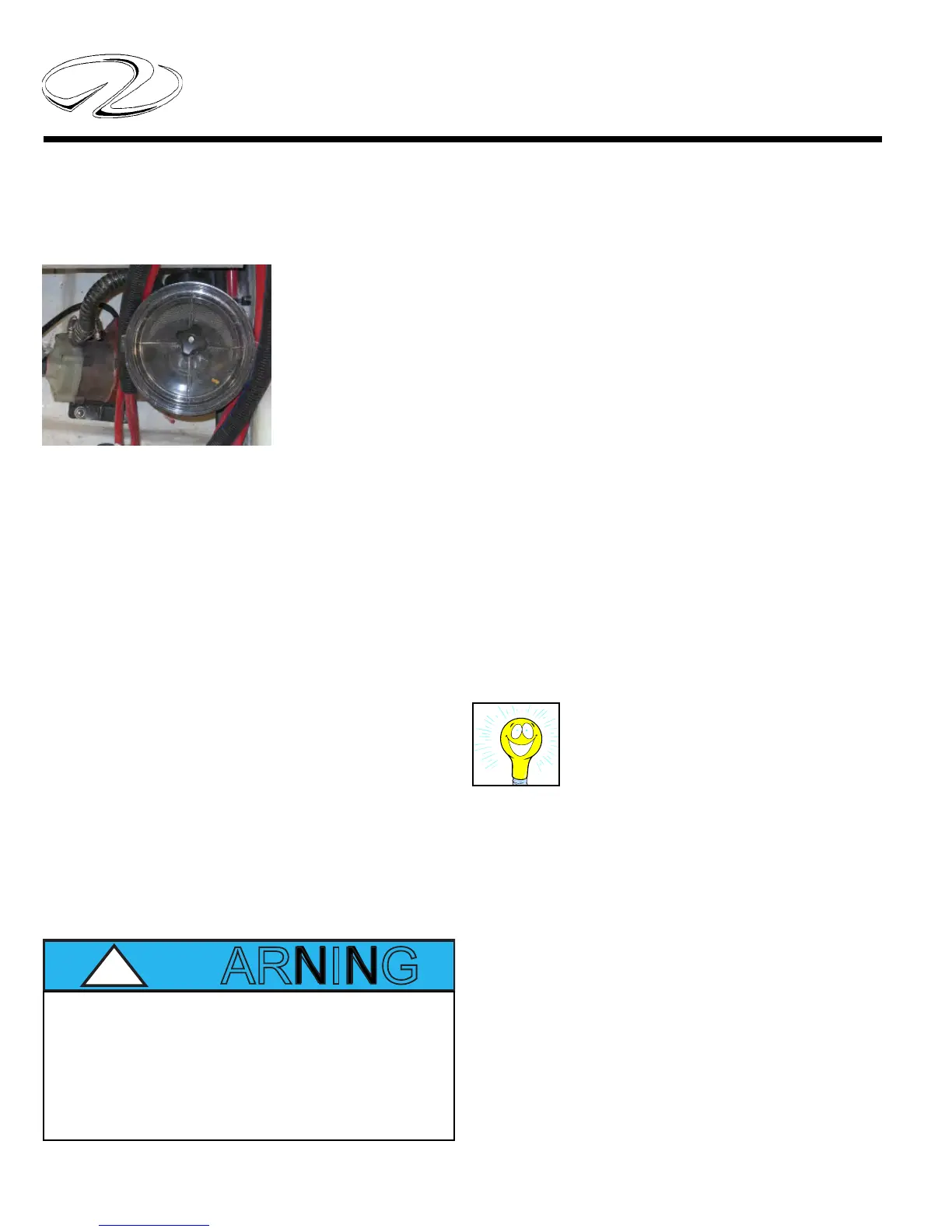
Seawater Strainer
The air conditioner
seawater strainer locat-
ed in the engine room
should be cleaned pe-
riodically of debris
which can inhibit or
stop the fresh sea wa-
ter supply.
Always turn the sea-
cock handle to the off
position (90 degrees
to the hose fi tting) before cleaning a seawater strainer.
Remove the basket by turning the plastic cap in a coun-
terclockwise direction. Set the cap and the O ring aside.
Pull the basket from the unit, rinse with water, air dry and
reinstall. Sediment at the bottom can be removed by just
turning the plug in a counterclockwise direction. Place a
container under the strainer to catch the sediment. Coat
the O rings with waterproof grease containing a silicone
or tefl on base. Reinstall O rings along with the plug and
plastic cap. Turn on the seacock and check for leaks.
Return Air Filters
Once a month check the return air fi lter located on the
face of the evaporator. To clean rinse with fresh water, air
dry and reinstall.
TYPICAL A/C SEAWATER
STRAINER/BASKET
Drain Pans
As noted on an earlier page the AC evaporator/condenser
features a 2” deep drain pan connected by a hose that runs
to a sump pump and eventually exits overboard. Periodi-
cally just like your home AC, the pan needs to be rinsed
clean of debris and possible mold.
You can use a purchased product made specifi cally for
cleaning AC units. Disconnect the outlet hose from the
AC pan and install a made up hose (5/8” ) that will catch
the used solution to fi ll a small container. Dispose of the
container in accordance with federal, state and local regu-
lations. Pour the solution into the pan and allow time for
it to drain. Reconnect the original drain pan hose when
fi nished.
Condenser Coil Cleaning
Periodically the condenser coils are recommended to be
cleaned. This procedure should be done by a professional
since an acid solution must be used.
POSSIBLE PROBLEMS/SOLUTIONS (A/C )
1. No or little water is noticed at the thru-
hull fi ttings and a HPF fault code shows
on the display which means the high pres-
sure switch is open.
The strainer or intake hose may be clogged,
seacock may be closed a hose may be col-
lapsed or the AC pump may be defective. Check AC
pump breaker to verify pump is energized.
2. Air conditioner will not start. Ensure the proper AC
breaker is activated on the ship’s main control panel.
3. No cooling or heating. Lower or raise set point on ther-
mostat control to offset set point being satisfi ed. Check
for obstructed seawater fl ow. Remove discharge side of
pump hose to purge air (air-lock). Seawater temperature
too high for cooling and too low for heating.
4. Fan coil is iced. Raise or lower control set point. Clean
return air fi lter. Switch AC to heat until ice melts or as a
last resort use a hair dryer to melt ice as needed.



 To Next Page