31
Please note that when using a UPnP/
DLNA server, the search and selection
criteria that are available to the user
are determined by the server software,
and not by the device playing the
content. Typical searches include Artist, Album and Genre. Many server
applications also allow you to access your les according to the folders
within which they are stored as well as other criteria. Windows Media
Player is less exible than some other UPnP servers in this regard, but is
generally easier to set up.
Many UPnP server applications are also capable of sharing pictures and
video les to other network connected devices. If this is the case (as it is
with Windows Media Player) you may see the option of choosing between
'Music', 'Video' and 'Pictures' on the Music Player's menu. Clearly you
should only select the 'Music' option. Content offered via the alternative
options will not be playable on your audio system.
Some third party server applications allow customisation of the search
criteria and indexing methods. This can be useful if you have a very large
collection of stored music les.
It is not possible in this book to describe server applications for all available
environments, and neither is it practical to describe how to get the best
out of each. Windows Media Player is used as an example in this case,
although many of the principles are applicable to other servers as well.
The access to the media, the choice of media for playing, and the use of
the media playback controls from the product or from its controlling app
are similar regardless of the UPnP / DLNA server being used.
When using your unit as part of a group of multi-room products, audio les
in ALAC and FLAC formats will only play on the group master (see page 86).
Music Player
Use with Windows, Apple Mac, Linux, USB memory
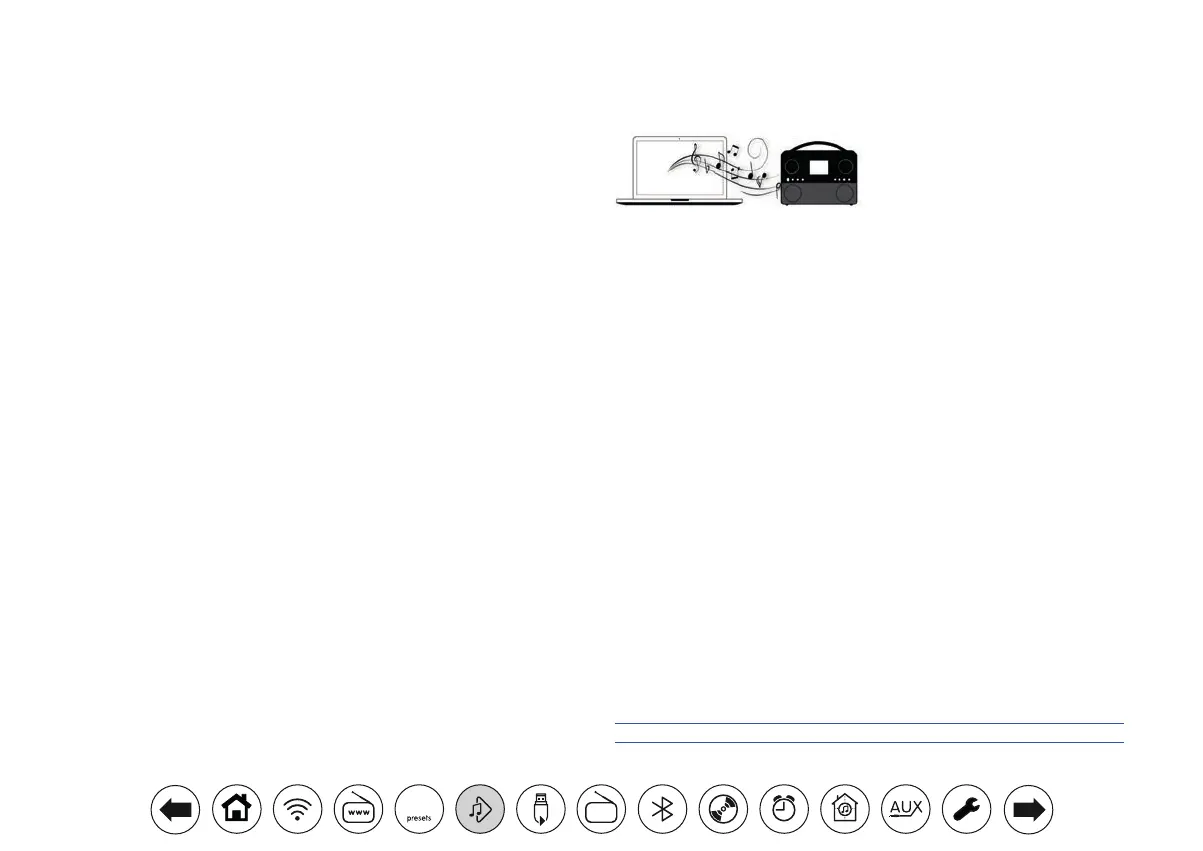
The Music Player allows you to play audio les which are stored on a
another device connected to your network or which are held on a USB
memory device plugged into your audio system.
Networked devices that could hold audio les can include computers,
smart phones, tablets, Network Attached Storage (NAS) units, and network
routers which have UPnP / DLNA le sharing capability. In order to play
les from a device on your network, your audio system must connect to
a le server program on that device which uses the Universal Plug and
Play (UPnP) protocol (often known as DLNA).
If the device is a computer or tablet using Windows, then it probably
already has a UPnP server program available in the form of Windows
Media Player (WMP). This allows you to share your les to devices on
your network, and you may then select les by Album, Artist, and so on
using your audio system's controls. WMP can serve MP3, WMA, AAC
and WAV les to your audio system (and FLAC les from Windows 10).
If you are an Apple MacOS, Linux, iOS or Android user, or if you have your
audio les stored in other formats, such as ALAC, there are many other
UPnP server programs available. Note that Apple computers do not support
UPnP streaming natively and third party software is required for this task.
If you wish to use a DLNA server built into your network router, you should
consult your router's documentation on how this should be congured.
The Music Player on the audio system can play audio les in MP3, WMA,
AAC, ALAC, FLAC and WAV formats. WMA Lossless les can also be
played when using Windows Media Player as the UPnP server. Note that
the playback of les encoded using WMA Voice, WMA 10 Professional,
and of les which have DRM protection is not supported by the unit.
DAB
30


 To Next Page