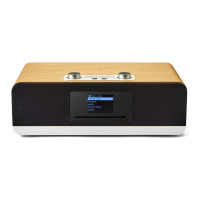
Need help?
Do you have a question about the Roberts Stream 67 and is the answer not in the manual?
Essential prerequisites and network setup for system operation.
Overview of the manual's sections and how they are organized.
Identifies physical controls and ports on the top of the audio system unit.
Details the connections and ports located on the back of the audio system.
Explains the functions of buttons on the included remote control for system operation.
Initial setup steps including power connection and language choice for the system.
Guide to setting the device's clock format, auto-update, timezone, and daylight savings.
Instructions for connecting the audio system to a home network via WiFi or Ethernet.
Steps for setting up the audio system using the UNDOK mobile application.
Introduction to accessing and listening to internet radio stations and podcasts.
How to find internet radio stations by searching geographically by continent and country.
Method for finding radio stations based on music genre preferences.
Procedure to search for internet radio stations using keywords or partial names.
Guide to saving favorite radio stations to memory using the remote control buttons.
Instructions on how to access and play stored favorite radio stations via the remote.
Steps to create an online account for managing custom radio station lists.
How to add and organize favorite radio stations via the web interface.
Information displayed for Internet Radio, including description, genre, and buffer status.
Details shown for DAB Radio, including station name, scrolling text, and signal strength.
Information available for FM Radio, including station name and RDS data.
Data displayed during Bluetooth playback, such as title, album, and artist.
How to play audio files from networked devices or USB storage.
Steps to set up and use UPnP/DLNA servers like Windows Media Player for streaming.
Navigating and selecting media files from UPnP servers for playback.
Detailed guide on inserting and playing audio files from USB drives.
Instructions on creating, viewing, and managing playlists of audio tracks.
Using Windows features to stream media directly to the audio system.
An introduction to Spotify and its premium subscription requirements for the device.
How to control Spotify playback using the audio system's buttons or the Spotify app.
Steps to scan for and select available DAB radio stations.
Procedure for rescanning DAB frequencies to find new or missing stations.
How to manually tune to specific DAB frequencies for optimal reception.
Guide to tuning and listening to FM radio stations, including scanning.
Adjusting the auto-scan sensitivity for finding stronger or all FM stations.
Steps to pair and connect Bluetooth-enabled devices like phones and tablets.
How to play music and control playback from a connected Bluetooth device.
Information on compatibility and playback of recordable CD formats.
Details on playing CDs containing MP3 and WMA audio files.
Instructions for inserting and playing audio CDs, including MP3/WMA discs.
How the clock synchronizes with the internet or other sources for accurate time.
Guide to manually setting the time, date, timezone, and daylight savings.
Detailed steps for configuring the dual alarms with various sound sources and frequencies.
Using the UNDOK app to set up and manage synchronized audio groups.
How to select content and play it across multiple synchronized audio devices.
Checking the current multi-room status, group, and role (Server/Client).
Step-by-step guide to forming a new multi-room audio group using the system's interface.
Adjusting audio sound profiles (bass, mid, treble) via the UNDOK app for personal preference.
Setting the audio system to automatically turn off after a specified period using the UNDOK app.
Detailed guide to setting equalizer modes and custom profiles (Bass, Mid, Treble) on the unit.
Customizing individual Bass, Mid, Treble, and Width audio settings for personalized sound.
Adjusting the bass level output from the unit's loudspeakers for desired sound depth.
How to temporarily silence the audio output from the loudspeakers.
Adjusting the display brightness for both standby and active use modes.
Information on connecting headphones and important safety warnings regarding listening volume.
Guide to connecting external audio sources like MP3 players via the Aux In port.
Setting the system to automatically enter standby mode after a period of inactivity.
Using the system's USB port to charge external devices like phones and tablets.
Procedure to restore the audio system to its original factory default settings.
Instructions on how to update the system's internal software via an internet connection.
Managing saved WiFi network connection details for different locations.
Displays current software version and radio ID for reference and support.
Frequently asked questions section for Internet Radio usage and troubleshooting.
Instructions for changing the audio system's network name for easier identification.
Supported audio formats and their maximum bit-rates for playback.
Basic checks to ensure the unit is properly plugged in and switched on.
Steps to diagnose and resolve issues related to audio playback and network connectivity.
 General
| Radio type | Internet |
|---|---|
| Tuner type | Digital |
| FM band range | 87.5 - 108 MHz |
| Supported radio bands | DAB, DAB+, FM |
| Preset stations quantity | 30 |
| Projection | - |
| Antenna type | External |
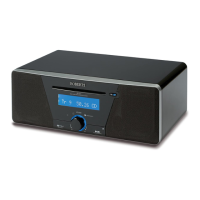
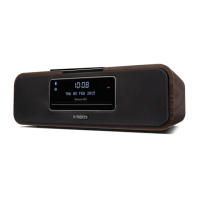
| Product color | Black, Brown |
| Internet radio | Yes |
| Volume control | Buttons |
| Number of alarms | 2 |
| Audible alarm type | Radio/Sound/Buzzer |
| Compatible products | iPhone, iPad, iPod touch |
| Internet radio services supported | Amazon Music, Deezer, Spotify, Tidal |
| On Screen Display (OSD) languages | DAN, DEU, DUT, ENG, FRE, ITA, NOR |
| Headphone outputs | 1 |
| Headphone connectivity | 3.5 mm |
| Audio formats supported | AAC, ALAC, FLAC, WMA |
| Wi-Fi standards | 802.11a, 802.11b, 802.11g |
| Ethernet LAN data rates | 10, 100 Mbit/s |
| Bluetooth profiles | A2DP, AVCTP |
| Security algorithms | WEP, WPA, WPA2 |
| Applications supported | UNDOK, Alexa |
| Timer duration (maximum) | 120 min |
| Timer duration (minimum) | 15 min |
| Compatible operating systems | iOS, Android |
| Battery type | AAA |
| Power source | AC |
| AC input voltage | 100 - 240 V |
| AC input frequency | 50 - 60 Hz |
| Power consumption (typical) | 66 W |
| Certification | CE |
| Operating temperature (T-T) | 5 - 35 °C |
| Clock mode | 12h/24h |
| Display type | LCD |
| Harmonized System (HS) code | 85271900 |
 Weight and Dimensions
| Depth | 285 mm |
|---|---|
| Width | 455 mm |
| Height | 160 mm |
| Weight | 7200 g |

 To Next Page