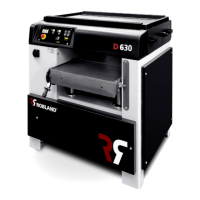
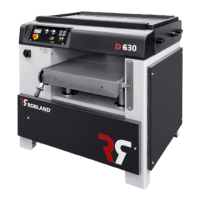
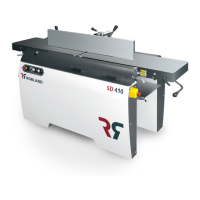
Transportation of the machine
Depending on the method of transport or shipping, you will retrieve the machine in a crate or on transport
blocks protected by a plastic foil.
Remove the sides of the crate or cover.
The machine can be lifted with a small crane, or by sliding the forks of a forklift into the opening in the
frame (Fig 1), but severe shocks should be avoided.
Attention!
When uploading the machine with a forklift, please raise the spindle arbor completely.
The spindle must protrude at least 10 cm at the top when the forks of the forklift are
pushed into the opening and the forks of the forklift must go so far as to support the
front and back of the frame).
Place the machine on a concrete base, and level the machine in both directions.
The packing itself, made of fireboard and wooden beams, can easily be recycled. Take the
sides off the crates and remove the cardboard and parts fastened to the bottom of the crate. For
will pick up, the assembled machine is mounted securely on transport blocks.
The table surface and all exposed parts are covered with a protective plastic film.
Avoid any impact when unloading the machine and never pull the worktable.
Use a wooden ramp made of thick board and wooden beams and secure the ramp to the pallet
to avoid slipping of the ramp. Never try the machine on rollers when it's on an incline. Once the
machine is on ground level, move it with a pallet jack or forklift.
Take the machine off the pallet by means of lever bands (Fig 2), always ensure that these are
not able to shift or loosen. Keep in mind the balance during the lifting, possibly provide a
counterweight (extra attention T120 P version).
Attention!
Make sure the loading capacity is sufficient. Place the lever bands in a way they don't put
pressure on the tables. Lift the machine a few centimeters to remove the bottom of the
crate.
Start up
Make sure the machine was not damaged during transportation or whilst uploading. Position the
machine in a stable position on solid underground and make sure there is enough space around
the machine to use safely.
It is necessary to ensure that all operating instruments are easily accessible, and that there is
enough space around the machine to be able to use them in all safety.
After that, the 4 height control bolts (Fig. 3) must be tightened and the machine must be set in
the 2 directions. Preferably let the machine rest on rubber plates, which then serve as shock
absorbers.
The machine is constructed in a way that it is not necessary to attach the machine to the
ground, but if you wish to do so, it is possible by means of a set screws.


 To Next Page