Operating Instructions
3-9
HP6A Manual
Cross Hatch Angle and Washout
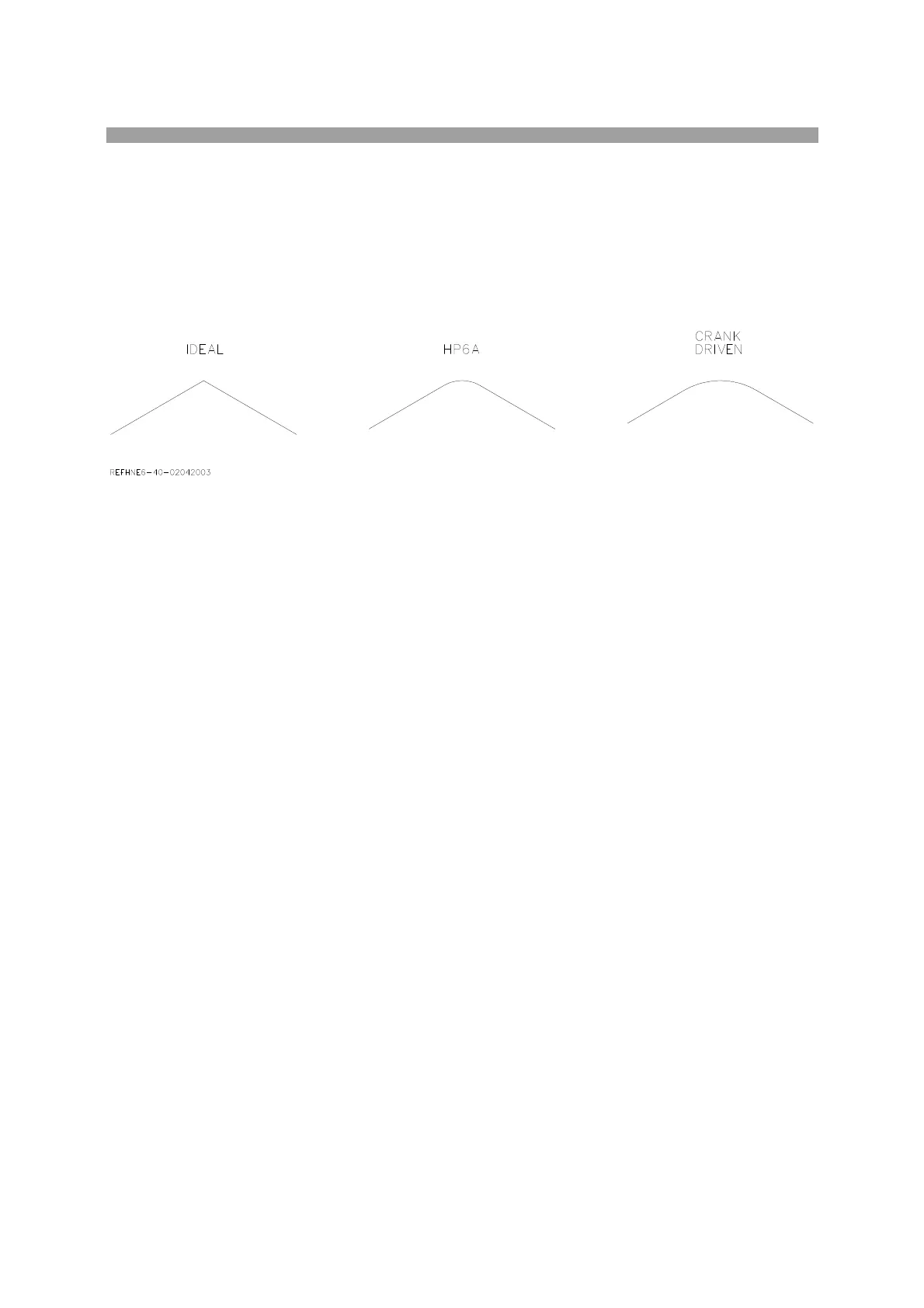
The ideal situation would be for a hone to change the direction it is traveling instantaneously. If this was
possible the angle of the cross hatch would stay consistent through the entire cylinder. The Rottler HP6A
uses high speed electronics in cooperation with an air driven ram to change the direction of travel. This
reduces the amount of Cross Hatch wipeout considerably from a crank driven rocker arm. As a rocker
arm changes direction, the rate of travel slows but the rotation speed of the hone head stays consistent.
This is the cause of washout at the top and bottom of cylinders. Below are examples of ideal cross hatch,
Rottler HP6A cross hatch and a crank driven cross hatch.
It is possible to mistake the slight washout of the cross hatch at the top of the cylinder as the hone head
rotating after it has come to a stop at the top of the cylinder. It is important to understand the difference in
washout and over rotation.
Stroking Speed
The HP6A is set at the factory to operate up to XXX inches per minute of stroking speed without banging
at the top of the cylinder. The strokes per minute indicator on the HP6A cannot be used to judge the
Inches Per Minute the hone head is traveling at. Stroking at 60 SPM in a 6 inch cylinder is allot different
than stroking at 60 SPM in a 10 inch bore. The following will show how to correctly calculate Inches Per
Minute with the HP6A.
Stroke Length = Length of Bore + Top and Bottom Overhang of stones – Length of stones.
Inches Per Minute = Stroke Length X Strokes per minute
Example:
60 SPM in 6 inch bore.
Stroke Length = Length of Bore (6) + Top and Bottom Overhang (.5 Top and .5 Bottom) – Length of
Stones (4) = 3. The actual stroke of the rocker arm is 3 inches.
Inches Per Minute = Length of Stroke (3) X Strokes Per Minute (60) = 180 IPM
Vs.
60 SPM in 10 inch bore.
Stroke Length = Length of Bore (10) + Top and Bottom Overhang (.5 Top and .5 Bottom) – Length of
Stones (4) = 7. The actual stroke of the rocker arm is 7 inches.
Inches Per Minute = Length of Stroke (7) X Strokes Per Minute (60) = 420 IPM
As shown above, there is quite a difference in the speed the hone head is traveling. The excessive
speed will cause the machine to “bang” at the top of the cylinder. The correct way to solve this is to lower
the stroking rate and increase the RPM of the Hone head. Use the cross hatch angel calculation chart in
this manual to determine correct stroke rate and RPM for your desired cross hatch angle.



 To Next Page