3 Design and principle of
operation
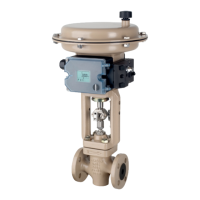
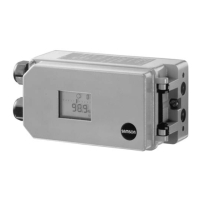
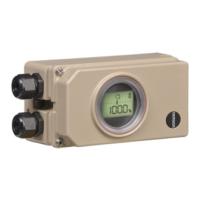
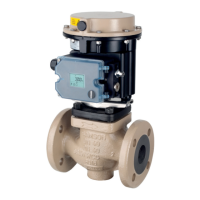
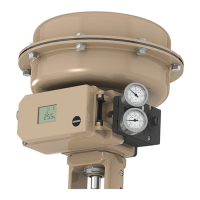
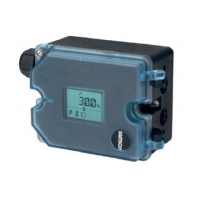
The electropneumatic positioner is mounted
on pneumatic control valves. It is used to as-
sign the valve stem position (controlled vari-
able x) to the control signal (reference vari-
able w). The electric control signal received
from a control system is compared to the
travel or rotational angle of the control valve
and a signal pressure (output variable y) is
produced for the pneumatic actuator.
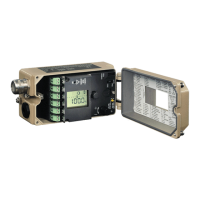
The positioner consists of an anisotropic
magnetoresistive (AMR) sensor (2), an ana-
log i/p converter (7) with a downstream
booster and the electronics unit with
microcontroller (4).
The travel or opening angle is measured by
the pick-up lever connected to a magnet and
a non-contact AMR sensor (2) installed in
the housing and the electronics.
The motion of the pick-up lever causes the
direction of the magnetic field to change.
This change is sensed by the AMR sensor.
The microprocessor determine the momen-
tary valve position from this information.
The position of the valve is transmitted to the
microcontroller (4) over the A/D converter
(3). The PD control algorithm in the micro-
processor (4) compares this actual position
to the 4 to 20 mA control signal (reference
variable) after it has been converted by the
A/D converter (3).
In case of a system deviation, the operation
of the i/p converter (6) is changed so that
the actuator (1) is filled or vented by the
downstream air capacity booster (7).
The pneumatic air capacity booster (7) and
the pressure regulator (8) are supplied with
supply air.
The output signal pressure supplied by the
booster can be limited to 2.4 bar by soft-
ware.
The volume restriction Q (10) is used to opti-
mize the positioner by adapting it to the ac-
tuator size.
Tight-closing function
The pneumatic actuator is completely filled
with air or vented as soon as the reference
variable falls below 1 % or exceeds 99 %
(see end positions set over parameter codes
P10 and P11).
Air to open (ATO): P10
®
ON; P11
®
OFF
Air to close (ATC): P10
®
OFF; P11
®
ON
8 EB 8394 EN
Design and principle of operation






 To Next Page