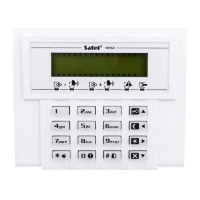
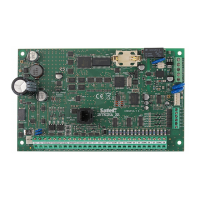
User Manual CA-5
10
• keypad alarms: one of the LEDs is off, and the other LEDs 1 to 5 are on, the meaning of
the extinguished diode being as follows:
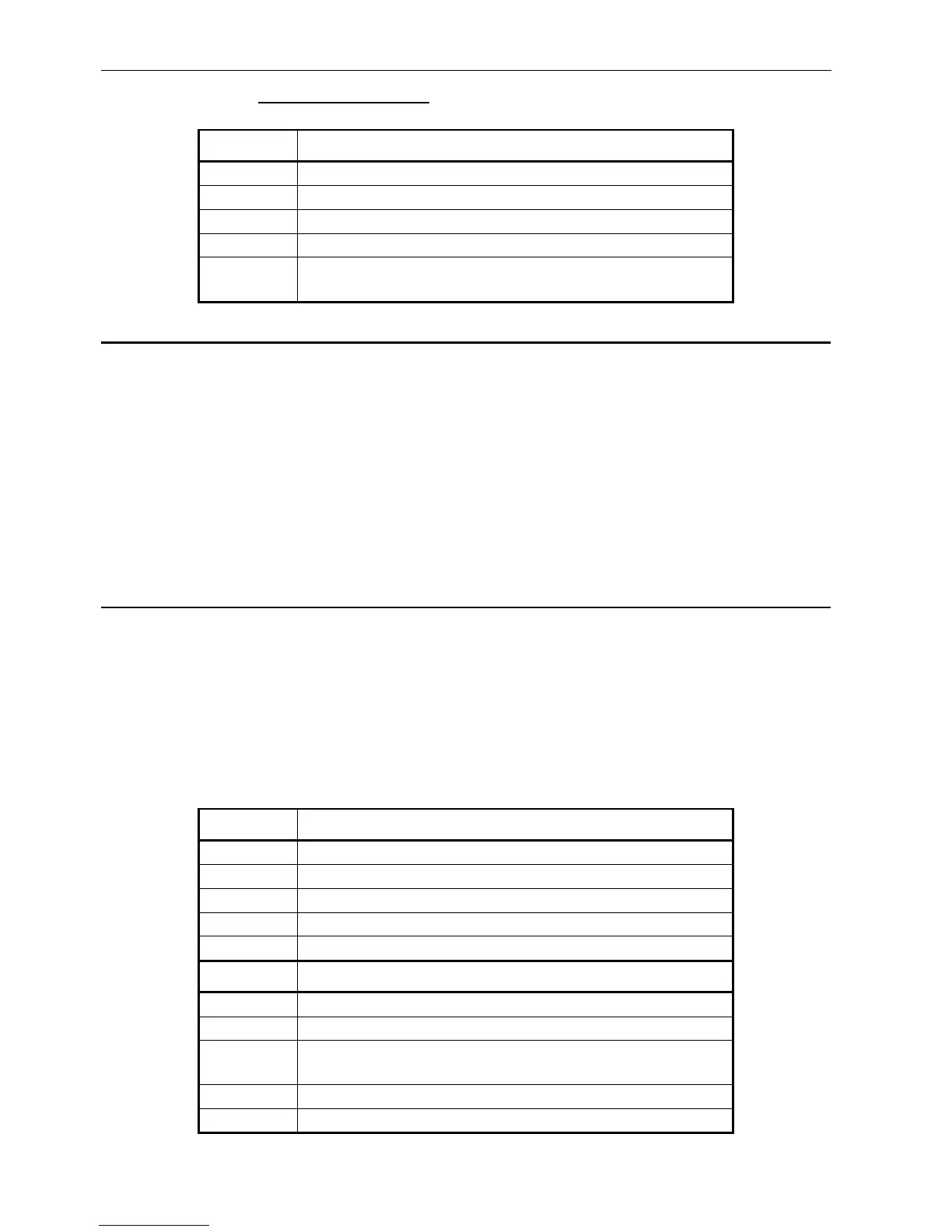
LED No ALARM DESCRIPTION
1 Fire alarm, keypad
2 Panic alarm, keypad
3 Auxiliary alarm, keypad
4 3 wrong access codes alarm
5
Keypad tamper alarm (short-circuiting of bus wires,
cutting off of keypad)
5.3 T
ROUBLE MEMORY REVIEW
[6]
This function allows the panel user to review the detailed information on the system trouble
conditions from the panel memory log.
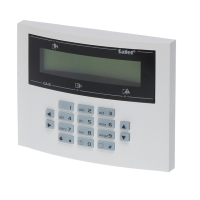
On pressing and holding down the [6] key (until you hear a single beep), the PROGRAM LED
will start blinking, and the LEDs from 1 to 5 will indicate the type of trouble according to the
list contained in the description of the CURRENT TROUBLE CHECK-OUT function. The list
of detectable troubles consists of two sets of five items each. Troubles relating to the first set
are indicated by the number of a lit up LED, whereas troubles relating to the second set are
indicated by the number of an extinguished LED (one of five).
The previous (earlier) troubles are available for readout by consecutively pressing any key of
the keypad, except for the [
*
] key which cancels the trouble memory review function.
5.4 C
URRENT TROUBLE CHECK
-
OUT
[7]
When the control panel signals a trouble detection (the TROUBLE LED is blinking), holding
down the [7] key (until you hear a single beep) will activate the Current Trouble Check-out
Function. On activating the function, the PROGRAM LED will start blinking, and the
LEDs 1 to 5 will indicate any possible troubles from the first set (list of troubles as per the
table). Pressing any key (except for the [
*
] key) will change the set of displayed troubles to
the other one, which will be signaled by two short beeps. Consecutive pressing of any key
will display information, alternately, on the first set of troubles and on the second one.
Pressing the [
*
] key will quit the function.
The meaning of the LEDs is as follows:
LED No. FIRST SET OF TROUBLES
1 230V AC power supply loss
2 Battery trouble (or F1 fuse)
3 OUT1 output trouble (F2 fuse)
4 Power supply outputs trouble (F3 fuse)
5 Clock loss
SECOND SET OF TROUBLES
1 No voltage on telephone line
2 Problem with access to settings memory
3
Wrong communication codes (connections from
computer blocked for 30 minutes by the panel)
4 Monitoring trouble
5 Dialing error


 To Next Page