ASSEMBLY
XH1500/XH1000 06-24 Assembly Section 3-5
ASSEMBLY
© 2024 Alamo Group Inc.
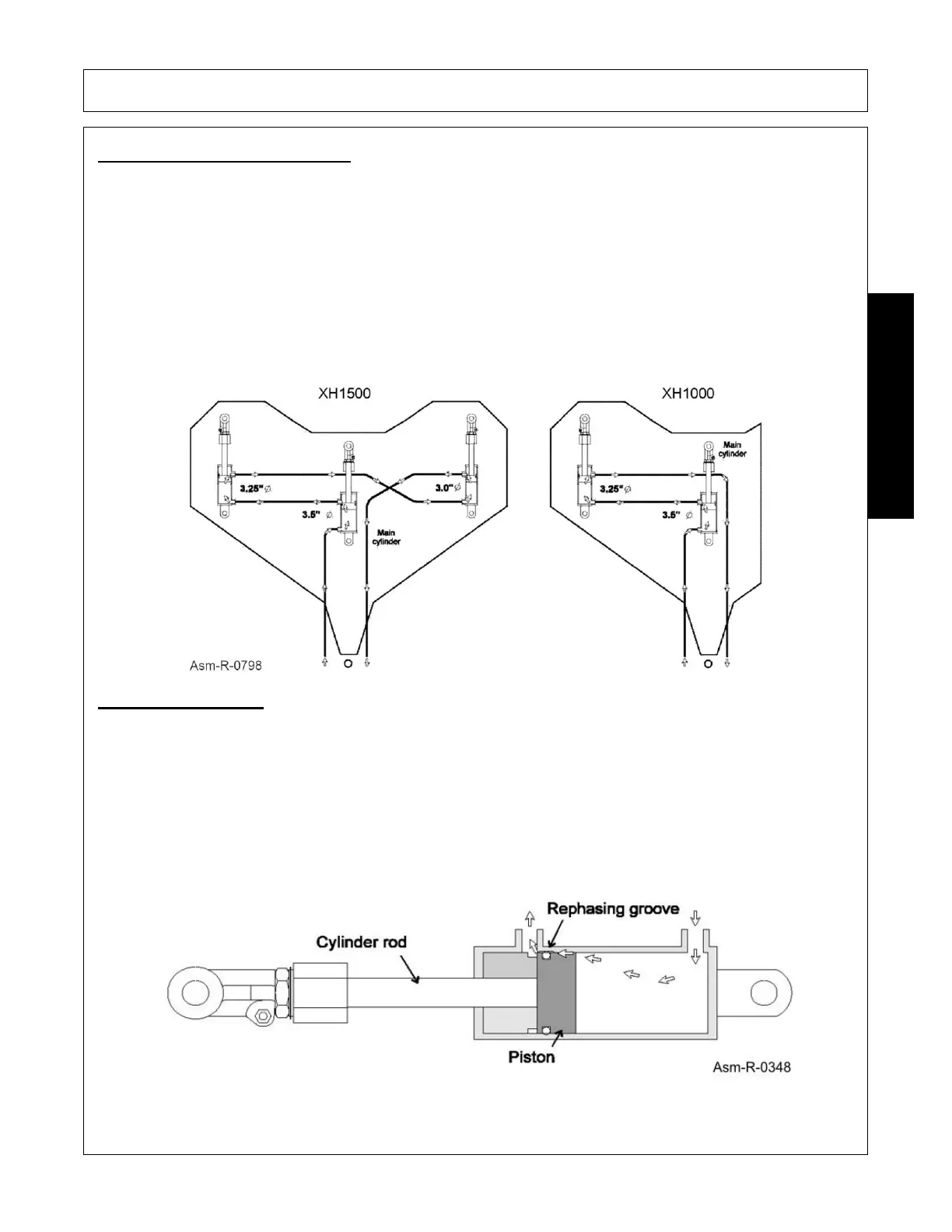
Hydraulic Phasing Cylinders
A hydraulic phasing cylinder system works by synchronizing the operation of a number of hydraulic cylinders
so that they extend and retract at exactly the same rate. This allows a multi-section machine such as a rotary
cutter to be raised and lowered evenly across its width. Because a hydraulic cylinder has a “cylinder rod”
attached to the “piston”, the effective area on the rod side of the cylinder is less than the basic effective area of
the cylinder.
In order to achieve synchronization, cylinder diameters are reduced as cylinders are connected to the “main
cylinder” so that the effective area of the upstream cylinder on the rod side is the same effective area of the
downstream cylinder on the piston side. The result of this stepping down of cylinder diameters is that all
cylinders move at the same rate resulting in a “level lift”.
The phasing system hoses are marked in yellow at the tractor connection.
Rephasing Groove
Hydraulic oil moves from one cylinder to the next through and indentation in the cylinder wall known as a
“rephasing groove”. When the cylinder is fully extended this groove creates a bypass over the piston main seal,
allowing oil to flow to the next cylinder in the set. Since these grooves are quite small it will often take a number
of minutes for oil to completely circulate through the set of cylinders.
On initial startup of a phasing cylinder system it may take a number of minutes to force oil through the system
and purge out any air in the hydraulic lines. During normal operation small amounts of oil may leak past piston
seals causing cylinders to fall out of synchronization. Synchronization can be restored by fully extending
cylinders and holding the circuit open for period of time



 To Next Page