Assembly
10.00 | SWS 005 – 300 | Assembly and Operating Manual | en | 389456
25
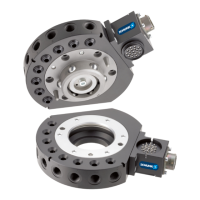
A variety of methods may be used to position the SWA in the Tool
Stand. A common method is to use tapered alignment pins and
bushings. Robot programming and positional repeatability are vital
in tool pickup and drop-off Operation [
}
41]
It is highly recommended that the customer provide a sensor that
detects the presence of a properly seated SWA in the Tool Stand.
The sensor may be used prior to coupling to ensure there is a SWA
properly seated in the stand. Sensors may also be used as the
robot starts to move away after uncoupling. This provides a safety
measure in the event that a SWA should become jammed in the
stand or if the SWA should fail to release properly from the robot.
Proximity sensors should be positioned so that the sensing face is
vertical to prevent metal shavings, weld spatter, or other debris
from falling on the sensor and creating false readings.
Tool Stands may also need to incorporate means for covering
SWAs and modules to protect them in dirty environments, such as
grinding or welding. Alternatively, positioning Tool Stands in areas
shielded from weld spatter, fluids, adhesives, or other debris
would eliminate the need for tool covers.
In order to avoid contamination of the pneumatic feedthrough
openings, as well as of the contacts of the electric options at the
SWA quick-change tool, an SWD dust cover has to be used while it
is located in the storage rack. SWD Dust Cover for SWA quick-
change adapter [
}
8]


 To Next Page
 Loading...