Schweitzer Engineering Laboratories, Inc. SEL-487E-3, -4 Data Sheet
13
Telnet and FTP
Use Telnet to access relay settings, metering, and event
reports remotely by using the ASCII interface. Use FTP
to transfer settings files to and from the relay via the
high-speed Ethernet port.
DNP3 LAN/WAN
DNP3 LAN/WAN provides the relay with DNP3 Level 2
Outstation functionality over Ethernet. Configure DNP3
data maps for use with specific DNP3 masters.
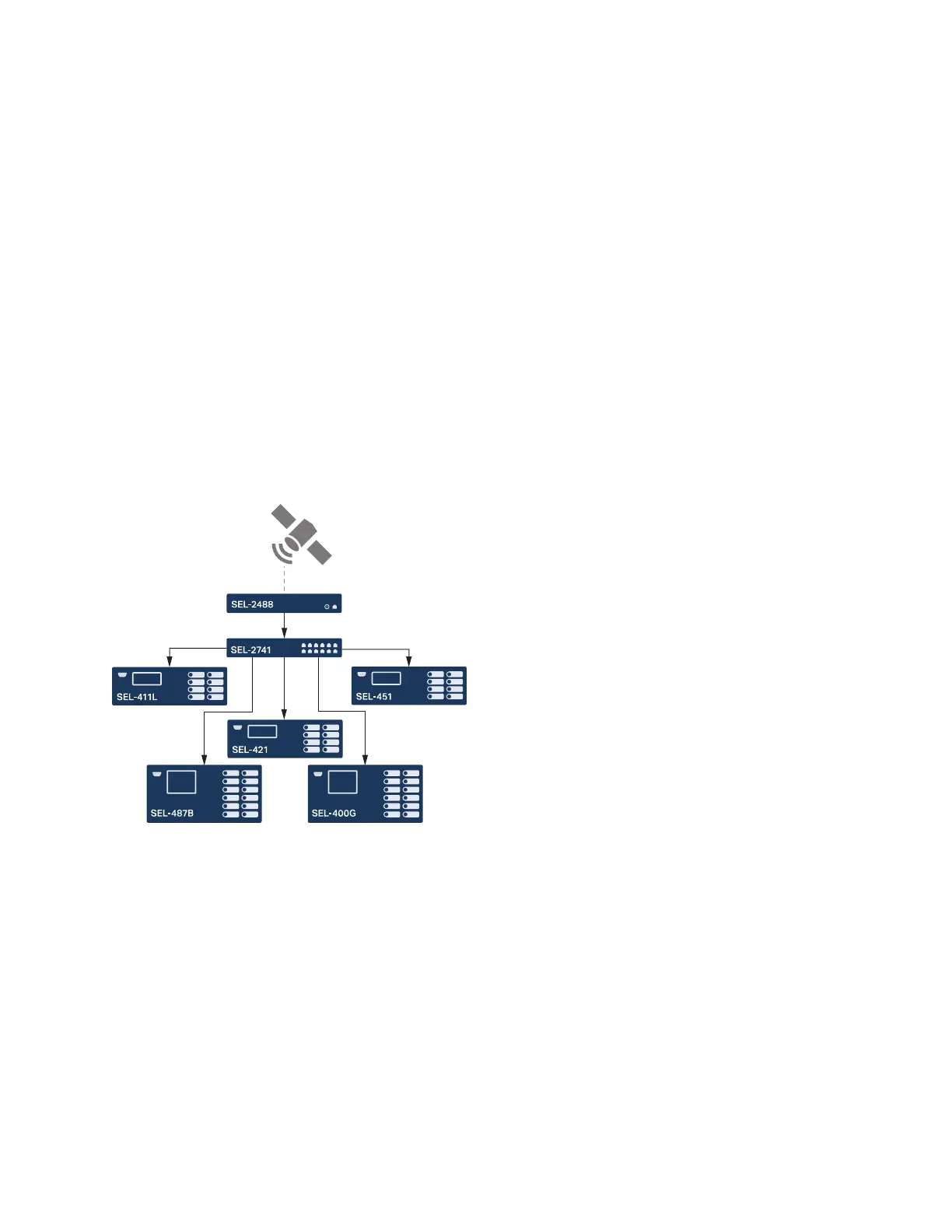
PTP
The Ethernet card provides the ability for the relay to accept
IEEE 1588 PTPv2 for data time synchronization. PTP
support includes the Default, Power System, and Power
Utility Automation Profiles. When connected directly to
a grandmaster clock providing PTP at 1-second synchro-
nization intervals, the relay can be synchronized to an
accuracy of ±100 ns in the PTP time scale.
SNTP Time Synchronization
Use SNTP to synchronize relays to as little as ±1 ms with
no time source delay. Use SNTP as a primary time source,
or as a backup to a higher accuracy time input to the relay.
PRP
Use PRP to provide seamless recovery from any single
Ethernet network failure, in accordance with IEC 62439-3.
The Ethernet network and all traffic are fully duplicated
with both copies operating in parallel.
HTTP Web Server
The relay can serve read-only webpages displaying cer-
tain settings, metering, and status reports. The web server
also allows quick and secure firmware upgrades over
Ethernet. As many as four users can access the embedded
HTTP server simultaneously.
IEC 61850 Ethernet Communications
IEC 61850 Ethernet-based communication protocols
provide interoperability between intelligent devices within
the substation. Standardized logical nodes allow inter-
connection of intelligent devices from different manufac-
turers for monitoring and control of the substation.
Eliminate system RTUs by streaming monitor and con-
trol information from the intelligent devices directly to
remote SCADA client devices.
You can order the relay with IEC 61850 protocol for relay
monitor and control functions, including:
➤ As many as 128 incoming GOOSE messages. You
can use the incoming GOOSE messages to control
as many as 256 control bits in the relay with <3 ms
latency from device to device depending on network
design. These messages provide binary control
inputs to the relay for high-speed control functions
and monitoring.
➤ As many as eight outgoing GOOSE messages.
Configure outgoing GOOSE messages for Boolean
or analog data such as high-speed control and
monitoring of external breakers, switches, and other
devices. Boolean data are provided with <3 ms latency
from device to device depending on network design.
➤ IEC 61850 Data Server. The relay equipped with
embedded IEC 61850 Ethernet protocol provides
data according to predefined logical node objects.
Each relay supports as many as seven unbuffered
MMS report client associations. Relevant Relay
Word bits are available within the logical node
data, so status of relay elements, inputs, outputs, or
SEL
OGIC control equations can be monitored.
➤ As many as 256 virtual bits. Configure the virtual
bits within GOOSE messaging to represent a variety
of Boolean values available within the relay. These
bits that the relay receives are available for use in
SEL
OGIC control equations.
➤ As many as 64 remote analog outputs. Assign the
remote analog outputs to virtually any analog quantity
available in the relay. You can also use SEL
OGIC
math variables to develop custom analog quantities
for assignment as remote analog outputs. Remote
Figure 22 Example PTP Network
GPS


 To Next Page