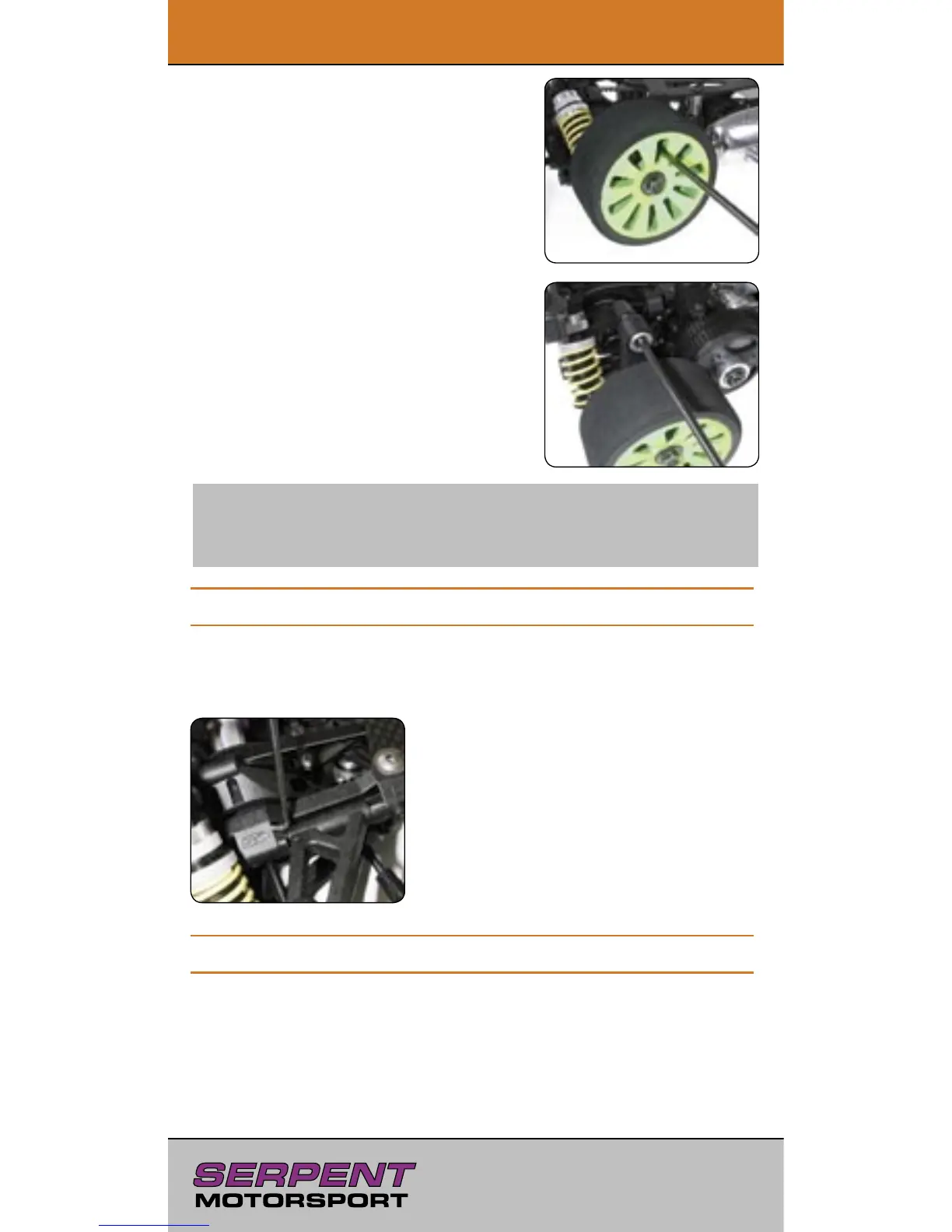
A5.1 Setting front camber
Front camber setting = -1.5°
Set the front camber to –1.5° (tops of
front wheels leaning inwards).
Adjust front camber by turning the front
upper pivotball in or out. To get more
negative camber, turn the front upper
pivotball IN. To get less negative camber,
turn the front upper pivotball OUT.
A5.2 Setting rear camber
Rear camber setting = -3.0°
Set the rear camber to –3.0° (tops of rear
wheels leaning inwards).
Adjust rear camber by turning the rear
upper pivotball in or out. To get more
negative camber, turn the rear upper
pivotball IN. To get less negative camber,
turn the rear upper pivotball OUT.
STOP!
After you set the camber, recheck the ride height settings. Camber
and ride height settings affect each other, so be sure to check each
one when you adjust the other.
A6. CASTER
Caster is the angle of an imaginary line between the top pivotball and
the bottom pivotball of the front steering block, with respect to a line
perpendicular to the ground.
Initial steps
None
Set-up apparatus
None
A6.1 Setting front caster
Set the front caster gap to 3mm (2+1mm
spacers in front of the upper wishbone,
4mm spacer behind).
A7. TOE
Toe is the angle of the wheels when looked at from above the car.
When the wheels are parallel with the centerline of the car, toe is 0°.
When the wheels are open towards the front, this is called toe-out
(negative value). When the wheels are closed towards the front, this is
called toe-in (positive value).



 To Next Page