bar is tweaked. Loosen the screw on the left front anti-roll bar mount.
Adjust the eccentric cam until both rear wheels lift from the ground at
the same time. Tighten the screw to secure the adjusting cam.
A10. REAR DIFFERENTIAL
The rear differential can be used to ne-tune the rear traction of the
710. A looser rear diff gives more rear traction, while a tighter rear diff
gives less rear traction. You can also adjust the slippage (preload) of the
rear diff pulley.
Set the initial diff preload before installing the rear differential in the car.
For more information, see Section 2.0: Differential Assembly in the 710
Instruction Manual.
Initial steps
None
Set-up apparatus
None
A10.1 Setting differential preload
Check the diff preload setting periodically by placing the car on the
track, and blocking the front of the car with your foot while opening
the throttle. The diff pulley should not slip at all. If the pulley slips, you
need to tighten the diff preload to prevent slippage.
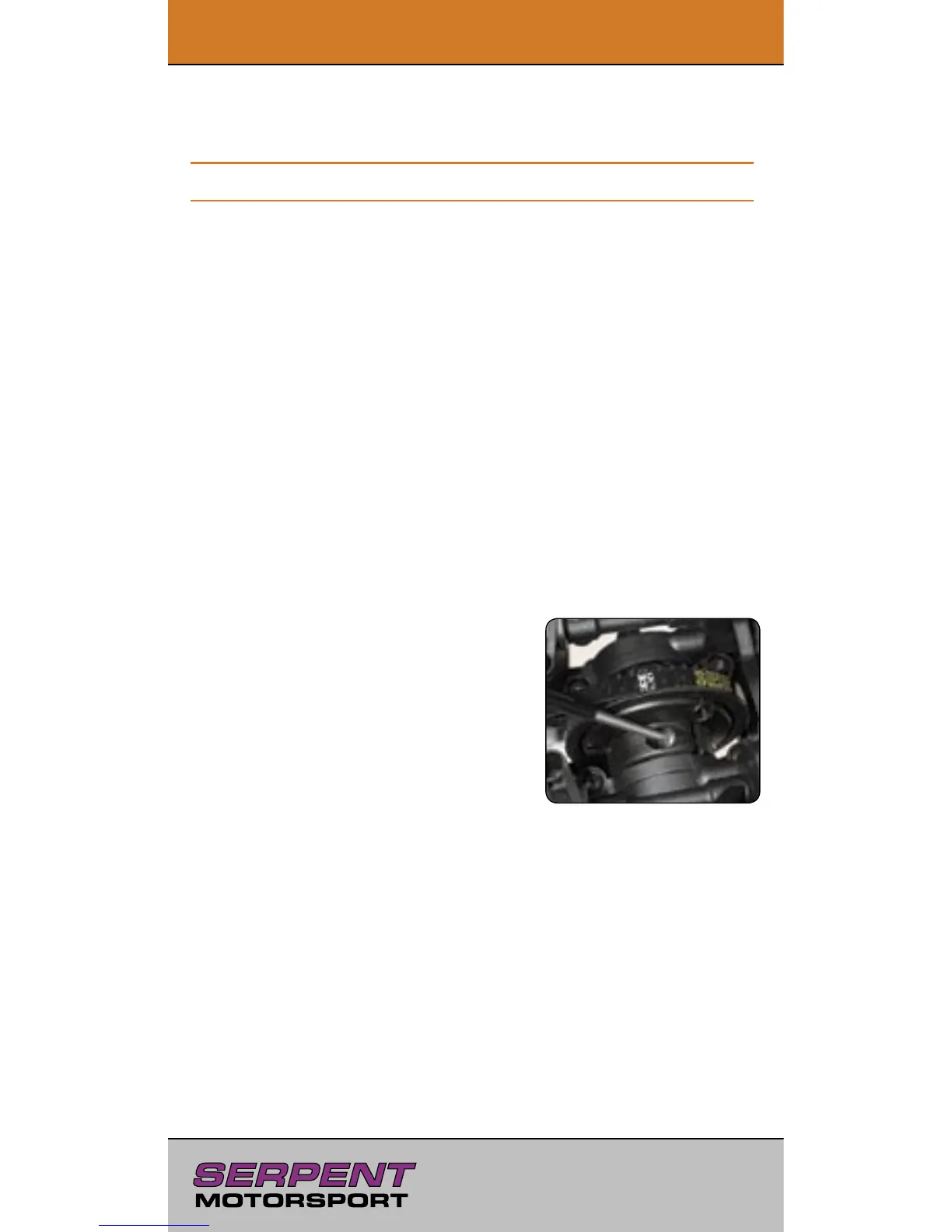
To tighten the diff preload, disassemble
the rear suspension until the two drive
shafts can be removed. Undo the locking
setscrew, tighten the diff preload screw,
and then tighten the locking setscrew
again. Reassemble the rear suspension and
check the diff preload setting.
A10.2 Setting differential action
Adjust the diff friction collar to adjust the
differential action. Tighten the adjustment
screw to increase the spin-resistance of the
differential; loosen the adjustment screw to reduce the spin-resistance
of the differential. The tighter the diff collar, the more the differential
resists the difference in speed between the inner and outer wheel.
Generally, the more grip a track has, the tighter the diff collar should be.


 To Next Page