9
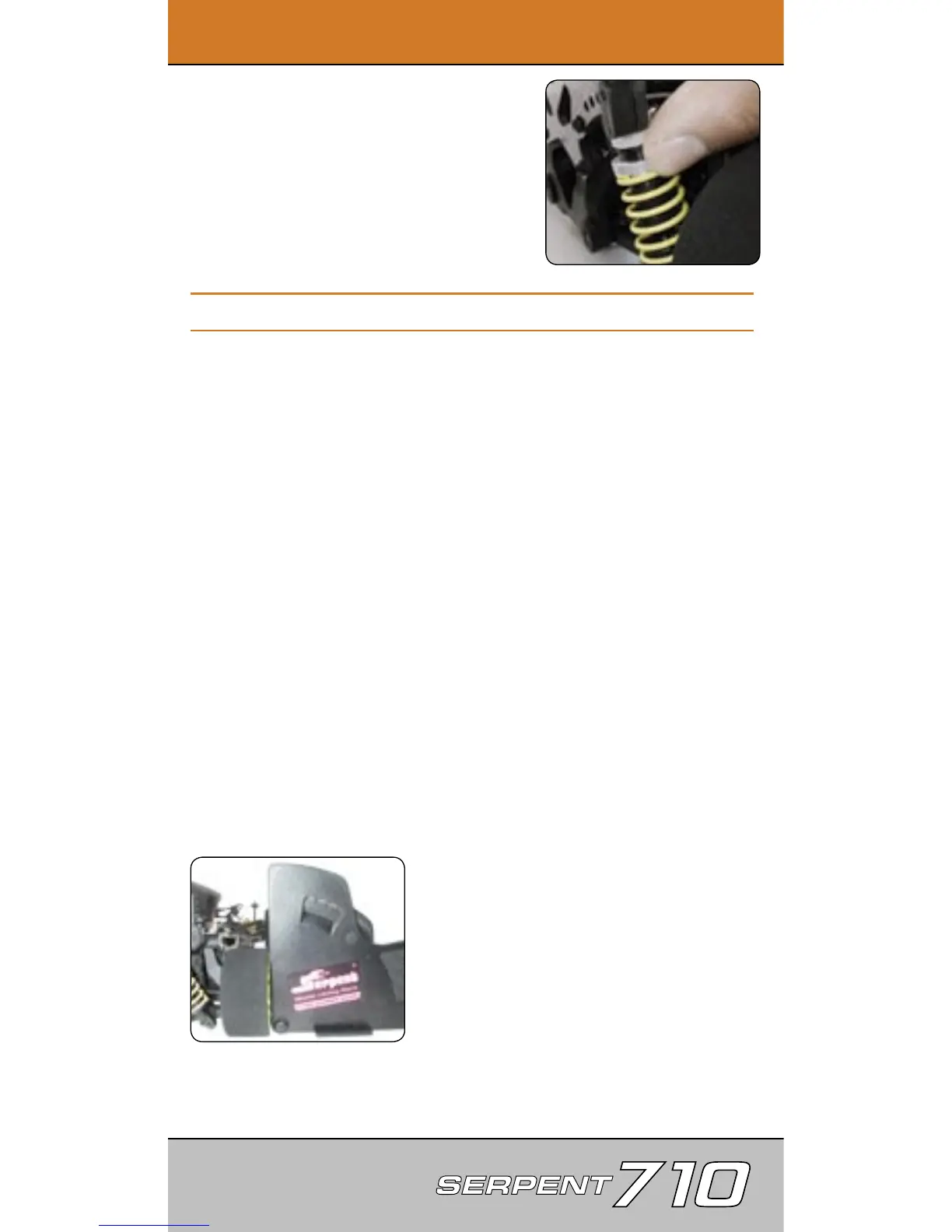
Decrease the rear ride height by loosening
the shock preload collars on the rear
shocks. This moves the collars UP the
shock body.
Make sure you change the shock preload
on both rear shocks equally.
A5. CAMBER
Camber is the angle of a wheel to the surface on which the car is resting
(with wheels and shock absorbers mounted). Zero degrees (0°) of
camber means that the wheel is perpendicular to the reference surface.
Negative camber means that the top of the wheel is leaning inwards
towards the centerline of the car. Positive camber means that the top of
the wheel is leaning outwards from the centerline of the car.
Camber affects the car’s traction.
Initial steps
A Shocks: Connect front and rear shocks.
B Anti-roll bars: Disconnect front and rear anti-roll bars.
C Wheels: If measuring camber using a set-up system, remove the
wheels. If measuring camber with the car sitting on a at surface,
mount the wheels.
Set-up apparatus
Measure the camber using Serpents camber gauge #1460.
Note: You can measure camber using the HUDY Set-Up System (on
a at reference surface), but you may get slightly different camber
readings than those from using Serpent camber gauge. The reason is
that tires (especially the rear tires) have a tendency to lay at on the
surface. If this happens (that is, if the tires are not pre-coned), the
camber readings may differ as much as 0.5° from the reading you would
get with the HUDY Set-Up System.
Measuring camber
Measure the camber using the Serpent
camber gauge. Before measuring camber,
lift and drop the end of the car (front or
rear) a few cm’s to let the suspension
settle.


 To Next Page