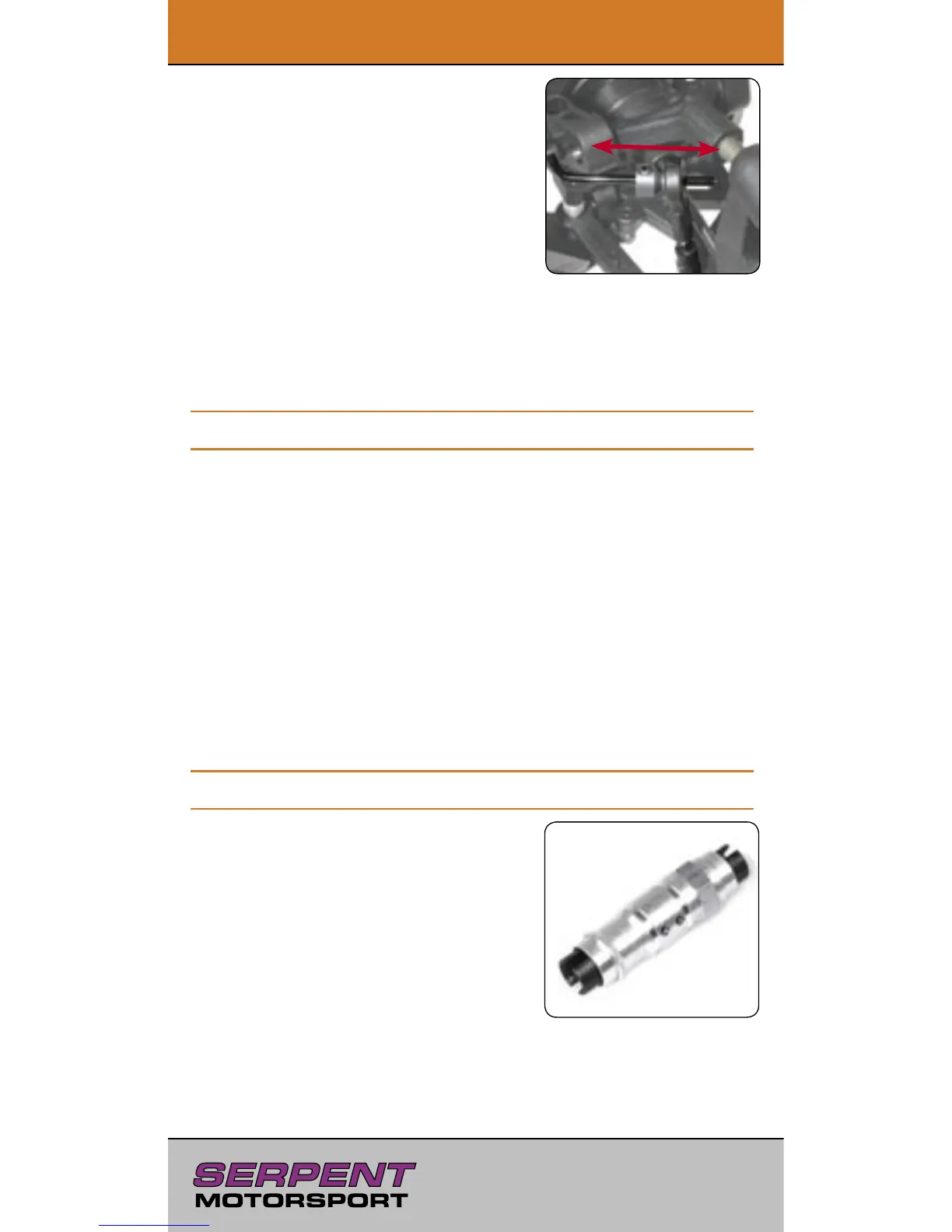
Stiffer rear anti-roll bar (linkage outer
mounting hole):
• less chassis roll
• decreases rear traction
• increases front traction
• increases on-power steering
(may cause oversteer)
• quicker steering response in
high speed chicanes
Softer rear anti-roll bar (linkage inner
mounting hole):
• more chassis roll
• increases rear traction
• decreases front traction
• decreases on-power steering (increases understeer)
B11. FRONT and REAR AXLES
The 710 has several options for front and rear axles. The choice of front
and rear axles depends on track conditions. The 710 is designed to
quickly change these axles with the least effort.
Front axles
• one-way front axle (standard)
• solid front axle (locked one-way axle)
• adjustable front ball differential (optional)
Rear axles
• adjustable rear ball differential (standard)
• solid rear axle (optional)
You may use any combination of front and rear axles, but some work
better together than others
B12. FRONT ONE-WAY AXLE
The front one-way axle behaves like a
differential off-power at corner entry and
in mid-corner, and like a solid front axle
on-power at corner exit. It allows the inner
and outer wheels to rotate at different
speeds under off-power conditions at
corner entry and sometimes mid-corner.
Under on-power conditions at mid-corner
and corner exit, the one-way front axle
locks up and acts like a solid front axle,
introducing some on-power understeer.
With the front one-way axle there is no braking of the front wheels since
the front wheels disengage under braking.
The front one-way axle allows you to use slightly bigger rear tires than


 To Next Page