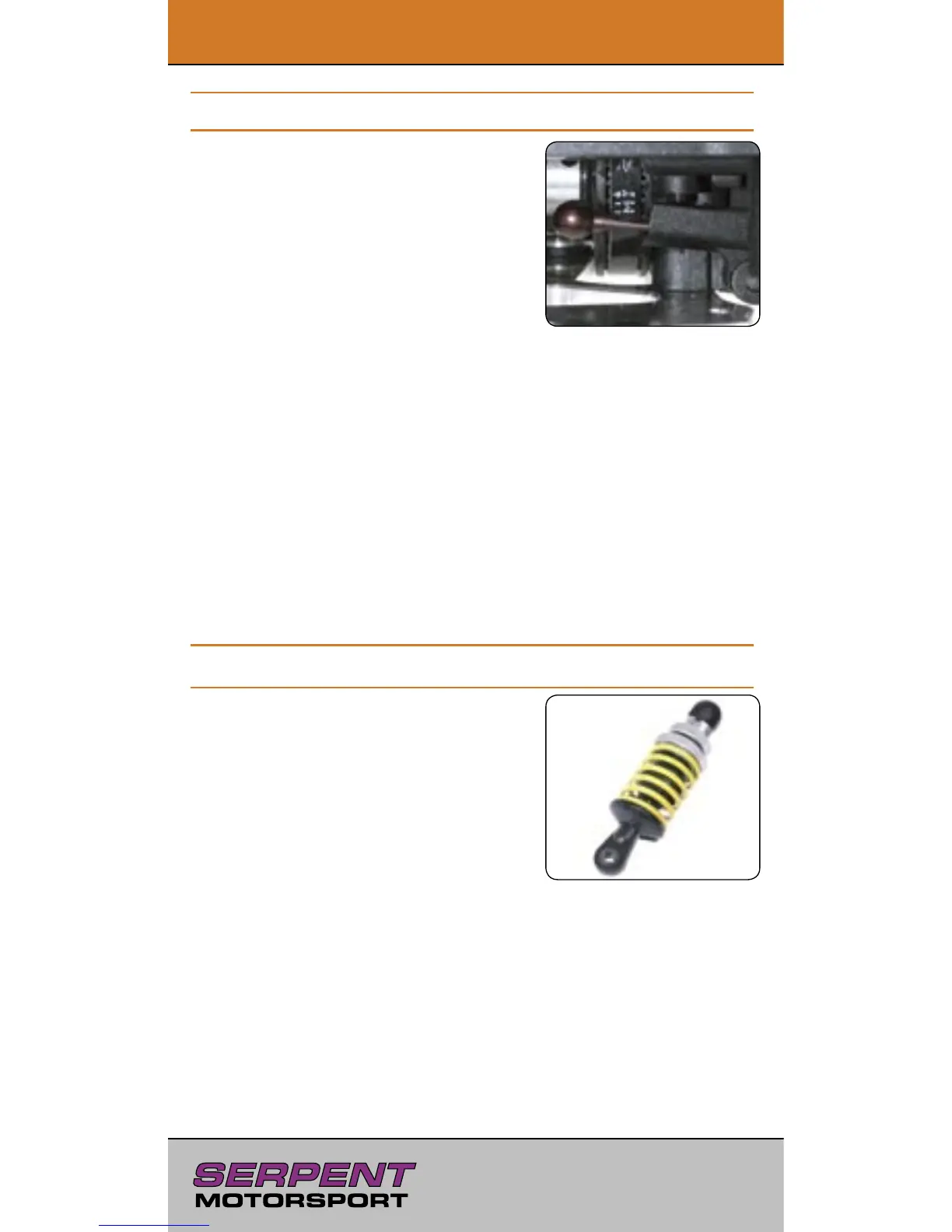
B2. DOWNSTOPS
Downstops limit how far the suspension
arms travel downward, which determines
how far upwards the chassis rises. This
affects the car’s handling, as it directly
impacts the weight transfer of the chassis.
The effect may change with the type of
track and/or amount of grip available.
In general, more suspension travel
(lower downstop value) makes the car
more responsive but less stable; it is also
typically better on a bumpy track or on a track with slow corners. Less
suspension travel (higher downstop value) makes the car more stable; it
is typically better on a smooth track.
Reduced downstops (higher downstop value)
• decreases upward chassis travel
• car more stable under braking
• better on smooth tracks
Increased downstops (lower downstop value)
• increases upward chassis travel
• car more responsive but less stable
• better on bumpy tracks
IMPORTANT! Adjust the downstops so the left and right sides are equal.
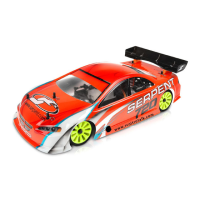
B3. SHOCK ABSORBERS
Shock absorbers are a key component to
setting up your 710. There are various
aspects of shock absorbers that can be
adjusted: spring choice, spring preload,
shock position & orientation, and damping.
Springs
The shock springs support the weight of
the car, and different spring tensions determine how much of the car’s
weight is transferred to the wheel relative to the other shocks. Spring
tension also inuences the speed at which a shock rebounds after
compression.
Spring selection depends on whether the track is fast or slow, or has
high or low grip.
• Stiffer springs: Makes the car more responsive. The car
reacts faster to steering inputs. Stiff springs are suited for
tight, high-traction tracks that aren’t too bumpy. Usually
when you stiffen all of the springs, you lose a small amount of


 To Next Page