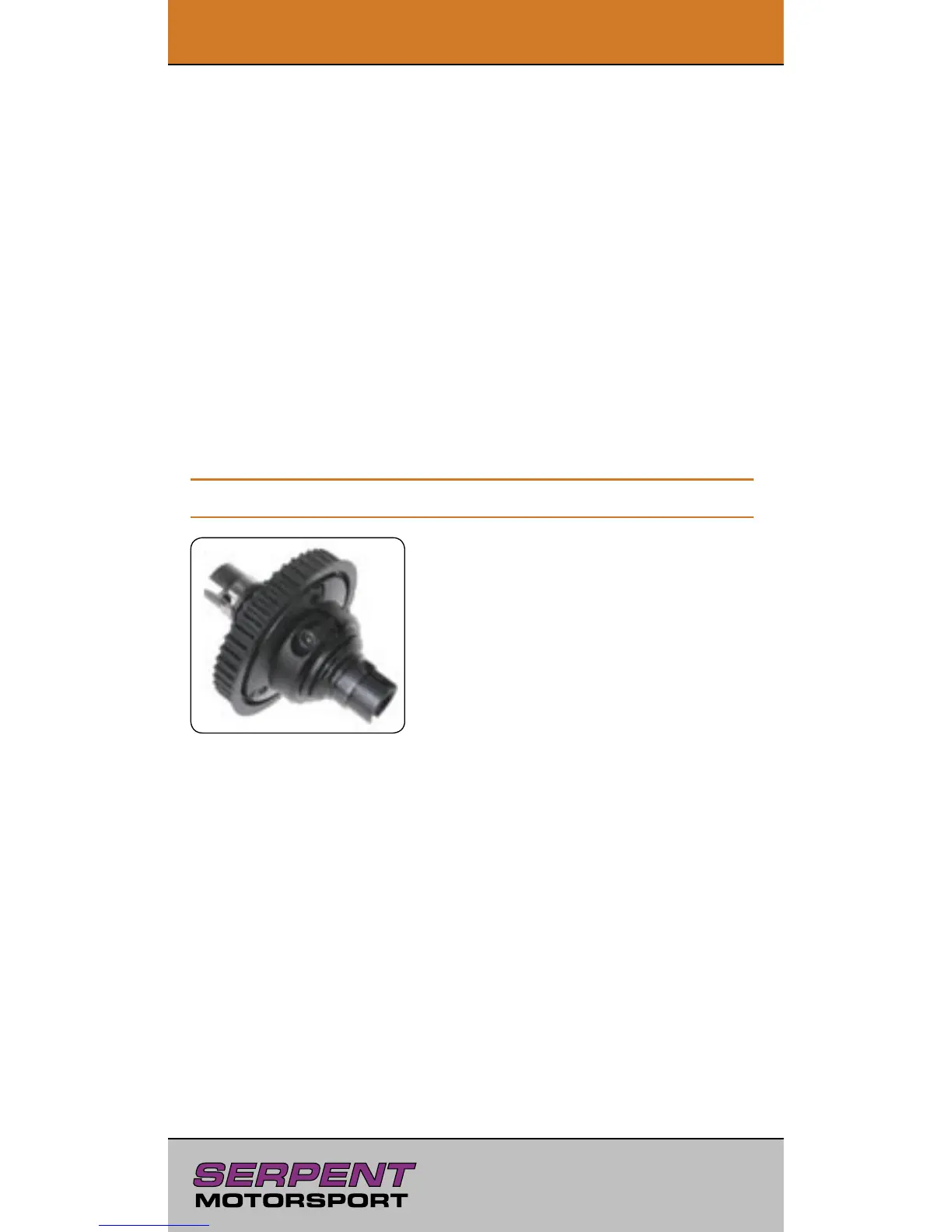
friction collar.
Adjust the diff friction collar to adjust the differential action. Tighten the
adjustment screw to tighten the diff; loosen the adjustment screw to
loosen the diff.
The front differential is most commonly used in low grip conditions. It
can improve on-power corner entry as well as braking.
The front differential is most commonly used with the rear differential.
Tighter front diff action
• Less Steering
• More stable under braking but less turn in
• Better on power out of a corner
Looser front diff action
• More Steering
• Less stable under braking but better turn in
• Understeer on power out of the corner
B15. REAR DIFFERENTIAL
The rear differential shares the same
design as the front differential. It is
designed to allow separate adjustment
of pulley slip and differential action. The
differential action is easily adjusted with a
single external screw.
Adjust the diff friction collar to adjust the
differential action. Tighten the adjustment
screw to tighten the diff; loosen the
adjustment screw to loosen the diff.
Tighter rear diff action
• car understeers slightly at corner entry, but makes the car
more difcult to control at corner exit (powerslides)
• increased on-throttle steering
• better on high-traction surfaces
Looser rear diff action
• more stability mid corner and corner exit
• understeer on-throttle
• better on low-traction surfaces
The rear differential can be combined with all front axle types. The
advantage of the rear differential is that you can quickly adjust it to
adapt your 710 to track conditions, using a single screw. Drawbacks
of the rear differential are that the weight and inertia are considerably
higher than the solid axle, and more maintenance is required.


 To Next Page