29
front tires, and to have the rear wheels overdrive the front wheels.
In that situation, when the rear wheels lose traction the front wheels
engage and start helping to generate forward traction.
The front one-way axle can be used with either the adjustable rear
differential or the solid rear axle.
B13. SOLID FRONT AXLE (Optional)
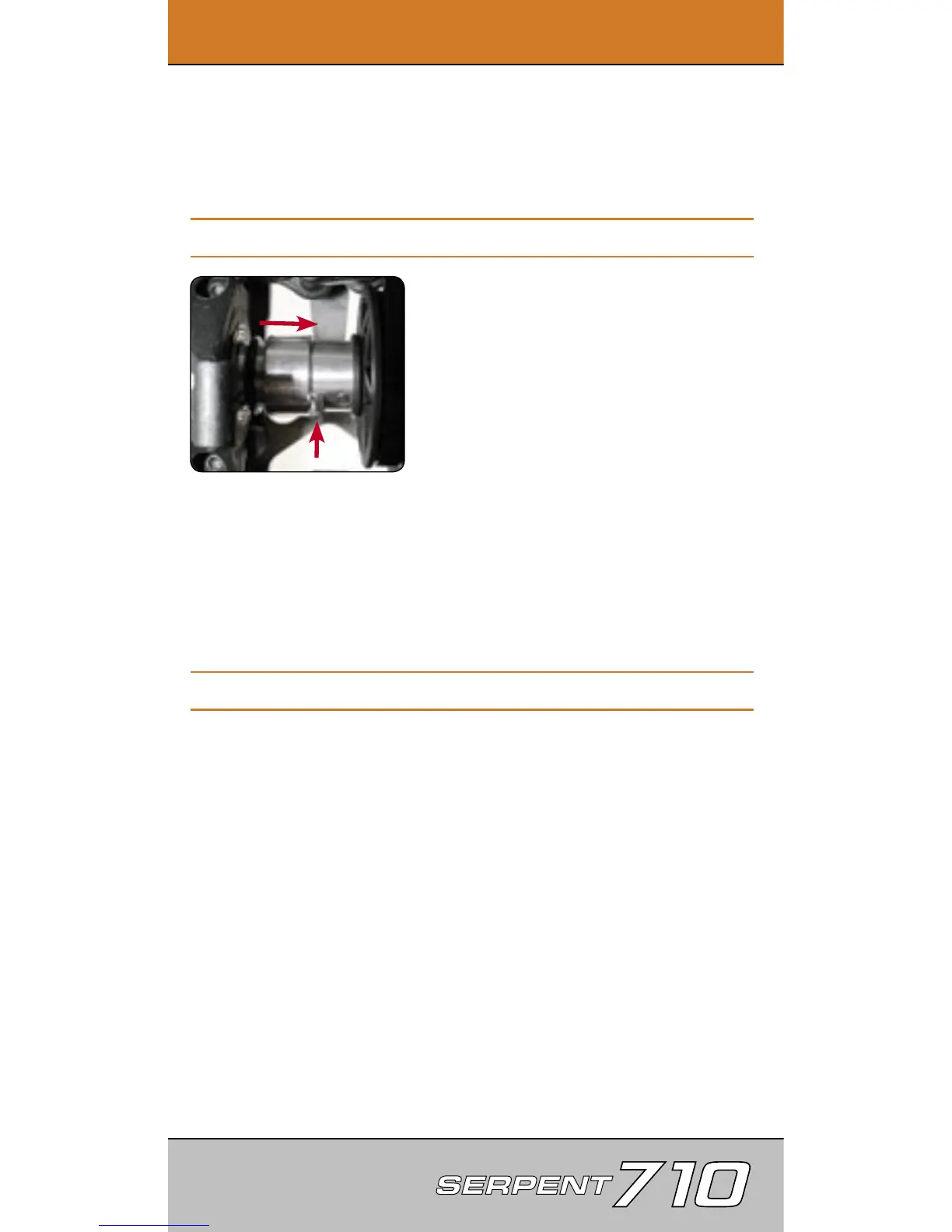
The 710 front one-way axle can be very
quickly converted into a solid front axle
by inserting two steel pins through the
front axle and both drive adapters. An alu.
bushing holds the pins in place.
The biggest advantage of the solid front
axle is that the car brakes using all four
wheels, allowing for much later braking
than with rear wheel brakes only (when
using a front one-way axle). This may
require you to adapt your driving style.
Using the solid front axle can be benecial in low-grip conditions and
especially wet or damp conditions. The drawbacks to using a front solid
axle are less off-power steering, and the car becomes more sensitive to
tire diameter differences. Overall, using the solid front axle makes the
car quite easy to drive.
The solid front axle is used mostly used with the adjustable rear
differential.
B14. FRONT BALL DIFFERENTIAL (Optional)
Differentials allow the wheels at opposite ends of the same axle to
rotate at different speeds. Why is this important? When a car turns in
a circle, the outer wheel has a larger diameter circle to follow than the
inner wheel, so it needs to rotate faster to keep up. If the differential is
too tight, the result is that the wheels “ght” each other for the proper
rotation speed; the result is a loss of traction. Generally, the more grip a
track has, the tighter the diff action should be.
For optimal performance, when building the ball differential, without the
diff friction collar applied the diff should be as free as possible, of course
with no (minimal) slippage on the balls. Use the diff friction collar to
adjust the amount of friction you want. Make sure the diff does not slip
under power; this causes power loss and excessive wear of the diff.
The front differential shares the same design as the rear differential,
and can be adjusted externally with a single screw. This enables very
quick changes to the steering characteristic and overall behavior of the
car.
Using the front differential combines some of the braking advantages of
the solid front axle while allowing inner-outer wheel speed difference.
The last adjustment depends on how much friction is applied on the diff


 To Next Page