5
A1.1 Setting front downstops
Front downstop setting = 0mm
Set the front downstops so that the
bottoms of the steering blocks are at 0mm
on the gauge. (Actual measurement =
0mm above level of elevating blocks, or
level with the bottom of the chassis).
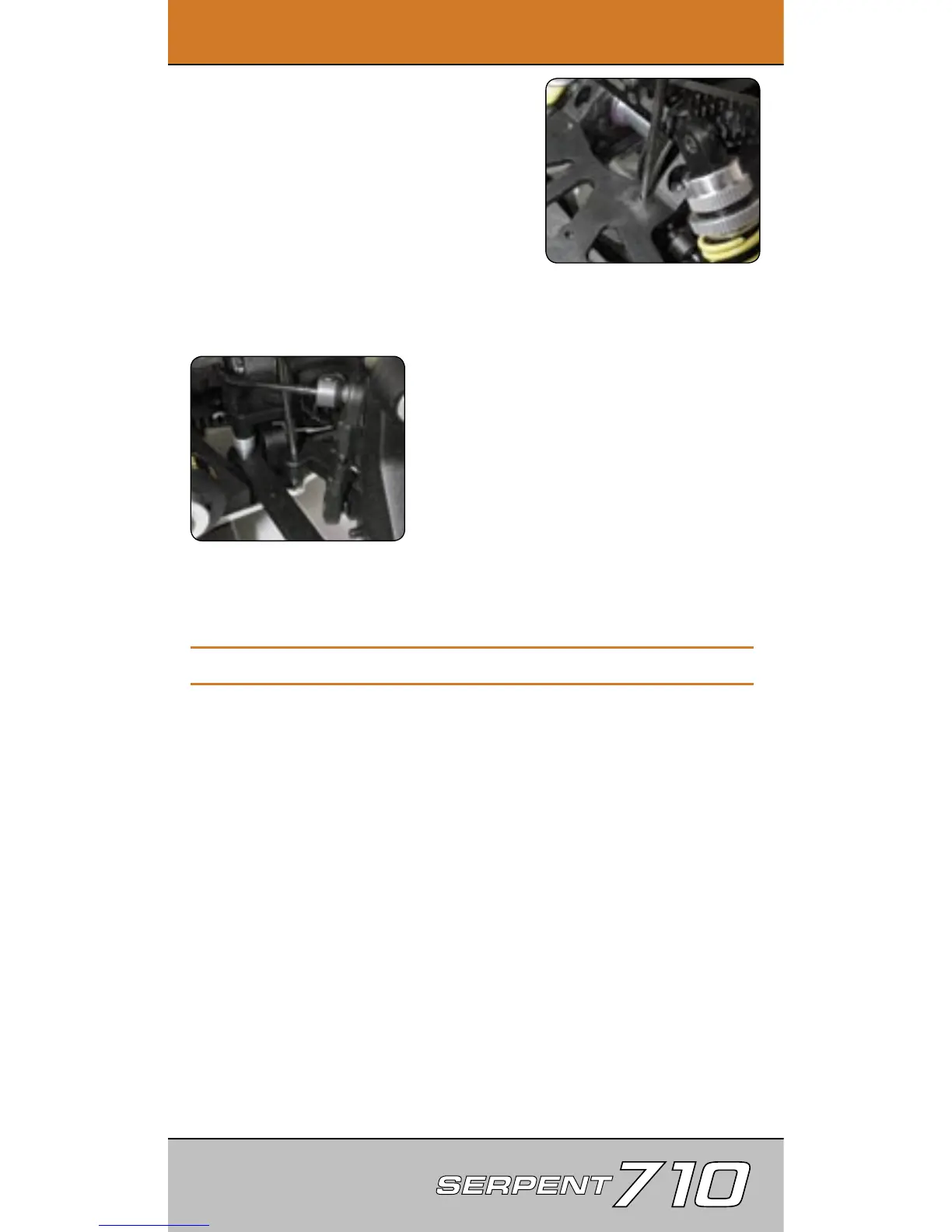
Adjust front downstops by turning the
front downstop setscrews in or out. Turn
the front setscrews IN to increase the front
downstop value. Turn the front setscrews OUT to decrease the front
downstop value. Make sure you adjust front downstops so they are
equal on both left and right sides.
A1.2 Setting rear downstops
Rear downstop setting = 7mm
Set the rear downstop screws so that the
bottoms of the rear uprights are at 7mm
on the gauge. (Actual measurement =
7mm above level of elevating blocks, or
above the bottom of the chassis).
Adjust rear downstops by turning the rear
downstop screws in or out. Turn the rear
setscrews IN to increase the rear downstop
value. Turn the rear setscrews OUT to decrease the rear downstop
value. Make sure you adjust rear downstops so they are equal on both
left and right sides.
A2. SHOCK ABSORBERS
Shocks, or shock absorbers, are a part of the suspension that allow the
wheels to keep as much contact with the running surface as possible.
The 710 features unique 4-step externally-adjustable racing shocks
that do not require you to change pistons or change shock oil to alter
the damping. Damping, mounting position, spring tension, and spring
preload are all characteristics that determine how the shock performs.
Initial steps
A Shocks: To adjust shock damping, remove the lower shock ball-joint
from the lower suspension arm. You do not need to disconnect the
shocks to adjust spring preload.
Set-up apparatus
None
Adjusting the shock absorbers
Pull out the piston rod and turn it slightly until it locks in the shock body.
Turning the piston rod fully CW aligns 2 piston holes (hardest setting);
turning the piston rod fully CCW aligns 5 piston holes (softest setting).
There are four positions (2-3-4-5 holes aligned), each of which can be
felt by a slight “click” when you turn the piston rod.


 To Next Page