27
into extra grip, the sum of the grip of both wheels is actually reduced.
This changes the balance of the car to the other axle.
Increasing the stiffness of an anti-roll bar on one particular axle
decreases the side traction of that axle and increases the side traction of
the other axle.
Keep in mind that the overall traction of a car cannot be changed, but
it can be balanced by distributing wheel loads. Anti-roll bars are a very
useful tool to change the balance of the car.
Chassis stiffness plays a very important role in the effectiveness of anti-
roll bars. A stiffer chassis makes the car more responsive to anti-roll
bar changes. For this reason, all Serpent cars use chassis side-plates to
bridge the car’s front section with the rear section.
Front Anti-Roll Bar
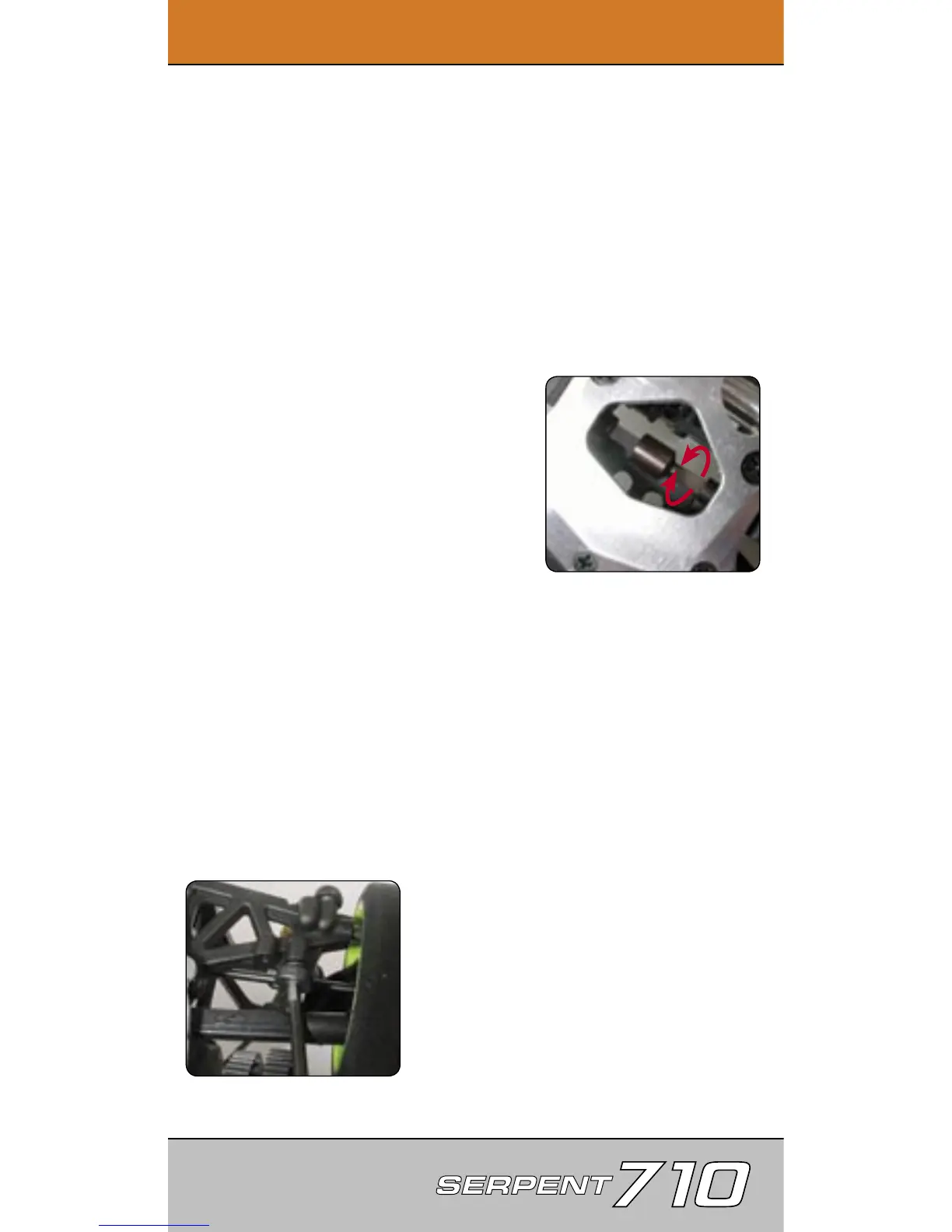
The front anti-roll bar affects mainly off-
power steering at corner entry. To make
the front anti-roll bar stiffer, rotate the
blades to a more vertical position. To make
the front anti-roll bar softer, rotate the
blades to a more horizontal position.
Stiffer front anti-roll bar (blade more
vertical):
• less chassis roll
• decreases front traction
• increases rear traction
• reduces off-power steering at corner entry (increases
understeer)
• quicker steering response
Softer front anti-roll bar (blade more horizontal):
• more chassis roll
• increases front traction
• decreases rear traction
• increases off-power steering (may cause oversteer)
Rear Anti-Roll Bar
The rear anti-roll bar affects mainly on-power steering and stability in
mid-corner and at corner exit.
The rear anti-roll bar is adjusted in two
ways. There are two positions on the lower
arms where the linkages connect; the
inside position is the softer setting, and the
outside point is the stiffer setting.
Rear anti-roll bar stiffness is also affected
by the position of the pivot ball on the anti-
roll bar itself. Placing the pivot ball towards
the end of the anti-roll bar gives a
softer setting.


 To Next Page