Need help?
Do you have a question about the Sharp UX-177 and is the answer not in the manual?
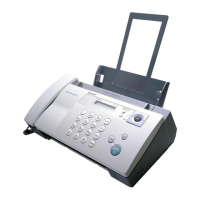
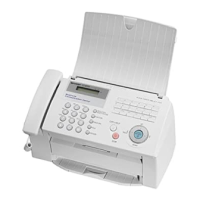
This document describes the SHARP UX-177H facsimile machine, a half-duplex, desktop transceiver designed for use with public switched telephone networks and compatible with ITU-T (CCITT) G3 mode.
The UX-177H operates as a facsimile machine, a copier, and a telephone. Its core functions are managed by a control PWB, which integrates a ROCKWELL 1-chip fax engine (SFE-LC), ROM, RAM, and a modem (R96DFXL-CID).
Transmission Operation: When a document is loaded, the document sensor activates, and the pulse motor feeds the document into the machine. Upon pressing the START key in off-hook mode, transmission begins. The CCD scans the document, converting the analog image signal into binary data via an AD converter. This data is then transferred to the RAM's image buffer, encoded, and stored in the transmit buffer. The modem converts this data from parallel to serial, modulates it, and sends it over the telephone line.
Receive Operation: Reception can be initiated manually by pressing the START key in off-hook mode or automatically upon detection of a CI signal by the LIU. The SFE-LC controls the modem to prepare for data reception. Once in phase C, the serial data from the modem is converted to parallel form by the modem interface of the SFE-LC and stored in the RAM's receive buffer. This data is then decoded, reproduced as a binary image, and transferred to the recording processor. The SFE-LC controls the motor rotation and strobe signal to print the image line by line using the thermal head.
Copy Operation: To make a copy, the COPY key is pressed when a document is on the document table and the telephone is on-hook. The document is fed to the scan line, and the image signal from the CCD is converted to binary data via the SFE-LC, similar to transmission. This data is then sent to the image buffer in RAM and subsequently transferred to the recording processor for line-by-line printing by the thermal head. The process repeats for multiple copies.
Modem: The R96DFXL modem supports synchronous 9600 bps, half-duplex operation, with error detection and DTMF reception. It features low power consumption and requires only a single 5V power supply. The modem is housed in a single VLSI device package. It can operate over public switched telephone networks (PSTN) through terminations provided by a data access arrangement (DAA). The modem supports G3 facsimile standards, including V.29, V.27 ter, and V.21 Channel 2, and meets the binary signaling requirements of T.30. It can operate at 9600, 7200, 4800, 2400, and 300 bps, and includes V.27 ter short train sequence option. The modem can also perform HDLC framing according to T.30 at 9600, 7200, 4800, and 2400 bps. It features a programmable DTMF receiver and three programmable tone detectors that operate concurrently with the V.21 channel 2 receiver. The voice mode allows the host computer to efficiently transmit and receive audio and fax modem tones. The modem is available in either a 100-pin plastic quad flat pack (PQFP) or a 64-pin quad in-line package (QUIP). General purpose input/output (GPIO) pins are available for host as-signment in both PQFP and QUIP. The modem's small size, single voltage supply, and low power consumption allow the design of compact system enclosures for use in both desktop and portable applications. MONOFAX is a registered trademark of Rockwell International.
General:
Resolution:
Input Document Size:
Paper Thickness & Weight:
Operation Panel:
Document Loading:
Troubleshooting:
Diagnostic Items:
Disassembly and Assembly Procedures:
Scan Optical System Adjustment:
 General
| Brand | Sharp |
|---|---|
| Model | UX-177 |
| Category | Fax Machine |
| Language | English |


 To Next Page