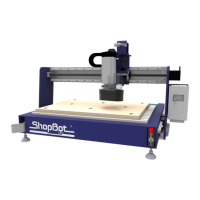
This document serves as a Quick-Start Guide for ShopBot PRSalpha and PRSstandard tools, including PRS and Buddy models, providing essential information for setting up, operating, and maintaining these CNC machines. The guide is designed to help new users get started quickly, with references to more detailed information available in the ShopBot User's Guide and other online resources.
Function Description
The ShopBot PRS (Production Router System) and Buddy tools are computer numerically controlled (CNC) machines designed for precision cutting, carving, and machining of various materials. These tools utilize a router or spindle to perform operations based on digital design files. The core function involves translating a digital design into physical movements of the cutting tool across X, Y, and Z axes, allowing for the creation of complex shapes and designs.
The system comprises several key components:
- Frame and Table: Provides the structural support and the work surface for materials. The PRS models feature a spoil board, while Buddy tools have a table.
- Gantry: The movable bridge that spans the width of the table, carrying the YZ Car.
- YZ Car: Mounts the spindle/router and moves along the gantry (Y-axis) and vertically (Z-axis).
- Spindle/Router: The cutting tool that rotates at high RPMs to remove material. Spindles are typically more robust and suitable for continuous use, while routers are often used for lighter-duty applications.
- E-Chain: Manages and protects the cables and hoses that move with the gantry and YZ Car.
- Dust Hose: Connects to a dust collection system to remove sawdust and debris generated during cutting, maintaining a cleaner work environment and improving cut quality.
- VFD (Variable Frequency Drive): Controls the speed (RPM) of the spindle.
- Control Box: Houses the electronics that drive the machine's motors and communicate with the computer.
The ShopBot control software is central to the machine's operation, allowing users to load part files, set up cutting parameters, and control the machine's movements. It operates in two modes: "Easy mode" for basic setup and cutting, and "Full mode" for access to all advanced functions and settings. The software facilitates axis orientation, testing of individual axes, and spindle/router control.
Usage Features
The guide outlines a systematic process for using the ShopBot tools, starting with software installation and machine setup, and progressing to running part files and basic maintenance.
Software Setup and Orientation:
- Software Installation: Users install ShopBot control software and VCarve Pro (a design application) from a USB drive. It's crucial not to connect the ShopBot to the computer before software installation. Administrative permissions are recommended for optimal performance, and for international users, the computer's language setting must be "United States (English)."
- Connection to Computer: The ShopBot control box connects to the computer via a USB cable, and the RPM controller (from the VFD) connects via another USB port.
- Settings File Load: After installation, users load a default settings file specific to their ShopBot model (PRSalpha, PRSstandard, or Desktop) and table size. Custom settings can be saved for specialized tools.
- Axis Orientation: Understanding the X, Y, and Z axis orientation is critical for job setup in CAD/CAM software. The bottom left corner of the work area is typically defined as the XY home location (0,0).
- Keypad Control: The ShopBot KeyPad allows manual movement of each axis (X, Y, Z, A, B) for precise positioning and testing.
- Spindle/Router Test: Users learn to engage the safety lockout (for spindles) and turn on the spindle/router through the control software or a physical start button (for PRSalpha models).
Running a Part File:
- Zeroing the Z Axis: This is a critical step performed each time the machine is turned on or a bit is changed. It calibrates the Z-axis to either the top of the material or the table surface, depending on the project's requirements (e.g., precise cut depth for inlays vs. through-cutting). The process involves placing a grounding clip on the bit, positioning a Z-zero plate, and running a C2 command.
- Zeroing the XY Axes: The X and Y axes are zeroed using a proximity switch homing process (C3 command) for accurate and repeatable start points. Temporary zero locations can also be set manually.
- Changing Bits: Detailed instructions are provided for safely changing bits, emphasizing cleanliness of the collet and nut, proper seating of the collet, and secure tightening of the nut with wrenches. Different procedures are noted for spindles and routers.
- RPM Control Setup: For spindle-equipped tools, users connect the RPM controller USB and configure RPM settings within the ShopBot software, including Hertz settings and VFD model.
- Holding Down Material: Various methods for securing material are discussed to prevent parts from shifting or being thrown during cutting, which can cause injury or damage. These include screws (with careful toolpath planning), T-track tables and clamps (requiring vertical clearance consideration), press-fit jigs, and adhesives like double-sided tape or spray adhesive (with precautions to protect the table).
- Holding Parts Within Material (Tabs and Onion Skin): To prevent small parts from moving once cut free, users can create "tabs" (small bridges of material) or use an "onion skin" technique (leaving a very thin layer of material at the bottom of a profile cut).
- Warming Up Spindle: For spindle-equipped machines, a warm-up routine (C5 command) is recommended after extended idle periods to maximize bearing life.
- Previewing with Offset: Users can perform "test runs" without cutting material by using a 2D or 3D offset. A 2D offset runs the file at normal depth in a different XY location, while a 3D offset (air cutting) runs the file above the material to check movements.
- Running the Cut: Once the test run is satisfactory, the part file is loaded, and the cut is initiated through the software, with specific steps for PRSalpha (pressing a start button on a pendant) and PRSstandard models.
- Pausing or Stopping the Cut: The machine can be stopped in two ways: a "soft stop" (hitting the space bar) which decelerates the tool, lifts the Z-axis, and retains zero locations, or an "emergency stop" (red button/switch) which immediately cuts power to all systems, requiring re-zeroing of all axes.
Maintenance Features
The guide emphasizes daily maintenance checks to ensure optimal performance and longevity of the ShopBot machine:
- Spindle Warm-up: For spindles, running the C5 warm-up routine daily.
- Collet, Nut, and Bits Inspection: Cleaning the collet, nut, and bits, checking for wear or damage, and replacing dull or damaged bits. A brass brush, compressed air, and appropriate solvent are recommended for cleaning.
- Wiring and Hoses Inspection: Visually inspecting all wiring and hoses for cuts, scrapes, or pinch points. Damaged motor cables require immediate attention from tech support.
- Cleanliness: Ensuring the machine and surrounding area are clean and free of obstructions on the rails and gear rack.
- Mechanical Looseness Check: Turning on the power and manually pushing/pulling the machine near each motor to check for locked axes and absence of mechanical looseness. Any looseness should be addressed with tech support.
For more detailed and long-term maintenance instructions, users are directed to the ShopBot Docs webpage.

 Need help?
 General

 To Next Page