Shure Incorporated
29/55
•
•
•
•
•
•
•
•
•
•
1.
2.
3.
Microphone Configuration
Control Software Overview
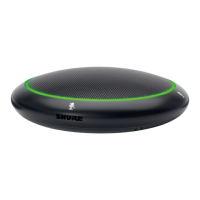
The boundary microphone user interface provides flexible, in-depth control of the microphone to deliver exceptional results for
nearly any room. The following control options are quickly accessible through a web browser on a desktop or mobile device:
Channel levels, monitoring, and mute status
Polar pattern selection
Pickup area aiming
Security and network settings
Automix settings
Light settings
External control switch configuration
Microphone Configuration
The microphone features multiple configurations to adapt to any meeting space, based on these variables:
Table size and shape
Number of meeting participants
Participant seating arrangement
Selecting Pickup Patterns
Select Configuration > Coverage
Select a channel to reveal the Channel Properties
Use the Polar Pattern pull-down menu to make a selection
Pickup Pattern Directional Characteristic Use When
Omnidirection
al
Picks up sound with equal sensitivity from
all directions
Participants are likely to move around, or when additional
sound sources are located away from the microphone.
The omnidirectional pattern performs best in a quiet, con-
trolled environment. Note: Omnidirectional channels are
not sent to the automix channel.
Toroid
Picks up sound from the edges of the mi-
crophone, while rejecting sounds from di-
rectly above it.
Rooms have a higher level of ambient noise, or when
noise from above is a concern (a video projector, for ex-
ample).
Bi-directional
Captures sound on two opposite sides of
the microphone in a figure-8 pattern
Two talkers are facing each other, sitting on opposite
sides of a table. The bi-directional pattern provides better
off-axis rejection than the two talkers setting, but does not
allow independent gain adjustment for each talker.


 To Next Page