Chapter 3 Operating Instructions
Ranger E/D
14 SICK IVP • Industrial Sensors • www.sickivp.com • All rights reserved 8011731
Overview
To get calibrated measurements – for example coordinates and heights in millimeters –
you must yourself perform the transformation from sensor coordinates (row, column,
profile id) to world coordinates (x,y,z). This transformation depends on a number of factors,
for example the distance between the Ranger and the object, the angle between the
Ranger and the laser, and properties of the lens.
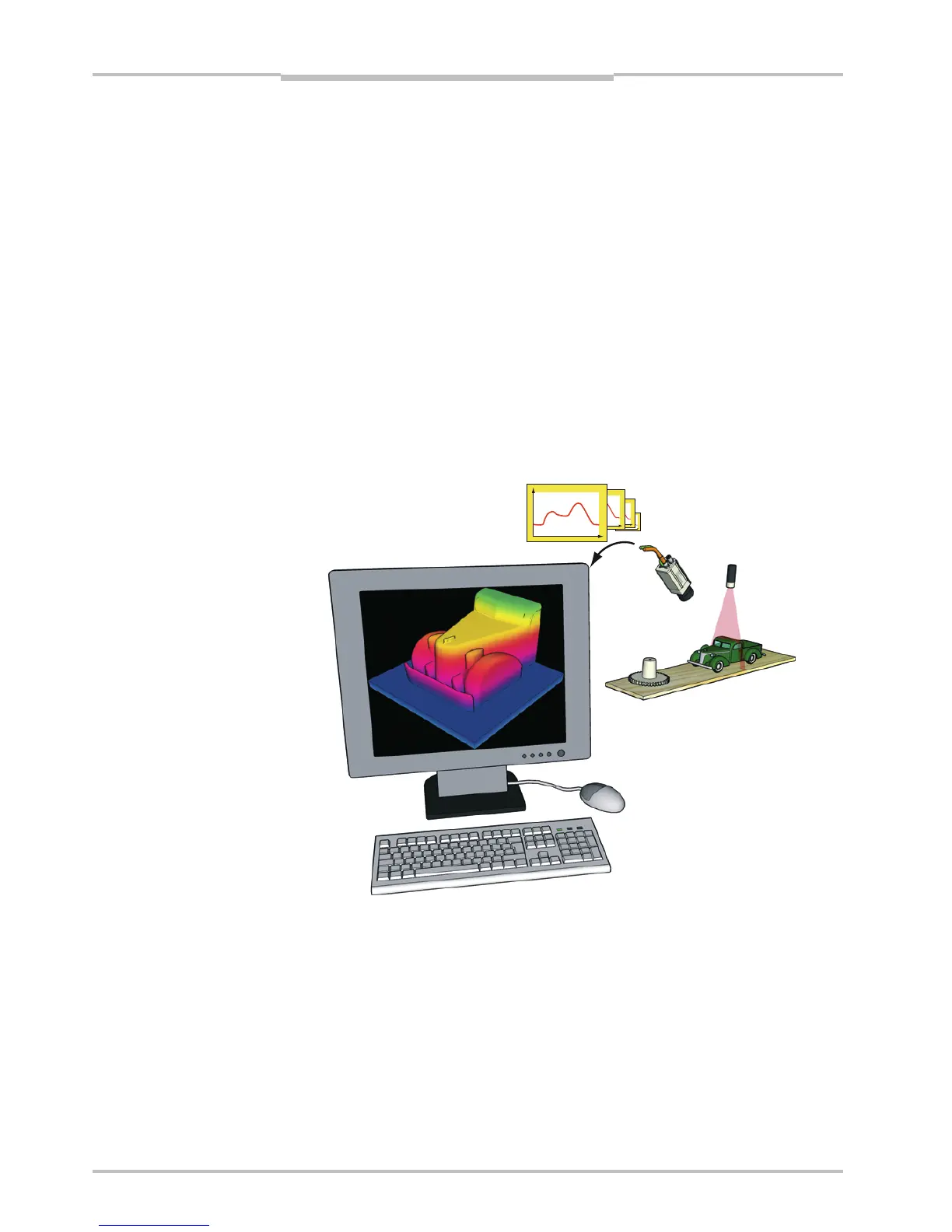
In the machine vision system, the Ranger acts as a data streamer. It is connected to a PC
through either a CameraLink connection (Ranger C) or a Gigabit Ethernet network
(Ranger D & E). The Ranger sends the profiles to the computer, and the computer runs a
custom application that retrieves the profiles and processes the measurement data in
them. This application can for example analyze the data to find defects in the objects and
control a lever that pushes faulty objects to the side.
Before the Ranger can be used in a machine vision system, the following needs to be
done:
Find the right way to mount the Ranger and illuminations.
Configure the Ranger to make the proper measurements.
Write the application that retrieves and processes the profiles sent from the Ranger.
The application is developed in for example Microsoft Visual Studio, using the APIs that
are installed with the Ranger development software.
Figure 3.2 – Profiles are sent from the Ranger to a PC, where they are analyzed by a
custom application.
3.2 Mounting the Ranger
Selecting the right way of illuminating the objects to measure, and finding the right way in
which to mount the Ranger and lightings are usually critical factors for building a vision
system that is efficient and robust.
The Ranger must be able to capture images with good quality of the objects in order to
make proper measurements. Good quality in vision applications usually means that there
is a high contrast between the features that are interesting and those who are not, and
that the exposure of the images does not vary too much over time.


 To Next Page