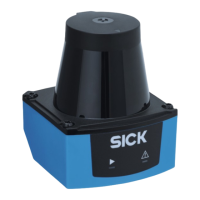
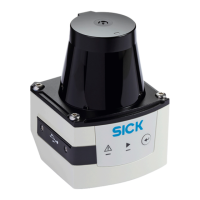
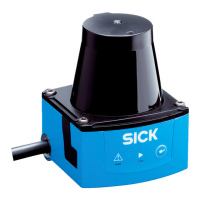
The TiM3xx is a 2D LiDAR sensor designed for non-contact optical measurement of contours and dimensions. It operates by scanning its surroundings with laser beams in a circular pattern, measuring distances and directions to objects in two-dimensional polar coordinates relative to its measurement origin. The device utilizes SICK's proprietary HDDM/HDDM+ (High Definition Distance Measurement) technology, which involves emitting pulsed laser beams and calculating the distance to an object based on the elapsed time between emission and reception of the reflected light. Direction measurement is achieved through a rotating mirror that deflects the laser beams, with measurements triggered by an encoder at regular angle increments. The device averages multiple pulses to determine individual measured values, with a measuring point representing the average of several combined measurements.
Function Description:
The primary function of the TiM3xx is field monitoring of user-defined areas, signaling field breaches via digital outputs. It is suitable for applications requiring precise non-contact optical measurement, such as stationary field protection, area monitoring, access control, and mobile applications like navigation and anti-collision for mobile platforms. The device can be configured with various field sets, which can be dynamically switched via static control inputs to adjust field size based on application requirements, such as vehicle speed.
Important Technical Specifications:
The TiM3xx series offers different variants (TiM31x, TiM32x, TiM35x, TiM36x) with varying performance characteristics:
- Measurement Principle: HDDM (lower statistical error) or HDDM+ (improved behavior for edge hits).
- Application: Indoor or Outdoor.
- Light Source: Infrared (wavelength 850 nm, max. pulse power 880 mW, pulse width up to 5 ns).
- TiM31x/TiM32x: Pulse rate 550 kHz.
- TiM35x/TiM36x: Pulse rate 500 kHz or 1,500 kHz.
- Laser Class: 1 (IEC 60825-1:2014, EN 60825-1:2014), complying with 21 CFR 1040.10 and 1040.11.
- Aperture Angle: 270°.
- Scanning Frequency: 15 Hz.
- Angular Resolution: 1° (TiM31x/TiM32x) or 0.33° (TiM35x/TiM36x).
- Working Range:
- TiM31x/TiM32x: 0.05 m ... 4 m.
- TiM35x/TiM36x: 0.05 m ... 10 m.
- Scanning Range with 10% Remission:
- TiM31x/TiM32x: Typically 2 m.
- TiM35x/TiM36x: Typically 8 m.
- Response Time:
- TiM31x/TiM32x: Typ. 1 scan; 67 ms.
- TiM35x/TiM36x: Max. 2 scans; 134 ms.
- Detectable Object Shape: Almost any.
- Measurement Errors:
- TiM31x/TiM32x: Statistical (1 σ): < 30 mm, Systematic: ± 10 mm, Temperature drift: 0.5 mm/K.
- TiM35x/TiM36x: Statistical (1 σ): < 20 mm, Systematic: ± 10 mm, Temperature drift: 0.5 mm/K.
- Integrated Application: Field evaluation (with flexible fields for TiM35x/TiM36x).
- Number of Field Sets:
- TiM31x/TiM32x: 16 triple fields (48 fields), 1 triple (3 fields) can be configured directly at the scanner.
- TiM35x/TiM36x: 16 triple fields, 1 triple (3 fields) can be configured directly at the scanner, contour as reference.
- Simultaneous Evaluation Cases: 1 (3 fields) for TiM31x/TiM32x; 2 (2 fields for detection and 1 field for contour as reference) for TiM35x/TiM36x.
- Interfaces:
- Ethernet: TCP/IP (TiM35x/TiM36x only).
- USB: Micro-USB (AUX, configuration).
- Digital Inputs: 4 (PNP, NPN; common reference potential 9 ... 28 V, opto-decoupled, debounce time approx. 10 ms).
- Digital Outputs: 4 (PNP, opto-decoupled, short-circuit protected, temperature protected).
- Delay Time: 67 ms ... 30,000 ms (configurable).
- Holding Time: 67 ms ... 600,052 ms (configurable).
- Optical Indicators: 2 LEDs (on, output state).
- Electrical Connection: Various cable types depending on the model (open end, D-Sub-HD, M12).
- Supply Voltage: 9 V DC ... 28 V DC.
- Power Consumption: Typ. 4 W (16 W with 4 max. loaded digital outputs).
- Housing Color: Light blue (RAL 5012) or Gray (RAL 7032).
- Enclosure Rating: IP65 (IEC 60529:1999+AMD1:1999+AMD2:2013).
- Protection Class: III (IEC 61140:2016-1).
- Housing: Lower part: aluminum die cast, Optics cover: Polycarbonate with scratch-resistant coating.
- Weight: 150 g (without connecting cables) or 250 g (without connecting cables) or 150 g (with connecting cables) or 250 g (with connecting cables).
- Dimensions (L x W x H): 60 mm x 60 mm x 79 mm or 60 mm x 60 mm x 86 mm.
- Ambient Temperature:
- Operation: -10 °C ... +50 °C.
- Storage: -30 °C ... +75 °C.
- Commissioning/switching on: -10 °C ... +50 °C.
- Operation: -25 °C ... +50 °C.
- Storage: -40 °C ... +75 °C.
- Ambient Humidity: Operation: ≤ 80%, non-condensing.
- Altitude: < 5,000 m above sea level.
- Ambient Light Immunity: 80,000 lx.
- Ambient Conditions: Contamination level 3 outside the housing (EN 61010-1:2011-07).
- Damp Heat: +25 °C, +55 °C, 95% r.h., 6 cycles.
- Temperature Change: -10 °C ... +50 °C, 10 cycles or -25 °C ... +50 °C, 10 cycles.
Usage Features:
- Configuration: The device is configured using SOPAS ET software, which allows for field evaluation, parameterization, and diagnostics. A USB interface is available for configuration with a PC.
- Field Evaluation: The device supports teach-in for field set selection, monitoring of field evaluation, and parameter adjustment for evaluation cases and fields. Field sets can be defined with different shapes (segmented, free field, rectangle) and can be dynamically switched.
- Filters: Digital filters (particle, median, average) are available for pre-processing and optimizing measured distance values, adapting the device to specific application requirements. These filters can be combined, with processing occurring sequentially.
- Mobile Applications: For mobile applications, the switching field length and width must be calculated to prevent collisions, considering stopping distance, vehicle control response time, and LiDAR sensor response time. A general safety supplement of 100 mm is recommended for both length and width. The recommended mounting height for mobile applications is at least 150 mm.
- Mutual Interference: The device is designed to minimize mutual interference with other optical sensors or IR light sources. For optimal accuracy, devices should be arranged to avoid laser beam reception by another device, with recommended angles ≥ 6° and distances ≥ 200 mm between devices.
- Electrical Installation: Requires adherence to wiring instructions, proper grounding to prevent equipotential bonding currents, and connection to a voltage supply as specified. Electro-optical signal isolators or insulated mounting can be used to prevent ground loops in complex systems.
Maintenance Features:
- Maintenance Plan: Regular maintenance tasks include checking the device and connecting cables for damage, cleaning the housing and optics cover, checking screw connections and plug connectors, and inspecting mounting accessories and vibration dampers.
- Cleaning: The optics hood should be cleaned at regular intervals using a lint-free lens cloth and plastic cleaning agent. Coarse dirt should be rinsed off with water. Sharp objects should not be used for cleaning.
- Troubleshooting: The device stores error information in its internal error memory. SOPAS ET software can generate a diagnostics report for error detection.
- Repairs: Repairs must only be performed by qualified and authorized personnel from SICK AG. Unauthorized modifications or repairs will invalidate warranty claims.
- Disposal: The device must be disposed of in an environmentally friendly manner in accordance with country-specific waste disposal regulations.
- Storage: Store the device in its original packaging in a dry, dust-protected area, away from direct sunlight and aggressive substances. For storage periods longer than 3 months, regular checks of components and packaging are recommended.

 Need help?
 General


 To Next Page