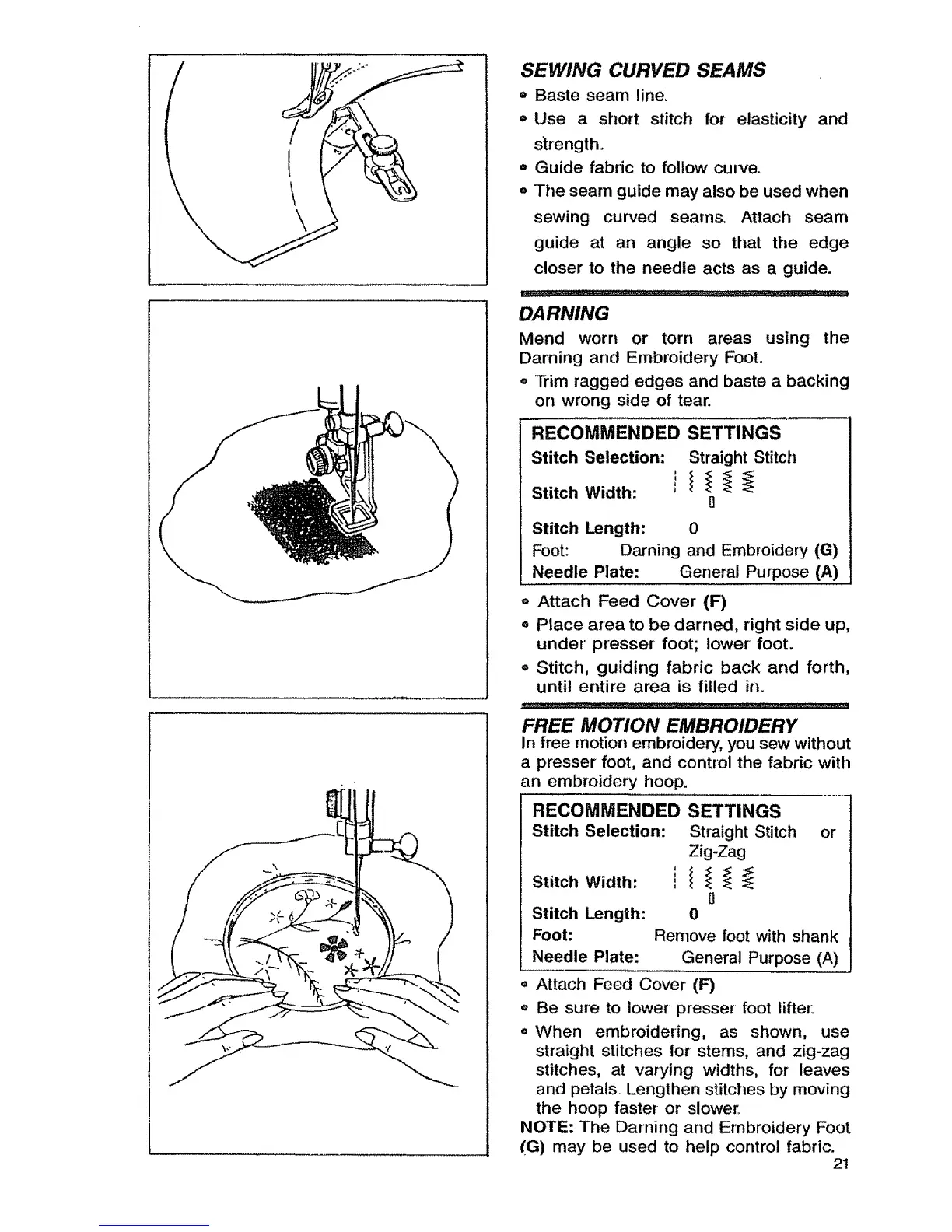
SEWING CURVED SEAMS
o Baste seam line.
o Use a short stitch for elasticity and
strength.
o Guide fabric to follow curve.
o The seam guide may also be used when
sewing curved seams° Attach seam
guide at an angle so that the edge
closer to the needle acts as a guide.
DARNING
Mend worn or torn areas using the
Darning and Embroidery Foot°
,, Trim ragged edges and baste a backing
on wrong side of tear.
RECOMMENDED SETTINGS
Stitch Selection: Straight Stitch
Stitch Width: _ O
Stitch Length: 0
Foot: Darning and Embroidery (G)
Needle Plate: General Purpose (A)
,, Attach Feed Cover (F)
o Place area to be darned, right side up,
under presser foot; lower fool
= Stitch, guiding fabric back and forth,
until entire area is filled ino
FREE MOTION EMBROIDERY
In free motion embroidery, you sew without
a presser foot, and control the fabric with
an embroidery hoop.
RECOMMENDED SETTINGS
Stitch Selection: Straight Stitch or
Zig-Zag
Stitch Width: i 1 _ _
D
Stitch Length: 0
Foot: Remove foot with shank
Needle Plate: General Purpose (A)
,, Attach Feed Cover (F)
,_ Be sure to lower presser' foot lifter:
o When embroidering, as shown, use
straight stitches for stems, and zig-zag
stitches, at varying widths, for leaves
and petals.. Lengthen stitches by moving
the hoop faster or slower:
NOTE: The Darning and Embroidery Foot
IG) may be used to help control fabric.
21



 To Next Page