QoS (Quality of Service)
Advanced Mode
Quality of Service refers to a resource reservation control mechanism, which guarantees
a certain quality to different services on the network. Quality of service guarantees are
important if the network capacity is insucient, especially for real-time streaming multimedia
applications. Quality can be dened as, for instance, a maintained level of bit rate, low latency,
no packet dropping, etc.
The following are the main benets of a QoS-aware network:
■
The ability to prioritize trac and guarantee a certain level of performance to the data ow.
■
The ability to control the amount of bandwidth each application may use, and thus provide
higher reliability and stability on the network.
Requirements for QoS
To utilize QoS in a network environment, the following requirements must be met:
■
All network switches and routers in the network must include support for QoS.
■
The network video devices used in the network must be QoS-enabled.
QoS models
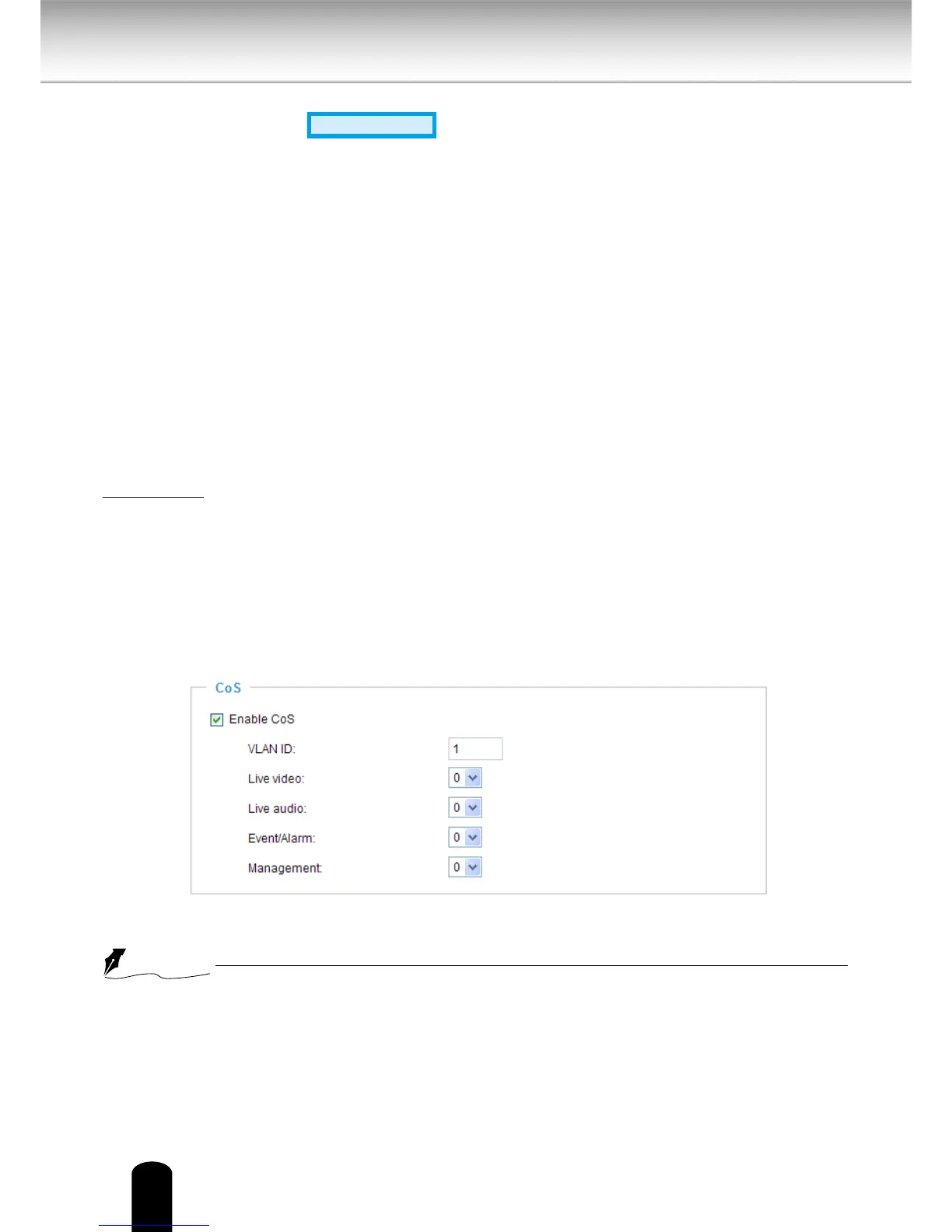
CoS (the VLAN 802.1p model)
IEEE802.1p denes a QoS model at OSI Layer 2 (Data Link Layer), which is called CoS, Class of
Service. It adds a 3-bit value to the VLAN MAC header, which indicates prioritization from 0~7
(Eight dierent classes of service are available). The priority is set up on the network switches,
which then use dierent queuing disciplines to forward the packets.
Below is the setting column for CoS. Enter the VLAN ID of your switch (0~4095) and choose the
priority for each application (0~7).
If you assign Video the highest level, the switch will handle video packets rst.
●
The VLAN Switch (802.1p) is required. The web browsing may fail if the CoS setting is
incorrect.
●
Class of Service technologies do not guarantee a level of service in terms of bandwidth and
delivery time; they oer a "best-eort." Users can think of CoS as "coarsely-grained" trac
control and QoS as "nely-grained" trac control.
●
Though CoS is simple to manage, it lacks scalability and does not offer end-to-end
guarantees since it is based on L2 protocol.



 To Next Page