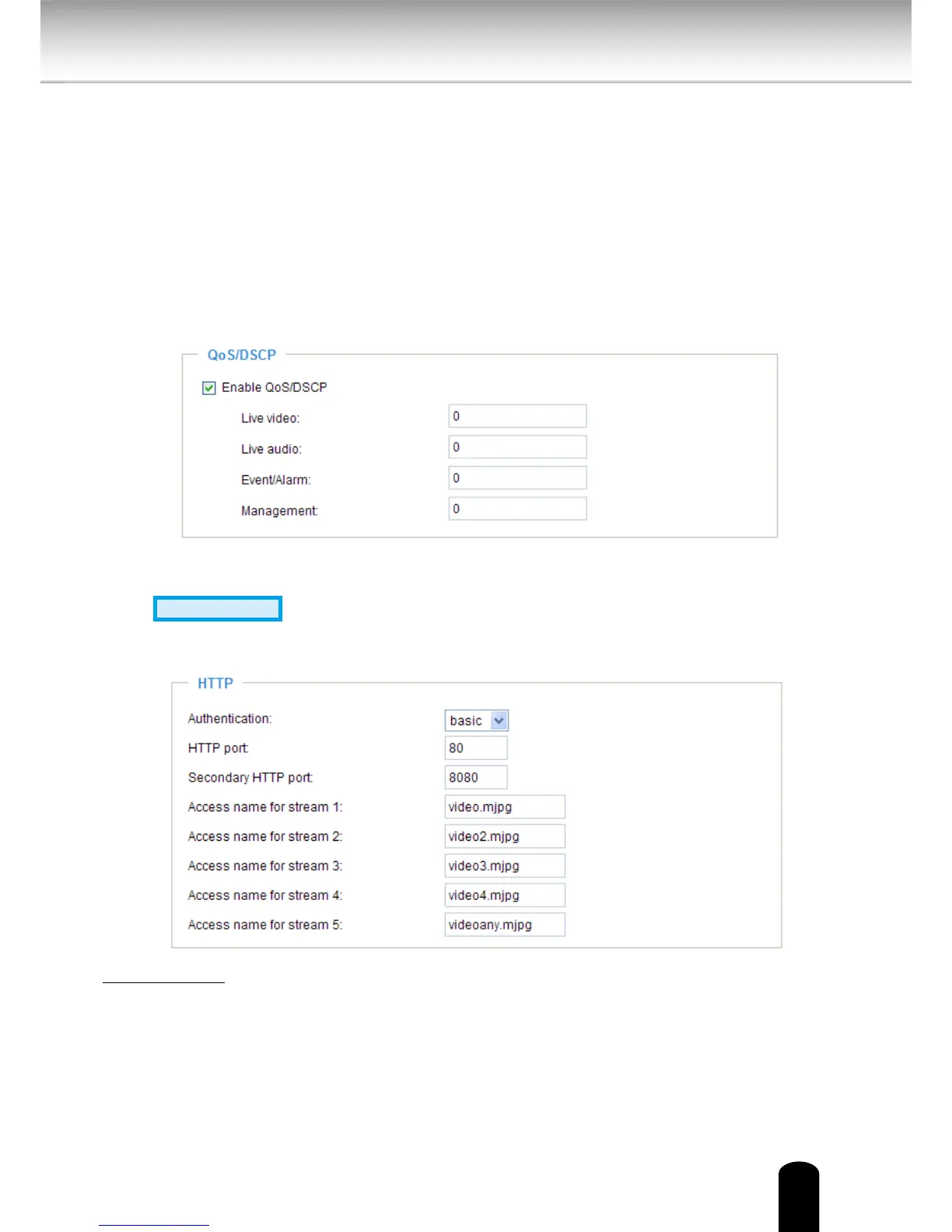
QoS/DSCP (the DiServ model)
DSCP-ECN denes QoS at Layer 3 (Network Layer). The Dierentiated Services (DiServ) model
is based on packet marking and router queuing disciplines. The marking is done by adding
a field to the IP header, called the DSCP (Differentiated Services Codepoint). This is a 6-bit
eld that provides 64 dierent class IDs. It gives an indication of how a given packet is to be
forwarded, known as the Per Hop Behavior (PHB). The PHB describes a particular service level in
terms of bandwidth, queueing theory, and dropping (discarding the packet) decisions. Routers
at each network node classify packets according to their DSCP value and give them a particular
forwarding treatment; for example, how much bandwidth to reserve for it.
Below are the setting options of DSCP (DiffServ Codepoint). Specify the DSCP value for each
application (0~63).
HTTP
Advanced Mode
To utilize HTTP authentication, make sure that your have set a password for the Network
Camera rst; please refer to Security on page 38 for details.
Authentication: Depending on your network security requirements, the Network Camera
provides two types of security settings for an HTTP transaction: basic and digest.
If basic authentication is selected, the password is sent in plain text format and there can
be potential risks of being intercepted. If digest authentication is selected, user credentials
are encrypted using MD5 algorithm and thus provide better protection against unauthorized
accesses.


 To Next Page