Need help?
Do you have a question about the Snom 370 and is the answer not in the manual?
Legal statement regarding reproduction and use of the publication.
SNOM TECHNOLOGY AG's disclaimer of warranties for the material.
Statement of compliance with European R&TTE directive.
Essential safety precautions to reduce risks during phone use.
Guidance on proper disposal of electronic products according to regulations.
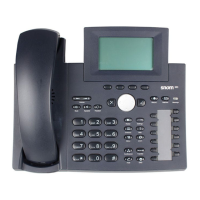
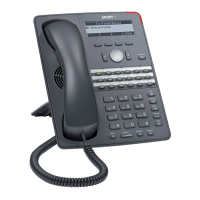
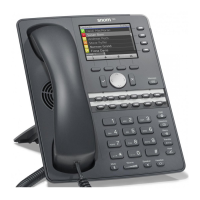
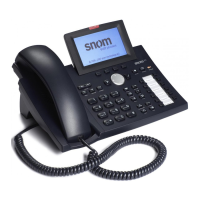
Identifies the main physical parts of the snom VoIP phone models.
Details the display features, tiltability, backlight, type, and character capacity.
Explains the grouping of keypad keys and LEDs into functional units.
Describes the on-phone interface for call and basic settings.
Explains the web-based interface for remote operation and advanced settings.
Differentiates between user and administrator modes and default password.
Lists available documentation for snom phones.
Step-by-step guide for installing the snom phone.
Covers hardware self-test, TFTP, automatic, manual initialization, DHCP.
Process of registering the phone's extension (SIP identity) with the PBX.
Describes the default and customizable idle screen appearance.
Configuration of idle screen appearance using XML files on snom 360/370.
Covers general configuration settings like language, time, and keyboard lock.
Tasks related to display settings like contrast and backlight.
Tasks related to audio settings like volume and headset use.
Managing multiple extensions (SIP identities) on the phone.
Configuring functionalities for the free function keys (Px).
Changing the administrator password for secure access.
Switching between Administrator and User modes with different access rights.
Information on updating the phone's software (firmware) via manual or auto methods.
Instructions for rebooting the phone to apply configuration changes.
Resetting the phone's configuration to factory default values.
Managing outgoing calls and selecting the active extension.
Supported formats and methods for making calls on the phone.
Enabling and using call completion when parties are busy or not answering.
Denying individual incoming calls or automatically rejecting them.
Activating and deactivating the Do Not Disturb feature.
Configuring call forwarding for Always, Busy, and Timeout scenarios.
Managing active calls and switching audio modes.
Placing active calls on hold and resuming them.
Performing blind and attended call transfers.
Establishing and disconnecting three-party conference calls.
Turning call recording on and off for active calls.
Logging off and on user accounts for shared phone use.
Accessing and managing the phone's built-in directory.
Accessing lists of missed, received, and dialed calls.
Using the phone to access web services via HTTP/HTTPS.
Publishing and checking presence states for contacts.
Accessing voice messages and configuring acoustic indications.
Monitoring call states of other extensions and picking up calls.
Overview of functions mapped to context-sensitive keys.
Table mapping key events to their descriptions and pages.
Details on available accessories like Expansion Modules and Headsets.
Power consumption details for power adapter and PoE.
Compliance statement regarding FCC radio frequency regulations.
 General
| Audio | Wideband audio |
|---|---|
| Lines | 12 lines |
| Ethernet Ports | 2 x 10/100 Mbps Ethernet |
| Power over Ethernet | Yes |
| Codecs | G.711, G.722, G.726 |
| Expansion Module Support | Yes, up to 3 Snom expansion modules |
| Security | TLS, SRTP |
| Protocols | SIP |
| Speakerphone | Full-duplex |
| Headset Port | Yes, RJ-9 |
| Power | PoE or external power supply (5V DC) |
| Dimensions | 220 x 200 x 70 mm |
| Connectors | Ethernet, Headset, Expansion module |
| Supported Languages | Multiple languages supported |
| Features | Call transfer, call forwarding, conferencing |
| Memory | Flash memory, RAM |

 To Next Page