Need help?
Do you have a question about the Snom D385 and is the answer not in the manual?
Legal information and disclaimers regarding the product and software.
General safety guidelines for using the phone and avoiding hazards.
Information on safety extra-low voltage compliance for connections.
Details on compliance with essential health, safety, and environmental directives.
Lists technical details like safety standards, Ethernet, power, and connectors.
Guidelines for disposing of the device according to European directives.
Instructions on how to clean the phone to avoid damage.
Lists the items included in the phone package.
Instructions on how to attach and remove the phone's footstand.
Guide on how to adjust the phone's display angle for optimal viewing.
Steps for connecting the phone to power and network cables.
Instructions for connecting wired and wireless headsets to the phone.
Process for initializing and registering the phone for network use.
Requirements needed before initializing and registering the phone.
Step-by-step guide for the phone's initial setup and registration.
Steps to take if phone initialization and registration are unsuccessful.
How to set or correct the phone's date and time settings.
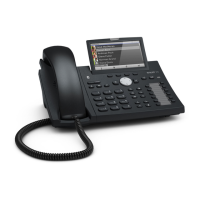
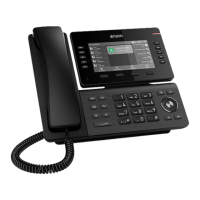
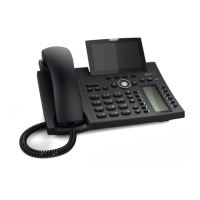
Overview of the phone's main components and factory settings.
Explains the meaning of different LED lights on the phone.
Description of the physical buttons on the phone and their functions.
Details on context-sensitive, navigation, and preprogrammed function keys.
Explains information shown on the display when the phone is idle.
Explains information shown on the display when the phone is active.
Describes the second screen for programmable function key labels.
Accessing and adjusting settings directly on the phone.
Overview of settings available in administrator mode via phone/web.
Overview of settings available in user mode via phone/web.
Adjusting backlight, contrast, and font size for phone and expansion modules.
Steps to adjust the brightness of the phone's primary and secondary displays.
How to adjust the contrast for the phone's secondary display.
Customizing font size and text alignment for function key labels.
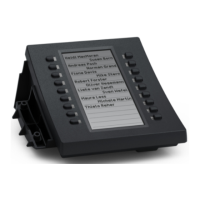
Configuring display settings for connected expansion modules.
Setting administrator and HTTP passwords for phone security.
Steps to access and open the phone's web interface.
Explanation of the web interface navigation and saving changes.
Differences and switching between user and administrator modes.
How to switch the phone to administrator mode from user mode.
How user mode affects web interface accessibility.
Information about the phone's built-in directory capacity and management.
Details on VIP and Deny List contact types and their behavior.
Step-by-step guide for manually adding and editing contacts on the phone.
Adding and editing contacts using the phone's web interface.
Making calls directly from the phone's directory.
Configuring and using LDAP for external directory searches.
Setting up and using external contact lists via URI.
Instructions on how to initiate calls using various methods.
Various ways to dial numbers, including auto dial and redial.
Setting up and using speed dial numbers for quick dialing.
How to answer incoming calls using different audio devices.
Managing multiple calls and handling incoming calls during an active call.
Setting up and managing multi-party conferences.
Methods for transferring calls to a third party.
Viewing and managing missed call indications.
Accessing and managing lists of missed, dialed, and received calls.
How to lock and unlock the phone's keypad.
Options for manually rejecting ringing calls.
How to automatically reject calls using features like Deny List or DND.
Configuring incoming calls to be forwarded under various conditions.
Introduction to the types and programmability of Snom phone function keys.
How to program function keys directly on the phone.
Configuring function keys via the phone's web interface for more options.
Practical examples of programming function keys for specific tasks.
Setting up keys to monitor and pick up calls from other extensions.
Programming function keys for quick speed dialing.
Customizing the behavior of context-sensitive keys.
Managing phone accounts or "identities" for different providers.
Steps to set up and modify phone identities on the phone and web interface.
Setting date and time formats on the phone and web interface.
Setting emergency numbers for dialing when the keyboard is locked.
Configuring call forwarding rules for different scenarios.
Managing incoming calls during an active call and setting notification preferences.
Enabling automatic number suggestions based on typed input.
Setting up and using speed dial numbers via the web interface.
Steps for manually updating the phone's firmware.
Information on automatic software updates and provisioning.
Instructions for restarting the phone to resolve issues.
Restoring the phone to its original factory settings.
How and where to get support from Snom or its partners.
How to capture SIP and PCAP traces for problem analysis.
Explains symbols displayed on the function key line for activation.
Visual cues on the display for phone status and activity.
Steps and diagrams for securely mounting the phone on a wall.
Brief descriptions of various programmable function key types.
List of available key events for function key programming.
Full text of the GNU General Public License.
 General
| Ethernet Ports | 2 x Gigabit Ethernet |
|---|---|
| PoE | Yes |
| SIP Accounts | 12 |
| Wideband Audio | Yes |
| HD Audio | Yes |
| Display | 4.3" TFT color display |
| Secondary Display | 64x128 pixel |
| Resolution | 480 x 272 pixels |
| Bluetooth | No |
| Headset Support | Yes |
| Audio Codecs | G.711, G.722, G.726, G.729 |
| Keys | 12 programmable line keys |

 To Next Page