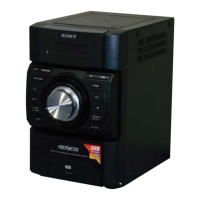
Need help?
Do you have a question about the Sony HCD-BX9 and is the answer not in the manual?
Details power output and input/output specifications for the amplifier.
Specifies laser type, frequency response, wavelength, and signal-to-noise ratio.
Outlines FM/AM tuning ranges, antenna types, and intermediate frequencies.
Describes the recording system and frequency response for the tape deck.
Covers power requirements, consumption, physical dimensions, and supplied accessories.
Provides precautions for handling, laser safety, component replacement, and circuit board repair.
Details model identification for various regions and associated parts numbers.
Provides essential service notes, including panel board installation and handling precautions.
Lists and explains the purpose of front panel buttons and indicators.
Identifies rear panel jacks and other controls like the volume knob.
Instructions for attaching speaker pads and positioning speakers for optimal sound.
Step-by-step guide to set the system's internal clock for timer functions.
Details the process for removing the top cover of the unit.
Explains how to remove the loading panel assembly, including disc tray access.
Outlines the steps for removing the front panel assembly and its components.
Provides instructions for detaching and removing the tape mechanism deck.
Details the procedure for removing the main panel board and associated knobs.
Explains how to remove the sub-transistor and transistor boards.
Guides on removing the main board and the power amplifier board assembly.
Describes the process for removing the leaf switch boards and head boards.
Instructions for removing the CD base unit assembly.
Details the removal of driver, motor, and sensor boards.
Clears all preset data in RAM to initial conditions for customer return.
Moves pickup to a stable position for shipping after repair.
Resets the set without clearing stored preset data.
Allows free operation of the CD sled motor for tasks like pickup cleaning.
Switches the Variable Attenuation Control System ON or OFF.
Allows switching MW tuner channel steps between 9 kHz and 10 kHz.
Checks software version, FL tube, LEDs, keyboard, and VACS status.
Checks operations of Amplifier, Tuner, CD, and Tape sections.
Checks CD and tape deck operation through automated aging sequences.
Explains error codes displayed during aging mode for mechanism and disc issues.
Describes the sequence of operations during CD and tape deck aging modes.
Allows switching between external function inputs like VIDEO or MD.
Advises on cleaning, demagnetizing, and using proper tools during adjustments.
Provides torque specifications for various tape deck mechanisms like FWD, REV, and tension.
Covers electrical adjustments required for optimal performance, including demagnetization and locking compound application.
Details test tape usage and settings for deck section adjustments.
Explains how to adjust azimuth for both decks to ensure proper head alignment.
Guides on adjusting tape speed for Deck B using specific test tapes and equipment.
Details the procedure for adjusting playback signal levels for Deck A and Deck B.
Describes the process for adjusting recording bias for Deck B using the "REC memory mode".
Explains how to adjust recording levels for Deck B to achieve optimal signal output.
Details adjusting the FM receiver's tuned level for optimal signal reception.
Guides on performing null adjustment for the FM section by measuring voltage.
Outlines electrical checks and adjustments for the CD section, including S-curve and RF level checks.
Important notes regarding CD section adjustments, including specific discs and oscilloscopes.
Procedure to confirm the symmetry and peak level of the S-curve waveform.
Method for checking the RF signal level and waveform clarity during CD playback.
Verifies the E-F balance and waveform symmetry during CD track jumping.
Confirms the frequency counter reading for the RF PLL free-run state.
Provides common notes for schematic diagrams and printed wiring boards, including component identification.
Illustrates the physical placement of main circuit boards within the unit.
Shows reference waveforms for key ICs on the BD, Main, and Panel boards.
Illustrates the block diagram for the tuner and CD sections, including signal paths.
Shows the block diagram for the main section of the unit, detailing signal flow.
Diagram showing component layout on the BD (Base Unit) board.
Detailed schematic for the BD (Base Unit) section, showing IC connections and signal paths.
Diagram illustrating component placement on the main board.
Part one of the main section schematic, covering FM/AM and PLL circuits.
Part two of the main section schematic, detailing tape deck and control circuits.
Part three of the main section schematic, covering digital output and power amplifier interface.
Component layout for the power amplifier board specific to the BX9 model.
Schematic for the power amplifier section of the BX9 model, showing output stages and control signals.
Component layout for the power amplifier board specific to the DX9 model.
Schematic for the power amplifier section of the DX9 model, detailing output stages.
Component layout diagram for the front panel section.
Schematic for the front panel section, including display control and button inputs.
Component layout for the leaf switch mechanism boards.
Schematic for the leaf switch mechanism, detailing reel detect and motor control.
Component layout diagrams for the motor, sensor, and driver boards.
Schematic for the driver section, illustrating motor control and sensor inputs.
Component layout for the trans boards (main and sub) used in the BX9 model.
Schematic for the trans boards, showing power supply and relay control circuits.
Component layout for the trans boards used in the DX9 model.
Schematic for the trans boards, detailing power transformer and voltage selector connections.
Detailed pin assignments and functions for the master control IC (IC401).
Block diagrams illustrating the internal structure and pin functions of key ICs.
Illustrates the disassembly of the main unit, including the CD mechanism and chassis.
Shows the exploded view of the front panel assembly, including controls and indicators.
Details the components and connections on the main board assembly.
Exploded view of the first part of the tape mechanism deck, showing head and pinch lever components.
Exploded view of the second part of the tape mechanism deck, including flywheels and chassis.
Exploded view of the CD mechanism deck, detailing its parts like pulleys, gears, and motor.
Exploded view of the CD base unit, showing the optical pick-up and BD board.
List of capacitors with part numbers, values, tolerance, and voltage ratings.
Lists various connectors and ferrite beads used in the circuitry.
Identifies integrated circuits and transistors with part numbers and types.
List of resistors with part numbers, resistance, tolerance, and wattage.
Details variable resistors, relays, and transformers used in the unit.
Lists terminal boards, vibrator components, and motor boards.
Covers various switches, capacitors, and connectors, often model-specific.
Further list of capacitors, including specific types like MYLAR and CERAMIC, with detailed specifications.
Lists diodes and ferrite beads, often including model-specific designations.
Details integrated circuits, input jacks, and inductors used in the system.
Provides a list of transistors with their part numbers and types, often specifying model variations.
Extensive list of resistors, categorized by type (CARBON, METAL OXIDE) and value.
Lists switches and capacitors, including model-specific notes and values.
Lists components for Power Amp and Panel sections, including resistors, switches, and capacitors.
Details vibrator components, power amp board assemblies, and various capacitors.
Lists connectors, diodes, and transistor types used in the unit.
Lists components for Power Amp and Sensor sections, including diodes, resistors, and switches.
Details components for the Sub-Trans board, including resistors, ICs, and fuses.
Covers components for Sub-Trans and Trans boards, including fuses, resistors, and transformers.
Lists miscellaneous items like wires, cords, adapters, optical pick-ups, and hardware.
 General
| CD Player | Yes |
|---|---|
| Cassette Player | Yes |
| Frequency Response | 20 Hz - 20 kHz |
| Functions | CD, Cassette |
| Supported Disc Types | CD, CD-R, CD-RW |
| Type | Mini Hi-Fi System |


 To Next Page