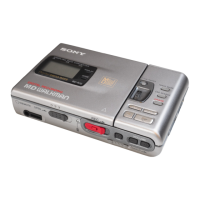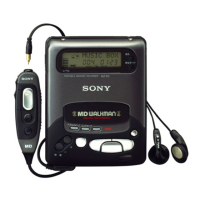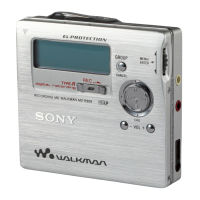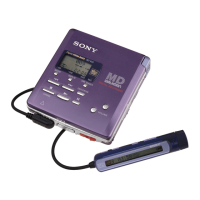
 Need help?
Do you have a question about the Sony MZ-R700 Analog PCLink and is the answer not in the manual?
 General
| Type | Portable Minidisc Recorder |
|---|---|
| Recording Format | ATRAC (Adaptive Transform Acoustic Coding) |
| Playback Format | ATRAC |
| Recording Media | Minidisc |
| PC Link | Analog PCLink |
| LP Mode | LP2, LP4 |
| Input | Line-in, Microphone |
| Output | Headphone/line output |
| Recording Time | Up to 320 minutes in LP4 mode |
| Frequency Response | 20Hz - 20kHz |
| Signal-to-Noise Ratio | 90dB |
| Battery Type | 2 x AA batteries |
| Power Supply | AC adapter (optional) |
| Headphone Output | Yes |
| Line Output | Yes |
| Line Input | Yes |
| Microphone Input | Yes |
Covers fire, shock, eye hazard, and hearing damage warnings for safe operation.
Details for recording serial and model numbers for warranty and service reference.
Details FCC rules for digital devices and potential interference management.
Instructions and information on how to recycle Nickel-Cadmium batteries.
Specific electrical safety and adapter usage advice for Canada and Australia.
Legal notices regarding trademarks and product disposal regulations.
General safety advice and warnings for operating the device.
Detailed guide to all buttons, jacks, and switches on the recorder unit.
Explanation of various icons and information displayed on the LCD screen.
Description of buttons and their functions on the supplied remote control.
Step-by-step instructions for correctly inserting the rechargeable battery.
Procedure for charging the rechargeable battery using the AC power adaptor.
Connecting headphones and unlocking the HOLD control for operation.
Instructions on how to properly insert a MiniDisc into the recorder.
Guide to using standard LR6 (AA) alkaline batteries as an alternative power source.
Notes on battery life, charging, storage, and potential short circuits.
How to connect to digital audio sources using an optical cable for recording.
Steps to initiate recording and how to stop it, including auto-off features.
Important notes regarding data saving, TOC edit, and recorder stability.
Common reasons why recording may not start and how to resolve them.
Information and notes specific to using the AC power adaptor.
Details on the LINE IN (OPTICAL) jack for digital and analog audio inputs.
How to listen to the audio being recorded using headphones.
Instructions on how to start playing an inserted MiniDisc.
How to stop the current playback and the recorder's auto-off behavior.
How to find the beginning of tracks, pause, and resume playback.
Instructions for fast backward and forward movement through tracks.
Explanation of the G-PROTECTION feature for enhanced shock protection.
Reasons why playback might not start and potential solutions.
Overview of digital (optical) and analog (line) input options for recording.
Comparison of connectable sources, cables, and signal types for inputs.
Differences in track marking and sound level adjustment between input types.
Notes on track mark copying and compatibility with playback modes.
Instructions for analog recording using a line cable (RK-G129/RK-G136).
Explanation of Stereo, LP2, LP4, and Monaural recording modes and their times.
Initial steps to set up the recorder for synchronized recording.
Steps to start synchro-recording and notes on its operation and limitations.
Procedure to record new material at the end of existing content without overwriting.
Instructions for connecting a stereo microphone and recording audio.
Steps to activate manual recording level adjustment from automatic.
How to set the recording level using the level meter and monitor.
How to check remaining time, track number, and recording position.
Explanation of different time displays like elapsed, remaining, and total time.
Instructions for selecting all repeat, single repeat, and shuffle repeat modes.
Visual representation of normal, all repeat, 1 repeat, and shuffle repeat modes.
How to enable and adjust the Mega Bass function for richer sound.
How to view elapsed time, remaining time, or total remaining time during playback.
How to enable the AVLS function to protect hearing by limiting maximum volume.
Instructions on how to lock and unlock the recorder's controls to prevent accidental operation.
How to connect the recorder to amplifiers or tape recorders via line cables.
Procedure to turn off the audible beep signals generated by operations.
Notes on Mega Bass function operability and volume adjustment for external recording.
General notes on editing MDs, including limitations and TOC Edit process.
Detailed steps to erase a specific track from a recorded MiniDisc.
Procedure for quickly erasing all tracks and data on a MiniDisc.
How to add track marks during playback or recording to segment content.
Steps to erase track marks and combine adjacent tracks.
Procedure for moving a track to a different position on the disc.
Final steps to confirm and execute the selected track movement.
List of characters usable for naming discs and tracks.
How to name a disc when the recorder is in the stop mode.
Procedure for naming a track while it is currently playing.
How to label tracks or discs while the recording process is active.
Steps to change the names of already labeled discs or tracks.
Information on using AC power, rechargeable, and dry batteries.
Table detailing approximate battery life for recording and playback modes.
Safety advice on jacks, power sources, heat build-up, and installation environment.
Warnings on headphone use while driving and preventing hearing damage.
Handling MD cartridges, cleaning the unit, and maintaining plugs.
Precautions for battery installation, leakage, and long-term storage.
Instructions for correctly reattaching the battery compartment lid.
How to use the write-protect tab on an MD to prevent changes.
Explanation of Serial Copy Management System and digital copying restrictions.
Flowchart illustrating analog and digital recording paths from sources.
Troubleshooting steps for connection, HOLD, moisture, and battery issues.
Solutions for 'NO SIGNAL', 'No sound', 'Volume cannot be turned up' messages.
Troubleshooting for playback skips, static, and vibration-related problems.
Resolving issues with track marks and rechargeable battery charging.
Explanation of 'TR FULL' errors related to track count and fragmentation.
Limitations on erasing track marks and factors affecting recording time.
Information on sound dropout during search due to data fragmentation.
Explanations for disc-related error messages and their solutions.
Meanings of messages indicating data processing and busy states.
Meaning of status indicators for power, lock, and battery levels.
Explanations for messages related to copying, disc presence, and signal detection.
Explanations for operational error messages like SORRY and TEMP OVER.
Technical details including audio system, laser properties, recording time, and coding.
Information on the recorder's physical size, dimensions, and weight.
Lists of accessories included with the recorder and available optional items.
Explanation of how premastered MiniDiscs are recorded and played.
Explanation of magneto-optical technology for recordable MiniDiscs.
How MiniDiscs offer fast, random access to tracks similar to CDs.

 To Next Page