28
7.1. SETTING AIR PRESSURE (SAG)
Sag is the amount the suspension compresses when the rider, including
riding gear, is seated on the bicycle in the riding position.
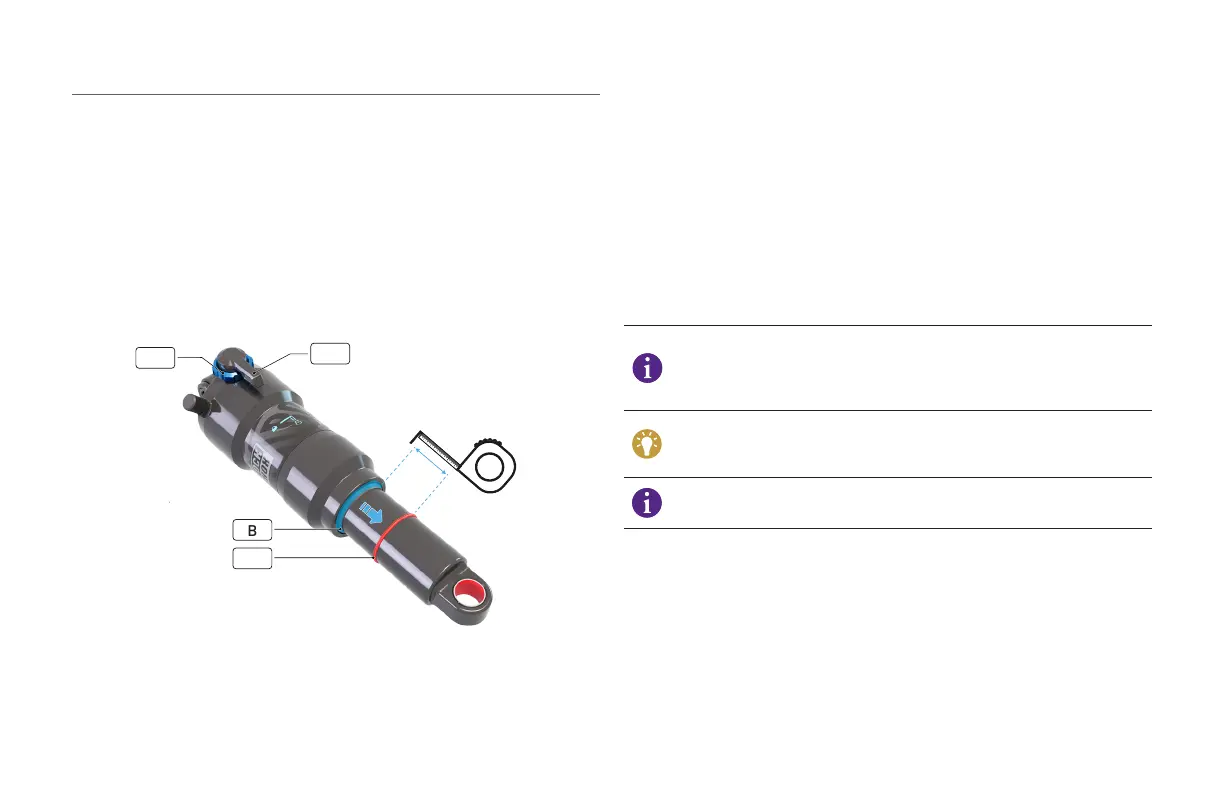
It is measured by the distance between the O-ring
(A)
and the shock body’s
seal
(B)
after the rider’s weight has been applied to the bicycle with no
bounce.
The correct sag allows the wheels to maintain traction without using too
much travel reserved for shock absorption. More sag increases small
bump sensitivity, while less sag decreases small bump sensitivity.
B
A
D
C
Set the shock compression adjuster (D) to the full open or closed
position and set the rebound adjuster (C) to the middle of the click
range.
Remove the air cap, attach a high-pressure shock pump to the air
valve and set your shock pressure based on the personalized baseline
suspension setup from the suspension calculator.
Push the O-ring (A) against the seal (B), then mount the bicycle while
propped up against a wall and sit in the saddle in a normal riding
position, without bouncing the suspension.
Measure the distance between the O-ring (A) and the shock seal (B).
Once the sag is close to the desired setting, increase or decrease the
pressure as needed in 5 psi / 0.35 bar increments until the desired sag
is achieved.
When the pressure is correctly set, sag should measure
approximately 11 - 12 mm or 27 - 30% of the stroke. If the rider
is approaching 127 kg / 280 lbs, sag may exceed the bicycle’s
prescribed amount.
Best practice is to equalize the air pressure about every 50 psi /
3.5 bar. Cycle the shock or fork after the air pressure has been
adjusted.
Refer to the shock manufacturer’s instructions for more
information on setting sag and shock setup.




 To Next Page