Tech Support: www.steppir.com/support Tel: 425.891.6134 support@steppir.com
Page 73
CHAPTER ELEVEN
SECTION 11.0
SECURE CABLES & MOUNT DB18 ON TOWER MAST
SECURE THE CABLES ONTO THE BOOM
When the antenna assembly is completed, the last step before attaching the DB18 Yagi to the tower mast is
the securing of cable and coax to the boom. Note that in many cases, the taping of the 16 wire control cable
may be the last step, done after the antenna is mounted on the tower. The most important aspect of the tap-
ing task is to be certain that NO control cable or coax is resting against a sharp edge. The most notable sharp
edges occur when routing past an aluminum saddle, mast or mounting plates and even the threads on the
stainless steel fasteners. AVOID these sharp edges! If you are routing the cable and find that you cannot
avoid a sharp edge, take measures to put something between the cable and the sharp edge. In addition, be
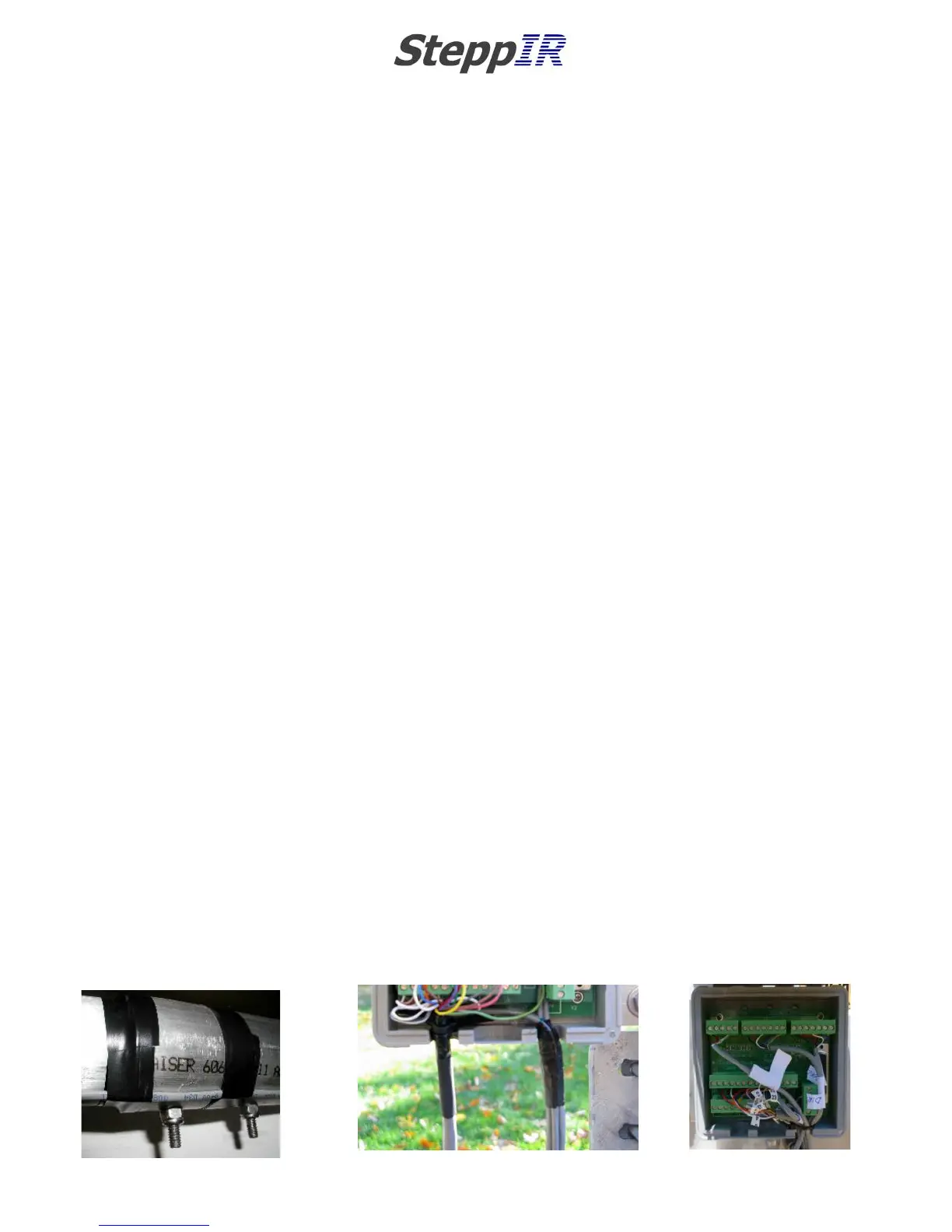
careful not to over-bend or kink any of the cables. Figure 11.01 shows an example of taping around a poten-
tial edge-hazard—in this case, the boom bolts.
There are several ways to secure the cables to the boom. The method used most of the time is to apply elec-
trical tape. We have provided you with enough electrical tape to secure the cables to the boom. When using
electrical tape, be sure to cut the tape with scissors. Do not pull the tape off until it severs, this can damage
the tape. When done wrapping the electrical tape, leave a small flap on the edge of the cut end, for easier re-
moval should the need occur at a later date. Approximately two wraps of electrical tape are sufficient for most
control cable, three wraps for coax jumpers. As a general rule, applying tape approximately every two feet is
adequate.
Other methods include the use of tie-wraps. Be careful when using tie-wraps! Be sure to purchase high quali-
ty, UV rated tie-wraps that are recommended for cable. Most of the standard off the shelf tie-wraps are not
properly rated and will become brittle and may fail within a short period of time. Do not pull the tie wraps too
tight, some brands have sharp edges and can actually damage the cable over time if pulled too tight.
When securing the cable to the boom, try to keep the cable at the bottom of the boom. The boom acts as a
shield from the sun and can prolong the life of the cable. Our cable is outdoor UV rated, but it never hurts to
err on the side of caution.
When taping cable that terminates at a terminal connection, such as the connector junction box or coax switch
housing, be sure to leave some excess cable before taping, to avoid unnecessary stress being placed on the
cable connection. Figure 11.02 shows good routing methods, with the control cable exiting out of one of the
connector junction box conduit plugs and the three EHU cables exiting out the other conduit plug.
We recommend you label each of the control cable wires and the coax jumpers. The best place to label them
is at the point nearest the connector junction box or the coax switch box. Labeling now will help out signifi-
cantly should you need to disconnect your antenna at some point in the future. Figure 11.03 shows a con-
nector junction box with labeled control cable. Note the tie wrap placed on the control cable as it exits the
connector junction box—this is a great way to make your own strain relief, coupled with leaving slack in the
cable itself when you tape it.
FIG. 11.01
FIG. 11.02
FIG. 11.03


 To Next Page