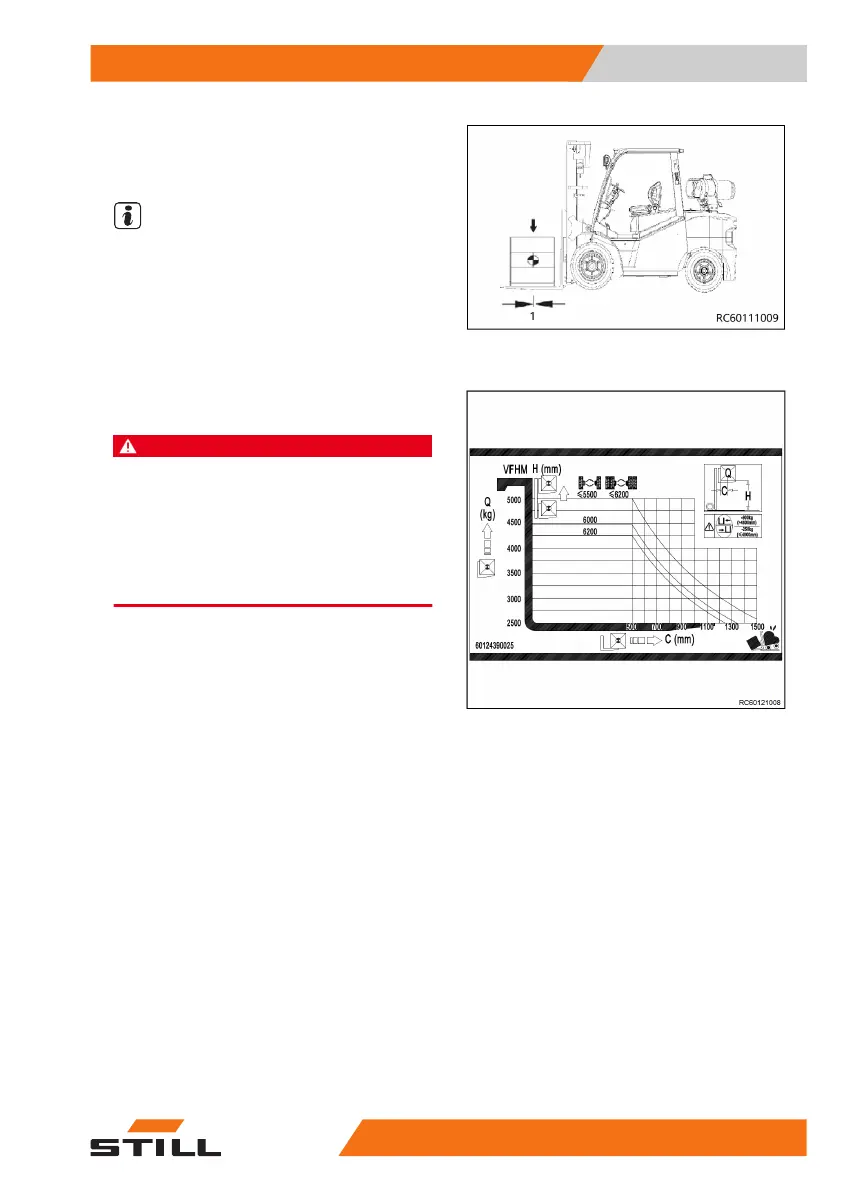
Load centre distance refers to the distance be-
tween the vertical plane of the fork arms and
the centre of gravity of the loads(1).
NOTE
The centre of gravity of a load is not necessa-
rily located at the central point of the load it-
self. The load capacity refers to the weight of
goods able to be lifted to a specified height
within a given load centre distance.
Capacity plate
DANGER
The parameters in the load diagram and on the la-
bels apply to compact, uniform loads. These load
limits must not be exceeded. Exceeding the load
limits will affect the stability of the forklift truck and
the strength of the lift mast.
Refer to the CAPACITY CHART before lifting goods.
If attachments are fitted, refer to the load rating label
for the attachment.
For example:
Truck model: RCG50 with single tyre
Load centre: 500 mm
Lift height: ≤5500 mm
In this case, the maximum load capacity is:
5000 kg
– Before loading, make sure that the dimen-
sions and weight of the load are within the
approved standard specified in the “Techni-
cal datasheet” chapter and on the load rat-
ing plate.
– Before operating an attachment, read the
load capacity data plate on the attachment.
Use and Operation
4
Handling loads
8760118011601 EN - 09/2020


 To Next Page