
 Need help?
Do you have a question about the STORK TRONIC ST121-KD1KAR.112 and is the answer not in the manual?
Overview of the ST121-KD1KAR.112 controller's features and applications.
Visual representation of electrical connections for the controller.
Diagram showing how to navigate through the controller's software menus.
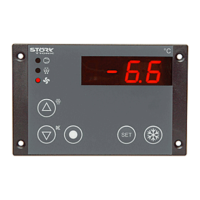
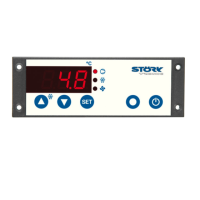
Explains the function of each physical button on the controller.
Outlines the steps and requirements for setting controller parameters.
Guide to navigating different parameter categories like Alarms and Network Address.
Details parameters for alarm sensors, limits, hysteresis, and suppression.
Configuration of functions for control buttons and external inputs.
Settings for sensors, setpoints, switching mode, and hysteresis for Control Circuit 1.
Parameters for limits, compressor protection, emergency operation, and humidity control.
Parameters for defrosting interval, mode, temperature, and time limitations.
Configuration of evaporator and condenser fan speeds, modes, and delays.
Settings for sensor selection, calibration, filtering, and value display.
Options for preset data, ST-Bus addressing, and display configurations.
Assigning functions to output relays and status LEDs.
Settings for sensors, setpoints, switching mode, and hysteresis for Control Circuit 2.
Parameters for monitoring relay switching cycles and operational times.
Steps to retrieve or reset controller passwords using a master password.
Table listing error messages, their causes, and recommended remedies.
In-depth explanation of parameters for alarm sensor assignment, limit values, and relay behavior.
Detailed descriptions of alarm suppression times, behavior, and fault handling.
Detailed explanation of parameters for sensor assignment, setpoints, switching mode, and hysteresis.
Detailed explanations for compressor protection, emergency operation, and humidity control.
In-depth explanations for defrosting interval, mode, temperature, and time limitations.
Detailed explanations for evaporator and condenser fan settings, delays, and control.
Detailed explanations for sensor selection, calibration, filtering, and value display.
Further details on fan control parameters like hysteresis and proportional range.
Detailed explanations for predefined sets, ST-Bus addressing, and display configurations.
Detailed explanations for assigning functions to output relays and status LEDs.
Detailed explanations for Control Circuit 2 sensor, setpoint, and mode settings.
Specifications for temperature sensors, relays, and their ratings.
Electrical specifications, connector types, and physical dimensions of the controller.
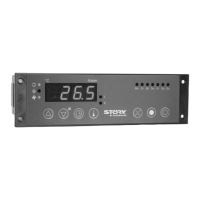
The ST121-KD1KAR.112 is a cooling controller designed for refrigerating plants, offering thermostatic temperature control with two sensor inputs and five keys. It operates on 230V AC and features two exit relays. The controller's functions and special keys are freely configurable, allowing for diverse applications. For instance, it can manage two coolers if the evaporator sensor is configured for a second refrigerating chamber. Networking is facilitated via the ST-Bus interface.
The controller is primarily used for thermostatic temperature control in refrigerating plants. It supports up to four temperature sensors, which can be used to monitor cold store temperature, evaporator temperature, super-frost core temperature, a second control circuit temperature, or condenser temperature. Each sensor's type, function, offset, and weighting can be individually configured. An analogue input (4-20mA) is available for capturing pressure levels, useful for condenser/fan control, provided the necessary hardware is present.
Up to four digital inputs can also be configured for functions such as standby, door contact, high-pressure, or low-pressure switches. The device supports up to eight relay outputs, whose functions are configurable via parameters. It is crucial to ensure that relays are not overloaded and to refer to the circuit diagram for proper wiring. All parameters are accessible via the RS485 interface. If an internal clock is available, functions like defrosting or night-time setpoint adjustments can be configured and activated.
The controller has various operating levels, including a software level for configuration. Parameterization is typically performed at the factory or during commissioning by qualified staff. Incorrect parameterization can lead to malfunctions or damage to refrigerated goods. Access to parameter settings requires entering one or more passwords.
To activate parameterization mode, the UP and DOWN buttons must be pressed simultaneously for approximately 3 seconds, after which the code word "Adr." will be displayed. Users can switch between "PR" and "Adr." using the UP or DOWN buttons. Other settings and values are adjusted using the default value setting method, which involves pressing SET and UP/DOWN simultaneously. If no button is pressed for 2 minutes, the operation stops, and the actual value is displayed again.
b1.b2.b3 (though it's unchangeable in this case).b5.b6. It is preset as a standby key, allowing the unit to be switched on or off without mains disconnection.The cooling controller is generally controlled using the UP, DOWN, and SET buttons. The standard display shows the cold store's actual temperature. Pressing SET switches the display to the setpoint temperature. Setpoint temperature can be changed by pressing SET and UP or SET and DOWN simultaneously. After changing the setpoint and releasing the buttons, the actual temperature is displayed again.
Pressing the STANDBY button for at least 3 seconds switches off the controller and displays "AUS". To switch it back on, press STANDBY again. The UP button, when pressed for 3 seconds, triggers a non-standard defrosting operation. The DOWN button can acknowledge a buzzer sound during an alarm.
Some parameter groups may be password-protected, requiring a specific password for access.
The controller offers extensive customization. Users can define temperature scales (°C or °F), display modes (3-digit or 4-digit, with or without decimal places), and which actual value is displayed during normal operation. The ST-Bus address can be configured for network communication, ensuring each device has a unique address.
The device includes counters for relay switching cycles (N level) and operating times (T level), accessible via the ST-Bus. These counters help monitor device usage and predict maintenance needs. For example, the number of switching cycles for K1 is calculated as 65536 * N1 + N0. Parameter N98 resets all relay counters. Operating time is calculated as 65536 * T11 + T10. Parameter T98 resets operating times (except for T10 and T11).
If a password is forgotten, the controller can still be parameterized and passwords edited using a master password. The process involves:
The controller provides status and error messages to indicate operational issues:
A1/A31).A2/A33).Errors EP0 and EP1 disable the controller until resolved. EP0 and EP2 can only be removed by repair. Errors are displayed alternately with the currently measured temperature.
 General
| Brand | STORK TRONIC |
|---|---|
| Model | ST121-KD1KAR.112 |
| Category | Controller |
| Language | English |





 To Next Page
