24
NOTES
1. * Last 0 is added as the initial register value is 0, this value is not part of the *IDN? string.
2. Always start register access from the first register address according to commands mapping table (refer
to Section 9.7) for each command / query. Access to any other register won’t represent the actual data.
For example for *IDN? query, always read from address 3.
3. Registers 27 ~ 52 contain 0.
Uint16 data type is the most common type used for most of the functions. Size of uint16 is 2 bytes.
Uint16 data type example – MEASure:VOLTage[:DC]? query (address 78, 2 bytes, 1 register) for 100 Volts
actual output value in a 100 Volts (nominal) power supply: 53620 = 0xD174
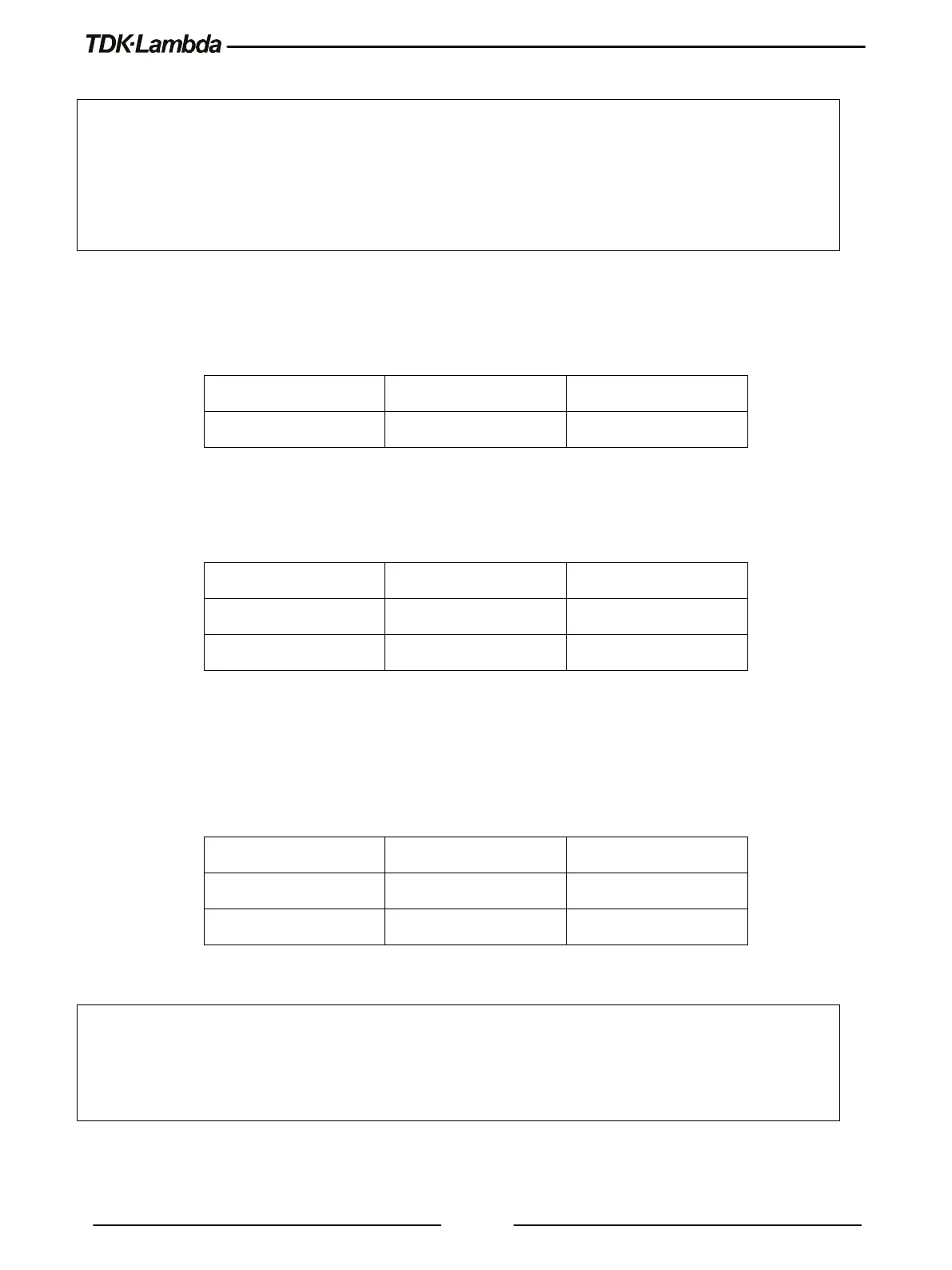
Register Address Decimal value Hexadecimal Data
78 53620 D174
Uint32 data type is used to query power supply operation time. Size of uint32 is 4 bytes.
Uint32 data type example – SYSTem:PON:TIME? query (address 997, 4 bytes, 2 registers). 100 hours
operation time is represented as:
Register Address Decimal value Hexadecimal Data
997 100 0064
998 0 0000
Float data type is used for sequencer time / dwell programming and voltage / current slew rate control. Size of
float is 4 bytes, represented according to IEEE 754 standard.
Float data type example – [PROGram]:LIST:DWELl? query (address 195, 400 bytes, 200 registers). One
second dwell for a single sequence point is represented as: 0x3F800000. Rest of the cells contain 0 if not
used.
Register Address Decimal value Hexadecimal Data
195 0 0000
196 16256 3F80
NOTES
1. Always start register access from the first register address according to commands mapping table (refer
to Section 9.7) for each command / query. Access to any other register won’t represent the actual data.
For example for
[PROGram]:LIST:DWELl?
query, always read from address 195.
2. First sequencer point always starts at the first register address.



 To Next Page