EasyManua.ls Logo

TDK-Lambda GENESYS GEN 2400W Series - User Manual

TDK-Lambda GENESYS GEN 2400W Series
88 pages
Print Icon
To Next Page IconTo Next Page
Loading...
83-517-000 Rev.A
TECHNICAL MANUAL FOR
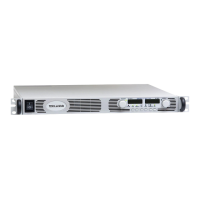
1U GENESYS™
2.4kW
PROGRAMMABLE DC POWER SUPPLIES
Document: 83-517-000 Rev. A
TDK-Lambda Americas Inc.
405 ESSEX ROAD, NEPTUNE, NJ 07753
TEL: +1.732.922.9300
FAX: +1.732.922.9334
WEB: www.us.tdk-lambda.com/hp

Table of Contents

Questions and Answers

  • K
    Kevin McdonaldAug 17, 2025
    What to do if TDK-Lambda GENESYS GEN 2400W has no output and all displays are blank?
    • M
      Margaret MitchellAug 17, 2025
      If your TDK-Lambda Power Supply shows no output and the displays are blank, check if the AC power cord is defective and replace it if necessary. Also, verify that the AC input voltage is within the correct range and connect to an appropriate voltage source.
  • H
    Heather FergusonAug 19, 2025
    What to do if TDK-Lambda GENESYS GEN 2400W Power Supply output is present momentarily but shuts off quickly and the display indicates “AC”?
    • J
      Jeremy HubbardAug 19, 2025
      If the TDK-Lambda Power Supply output appears briefly but then shuts off, and the display reads “AC”, it might be due to voltage sag when the load is applied. Check the AC input voltage and connect to an appropriate voltage source.
  • S
    Stephen JosephAug 22, 2025
    What does it mean if TDK-Lambda GENESYS GEN 2400W front panel ALARM LED is blinking?
    • M
      marcusmilesAug 22, 2025
      If the front panel ALARM LED is blinking on your TDK-Lambda Power Supply, it could indicate several issues: - If the display shows “EnA”, check the rear panel J1 ENABLE connection. - It can be related to SW1 DIP-switch setting. See section 4.4 for details. - If the display indicates “SO”, examine the rear panel J1 Output Shut-Off (SO) connection. - If the display indicates “OTP”, check for blocked air intake or exhaust, or proximity to heat-generating equipment. - If the display indicates “Fb”, verify the Foldback setting and load current.
  • C
    christopher90Aug 25, 2025
    Why TDK-Lambda Power Supply output is present momentarily but shuts off quickly and the display indicates “OUP”?
    • K
      Katherine VelezAug 26, 2025
      If your TDK-Lambda Power Supply shows output briefly before shutting down, and the display indicates “OUP”, check if the power supply is configured to Remote sense and whether the positive or negative load wire is loose.
  • J
    Jon WatersAug 28, 2025
    What to do if TDK-Lambda GENESYS GEN 2400W has no output and Display indicates “OUP”?
    • B
      bsmithAug 28, 2025
      If your TDK-Lambda Power Supply has no output and the display shows “OUP”, the Over-Voltage Protection (OVP) circuit might have tripped. Turn OFF the AC Input power switch and check the load connections. If J1 Analog Programming is in use, verify that the OVP setting is not lower than the output.
  • K
    Kelly MoralesAug 30, 2025
    How to fix poor load regulation on TDK-Lambda GENESYS GEN 2400W Power Supply when the front panel CV LED is illuminated?
    • M
      mbaileyAug 30, 2025
      If you're experiencing poor load regulation on your TDK-Lambda Power Supply and the front panel CV LED is lit, ensure that the sensing wires are connected correctly according to the User’s Manual instructions.
  • R
    Richard VasquezSep 2, 2025
    How to resolve large voltage ripple across TDK-Lambda GENESYS GEN 2400W output?
    • J
      Justin KennedySep 2, 2025
      To address a large voltage ripple across the output of your TDK-Lambda Power Supply, check the load and sense wire connections for noise and impedance effects. Also, minimize the voltage drop on the load wires. Check if the power supply is in remote sense and if the voltage drop on the load wire is too high.
  • C
    Cole LopezSep 5, 2025
    What to do if TDK-Lambda Power Supply output voltage will not adjust and front panel CC LED is illuminated?
    • R
      Regina WatsonSep 5, 2025
      If the output voltage of your TDK-Lambda Power Supply won't adjust and the front panel CC LED is lit, the unit might be in Constant-Current (CC) mode. Check the output current limit setting and the load current.
  • T
    tmartinSep 7, 2025
    What to do if TDK-Lambda Power Supply output current will not adjust and front panel CV LED is illuminated?
    • M
      Micheal AndersonSep 7, 2025
      If the output current of your TDK-Lambda Power Supply will not adjust and the front panel CV LED is illuminated, the unit may be in Constant-Voltage (CV) mode. Check the Output current limit and Output voltage setting.
  • R
    restradaSep 10, 2025
    What to do if TDK-Lambda Power Supply output voltage will not adjust and front panel CV LED is illuminated?
    • J
      John SmithSep 10, 2025
      If the output voltage of your TDK-Lambda Power Supply will not adjust and the front panel CV LED is illuminated, check if the output voltage is adjusted above the OVP setting or below the UVL setting. Adjust the OVP or UVL settings so they do not limit the output voltage.

Summary

Warranty Information

Warranty Limitations

Exclusions from warranty coverage due to improper use, modifications, or unauthorized service.

Warranty Service Procedure

Instructions for returning products for repair or warranty service.

Safety Instructions

Grounding Requirements

Chassis must be connected to electrical ground via a three-conductor power cable.

Live Circuit Precautions

Do not remove covers; internal adjustments only by qualified personnel.

Parts Substitutions and Modifications

Safety and Environmental Conditions

Chapter 1: General Information

Serial Communication Port Control

Parameters programmable/monitorable via serial port: voltage, current, ON/OFF, etc.

Analog Voltage Programming and Monitoring

Rear panel analog inputs/outputs for remote control and monitoring of voltage and current.

Chapter 2: Specifications

Output Rating

Table detailing rated output voltage, current, and power for various models.

Constant-Voltage Mode Specifications

Specifies line/load regulation, ripple, temperature coefficient, and response times.

Constant-Current Mode Specifications

Specifies line/load regulation, ripple, temperature coefficient, and response times.

Analog Programming and Monitoring Specifications

Details Vout/Iout programming, monitoring signals, and control functions.

Remote Programming and Readback Specifications

Accuracy and resolution for programming and readback via serial or optional interfaces.

Protective Functions

Details Foldback, OVP, UVL, and OTP trip points and settings.

Safety Specifications

Lists applicable safety standards (UL, CSA, IEC) and interface classifications.

Outline Drawing

Chapter 3: Installation

AC Input Power Connection

Connection procedure for AC power source, requiring qualified personnel and protective device.

AC Input Wire Connection Procedure

Detailed steps for stripping wires and connecting them to the AC input connector.

Constant-Voltage Check

Verifies output voltage adjustment and accuracy against the VOLTAGE meter.

Constant-Current Check

Verifies output current adjustment and accuracy using a DC shunt and CURRENT meter.

Over-Voltage Protection (OVP) Check

Tests OVP function by adjusting voltage and verifying shutdown at preset limit.

Under-Voltage Limit (UVL) Check

Tests UVL function by adjusting voltage and verifying it cannot be decreased below the set limit.

Foldback Protection Check

Verifies Foldback protection by shorting the output and observing display/LED indications.

Address Setting

Procedure for setting the unit's communication address (0-30) using the VOLTAGE encoder.

Baud Rate Setting (RS-232;RS-485)

Procedure for selecting baud rate (1200-19200) using the CURRENT encoder.

Making Load Connections

Details load connection methods for different models.

Single Load Connection with Local Sensing

Recommended connections for single loads using default local sensing.

Single Load Connection with Remote Sensing

Recommended remote sensing connections for single loads where regulation is critical.

Multiple Loads Connection (Radial Distribution)

Connecting multiple loads to one supply using separate wire pairs.

Multiple Loads Connection with Distribution Terminals

Connecting loads to distribution terminals using twisted/shielded wires; remote sensing options.

Grounding Outputs

Recommendations for grounding output terminals to minimize noise.

Local and Remote Sensing

Configuration and wiring for local and remote sensing.

Local Sensing Configuration

Details J2 connector assignments for local sensing; suitable for less critical load regulation.

Remote Sensing Configuration

Procedure for configuring remote sensing to compensate for voltage drop across load wires.

Chapter 4: Front and Rear Panel Controls and Connectors

Front Panel Controls and Indicators

Details the function of each control, indicator, and meter on the front panel.

Rear Panel Connections and Controls

Overview of rear panel connectors and controls.

Rear Panel SW1 Setup Switch

Explains the 9-position DIP-switch for selecting programming modes and functions.

SW1 DIP-Switch Position Functions

Details the function of each DIP-switch position for various settings.

Rear Panel J1 Programming and Monitoring Connector

Details the J1 connector for programming and monitoring functions.

Making J1 Connections

Details connector types, wire dimensions, and necessary tools for J1 connections.

Chapter 5: Local Operation

Standard Operation Modes

Explains the two basic modes: Constant-Voltage (CV) and Constant-Current (CC).

Constant-Voltage Mode Operation

Details how to set and adjust output voltage, including resolution and display behavior.

Constant-Current Mode Operation

Details how to set and adjust output current limit, including display behavior.

Automatic Crossover Operation

Explains the automatic switch between CV and CC modes based on load conditions.

Over-Voltage Protection (OVP)

Describes the OVP circuit's function and how it protects the load.

Setting the OVP Level

Procedure for setting the OVP level using the VOLTAGE encoder and display.

Resetting the OVP Circuit

Methods to reset the OVP circuit after it has activated.

Under-Voltage Limit (UVL)

Explains the UVL function to prevent output adjustment below a set limit.

Setting the Output UVL Level

Procedure for setting the UVL level using the VOLTAGE encoder and display.

Foldback Protection

Explains foldback protection to shut down output if current exceeds limit.

Setting Foldback Protection

How to arm foldback protection using the FOLD button and its activation.

Resetting Foldback Protection

Methods to reset foldback protection after it has been activated.

Output ON;OFF Control

Enables/disables power supply output using front panel button or rear panel pins.

Rear Panel J1 Output Shut-Off (SO) Control

Details SO terminals, function, activation logic, and use for daisy-chaining.

Rear Panel J1 Enable;Disable Control

Configures output enable/disable via J1 terminals and SW1-9 setting.

Safe-Start and Auto-Restart Modes

Selectable start-up modes: Safe-Start (output OFF) or Auto-Restart (output ON).

Over-Temperature Protection (OTP)

Shuts down supply if internal components exceed safe operating temperature.

Series Operation

Connecting identical models in series for increased output voltage.

Series Connection for Increased Output Voltage

Connecting two units in series to sum outputs; includes diode recommendations.

Series Connection for Positive;Negative Output Voltage

Configuring two units for positive and negative output voltages.

Parallel Operation

Connecting up to four units in parallel for increased current capability.

Basic Parallel Operation

Method using J1 connections and SW1 for master/slave setup and load current programming.

Setting Up the Master Unit (Basic Parallel)

Procedure for setting master unit voltage, current limit, and sensing.

Setting Up the Slave Units (Basic Parallel)

Procedure for setting slave units' voltage, current limit, and connections.

Setting Over-Voltage Protection (Basic Parallel)

Setting OVP levels for master and slave units in parallel operation.

Setting Foldback Protection (Basic Parallel)

Foldback protection is only used with the master unit in parallel operation.

Advanced Parallel Operation

Configuring multiple supplies as a single unit; master displays total current.

Setting Units as Master or Slave (Advanced Parallel)

Using FINE button and CURRENT encoder to display and set master/slave configuration.

Master and Slave Units Default Operation (Advanced Parallel)

Slave units enter Remote mode with Local Lockout; parameters are auto-set.

Releasing Units from Slave Mode

Procedure to release slave units from slave mode operation.

Daisy-Chain Connection

Configuring multiple supplies to shut down on fault; uses SW1-5 for Daisy-Chain Shut-Off.

Front Panel Locking

Locks front panel controls to prevent accidental parameter changes.

Chapter 6: Remote Analog Programming

Local;Remote Analog Control Selection

Selecting Local or Remote Analog mode using J1-9 and SW1 settings.

Remote Voltage Programming (Output V & I)

Procedure for setting power supply to Remote Voltage programming using external voltage source.

Chapter 7: RS-232 & RS-485 Remote Control

Chapter 7.8: Status, Error, and SRQ Registers

Chapter 7.9: Serial Communication Test Setup

Chapter 8: Isolated Analog Programming Option

Chapter 9: Maintenance

TDK-Lambda GENESYS GEN 2400W Series Specifications

General IconGeneral
BrandTDK-Lambda
ModelGENESYS GEN 2400W Series
CategoryPower Supply
LanguageEnglish

Related product manuals