TEMPERATURE SENSORS
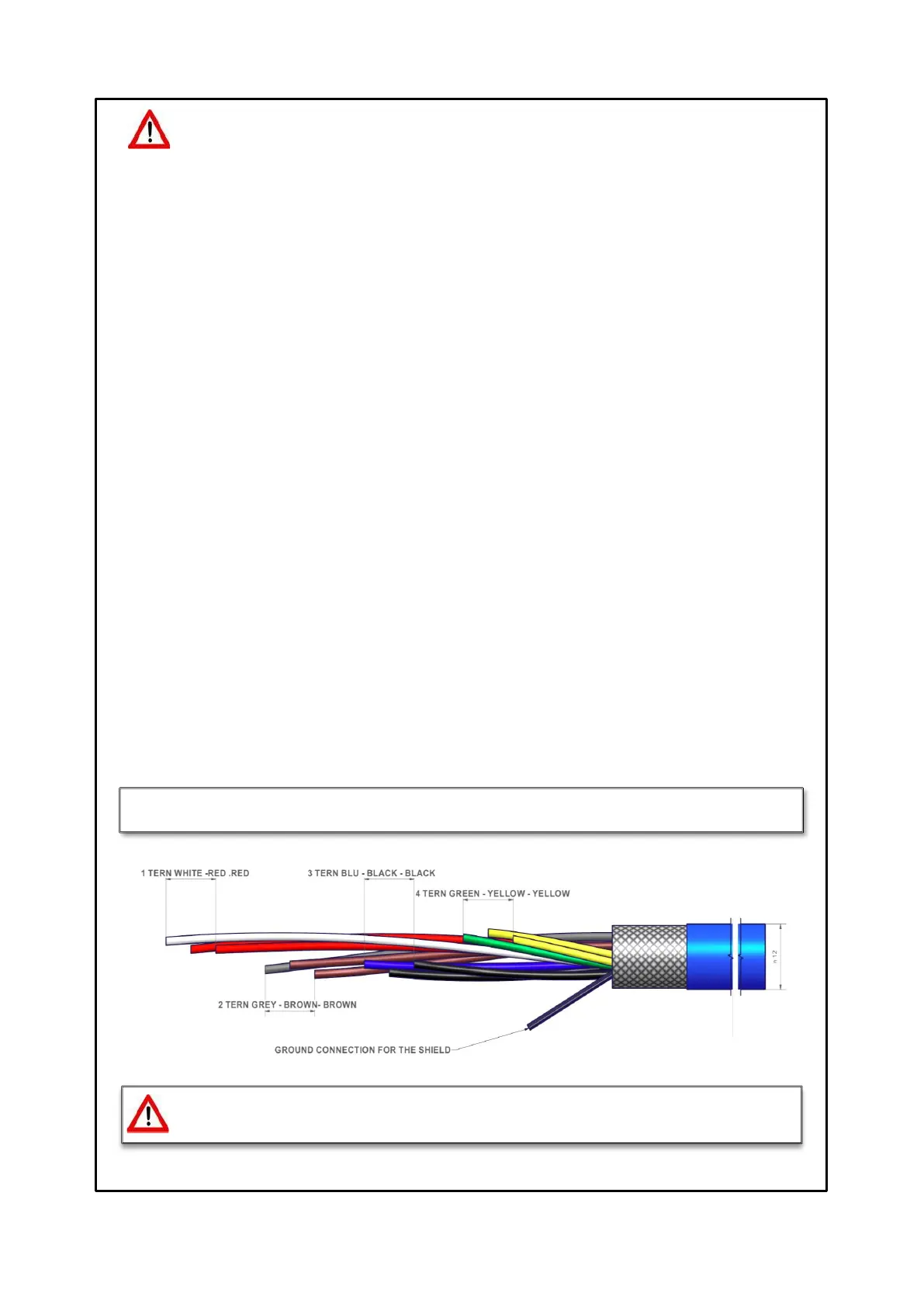
Each Pt100 thermometric sensor has a white conductor and two red ones (CEI 75.8 standards).
The CH2 channel must always refer to the central column of the transformer.
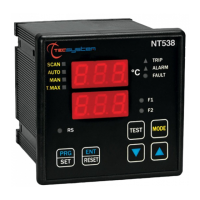
The CH4 channel must refer either to the transformer core, or to the Pt100 room sensor whenever it is necessary to thermostat
the transformer room using the NT935 WS EVO control unit.
MEASUREMENT SIGNAL TRANSFER
All the Pt100 measurement signal transfer cables must strictly comply with the following rules:
1. Every Pt100 must be connected with a three-wire cable with a minimum section of 0.35mm² and a maximum of 1 mm².
2. The extension cable must be screened with tinned copper braid with an 80% cover
3. Conductors must be twisted, maximum recommended step 60mm
4. The cable screening must only be earthed with a termination, preferably on the control unit side.
5. The sensors' signal transfer cable must not be near electrical cables, either low or medium-high voltage.
6. The Pt100 cable and the signal transfer cable must be laid in a straight line, without any winding.
7. Any caps used to butt conductors must be crimped properly to avoid false contacts.
NOTE: to install the sensors and signal transferring cable correctly, read the SCS/PT100 SENSORS installation note
manual.
What may happen when installation rules are not complied with.
1)The electrical field propagating from the power line of another circuit couples capacitively with the conductors (in particular
with unscreened cables). The effect of this coupling creates a signal that overlaps the signal transmitted by the nearby
conductors, causing incorrect readings.
2) The variations in magnetic flux in the power lines may induce an electromotive force on the signal transferring cables (in
particular non-twisted cables), that, being a closed circuit, generates a current. This interference current, multiplied by the
circuit resistance, gives a voltage value that overlaps the signal to be transmitted, distorting the sensor measurement.
3) False contacts can alter the signal with the consequent variation in the temperature detected.
In specific cases, when the rules for connecting the Pt100 sensors are not complied with, the following anomalies can occur
between the SCS box and the temperature control unit:
a) incorrect temperature readings, alarms or anomalous tripping
b) mechanical/electrical fault of the Pt100 sensors
c) damage to the Pt100 inputs of the control unit.



 To Next Page