EasyManua.ls Logo

TELEVAC CC-10 - 1.0 Introduction and Safety Instructions; 1.0.1 Product Overview; 1.2 Sensor Technology

TELEVAC CC-10
40 pages
Print Icon
To Next Page IconTo Next Page
To Previous Page IconTo Previous Page
Loading...
CC-10
INSTRUMENT MANUAL
Phone:(215) 947-2500 fax:(215) 947-7464 e-mail:sales@televac.com web site:www.televac.com
CC-10 MANUAL REV D
Page 2 of 40
Y
TELEVA
1.0
I
n
t
r
odu
c
t
i
on
a
nd
Sa
f
e
t
y
I
n
s
t
r
u
c
t
i
on
s
1.0.1
Product
Overview:
The
CC-10
is
a
self-contained,
compact
wide
range
vacuum
gauge
and
controller
employing
the latest
sensor
technology.
The
CC-10
is
able
to
replace
multiple
traditional
gauges
and
provides the
user
with
measurement
capability
from
atmospheric
pressure
to
10
-9
Torr.
The
gauge
requires
22-26
VDC
input
power
and
provides
the
user
with
a
digital
pressure
indication,
analog
output and
RS485
digital
communications.
Three
independent
set
points
can
be
addressed
from
the instrument‟s
control
panel,
from
a
tethered
remote
display
module
or
via
RS485.
1.2
Sensor
Technology:
The
CC-10
uses
two
sensor
types
to
seamlessly
measure
a
pressure
range
of
12
decades.
An crystal
sensor
is
used
to
measure
from
atmospheric
pressure
to
10
-4
Torr
and
a
double
inverted magnetron
cold
cathode
is
used
to
measure
from
10
-2
to
10
-9
Torr.
1.2.1
Crystal
Sensor
Operating
Principle
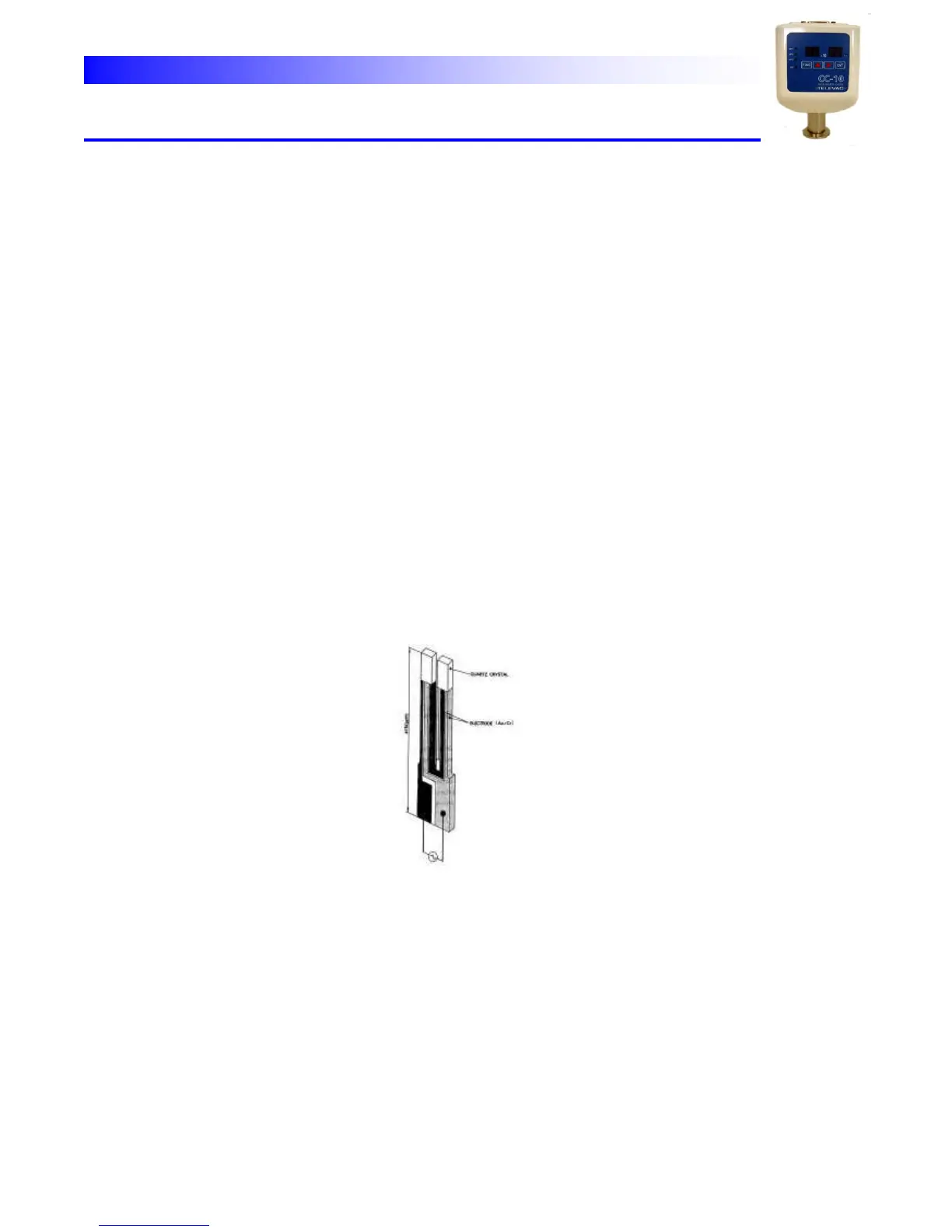
The
crystal
sensor
is
a
simple
tuning-folk
shaped
quartz
oscillator
that‟s
similar
to
the
oscillators commonly
used
in
wrist
watches.
The
electrical
impedance
of
the
oscillation
depends
upon
the pressure
of
the
gas
that
surrounds
the
quartz
oscillator,
because
the
resistance
to
the
oscillation
(as
caused
by
friction
between
the
quartz
surface
and
gas
molecule),
varies
as
the
pressure changes.
The
crystal
sensor
measures
the
electrical
impedance
of
the
quartz
oscillator
and
its circuitry
converts
it
to
the
pressure
value.
Crystal
Sensor
1.2.2
Cold
Cathode
Operating
Principle
The
double
inverted
magnetron
cold
cathode
sensor
measures
pressure
by
ionizing
the
residual gases
in
a
magnetron
discharge.
The
body
of
the
sensor
serves
as
the
cathode
ands
is
at
ground potential.
The
anode
operates
at
as
much
as
4000
volts.
A
permanent
magnet
traps
electrons
in the
sensor
to
sustain
the
discharge
at
a
very
low
pressure.
This
type
of
sensor;
like
all
ionization sensors,
is
sensitive
to
gas
type,
but
unlike
conventional
ionization
gauges,
has
no
filaments
to burn
out,
can
operate
continuously
at
higher
pressure
and
is
considerably
more
rugged
and reliable.