Working the Machine
5-6
Dumping
When dumping, the operator should steer the machine ensuring that
it is straight and with the loaded body on level ground. The dumping
operation usually depends upon the type of material being hauled.
For instance, overburden and other waste material is usually dumped
over a spoil bank or piled into large mounds. The dumping on a job of
this type might be controlled by a dump 'SPOTTER', 'FLAGMAN' or
'BANKSMAN' or second person who directs the machine to its dump-
ing area. While backing to dump, the operator must watch the 'SPOT-
TER' at all times and follow his/her direction. Under no circumstances
should the operator leave the seat to gain better visibility while back-
ing. Always remain seated to maintain maximum machine control.
Mineral ores, blasted rock etc., are usually dumped into a hopper, or
crusher, where it is processed. When dumping into a hopper, the
operator, in order to avoid excess wear on the tyres, must avoid hitting
the protecting rail at the hopper. If a DRIVEOVER HOPPER is used,
the operator must avoid rubbing the tyre inner sidewalls.
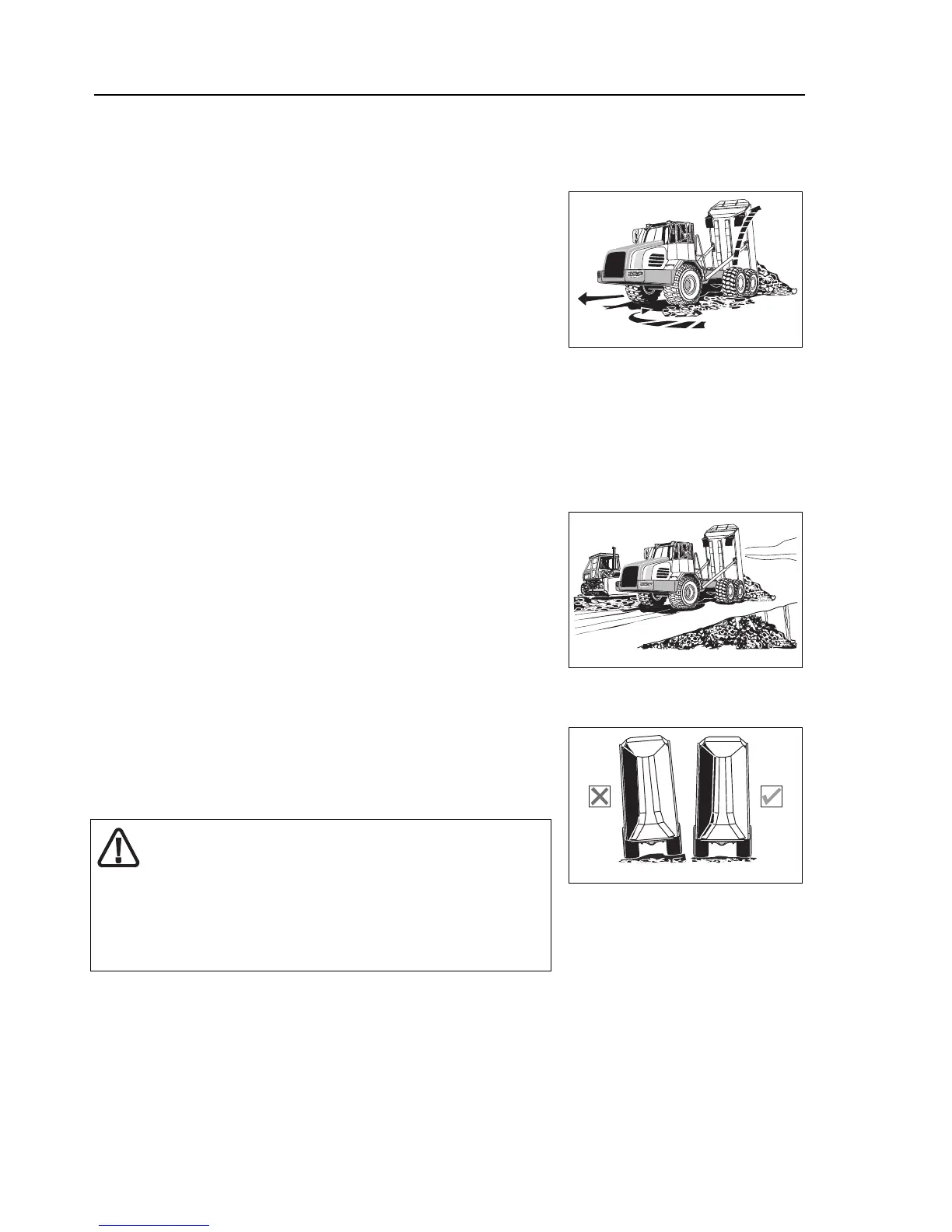
When hauling dirt or rock from a borrow pit into a fill area such as an
earth-fill dam, the load is usually dumped in a string with other loads
and the loads smoothed out with a crawler tractor. When dumping on
a fill of this type, the operator usually works alone and picks his/her
own dumping place. To save bulldozer work and cleaning up, the load
should be dumped as close as possible to the preceding load. The
operator should pull past the preceding load, turn in line with the
string and back the machine until it is within a few feet of the last load.
This assures that the load will fall in the right place. No matter what
kind of job the operator is working, there are a few things which are
common to all jobs and which the operator should observe -
NOTICE: Before raising the body, make sure that the rear wheels are
on firm level ground. If one wheel is higher than the other, a twisting
strain is imposed upon the body hinge pins, hoists and chassis. Stop
the machine, allow the engine to slow to idle, shift the transmission to
'NEUTRAL' so that the parking brake is applied automatically and the
machine is held stationary.


 To Next Page