8.2.8
Historical tunings
This feature allows you to experiment with different historical tunings, if you play cer‐
tain music genres that are not composed according to the equal temperament
tuning.
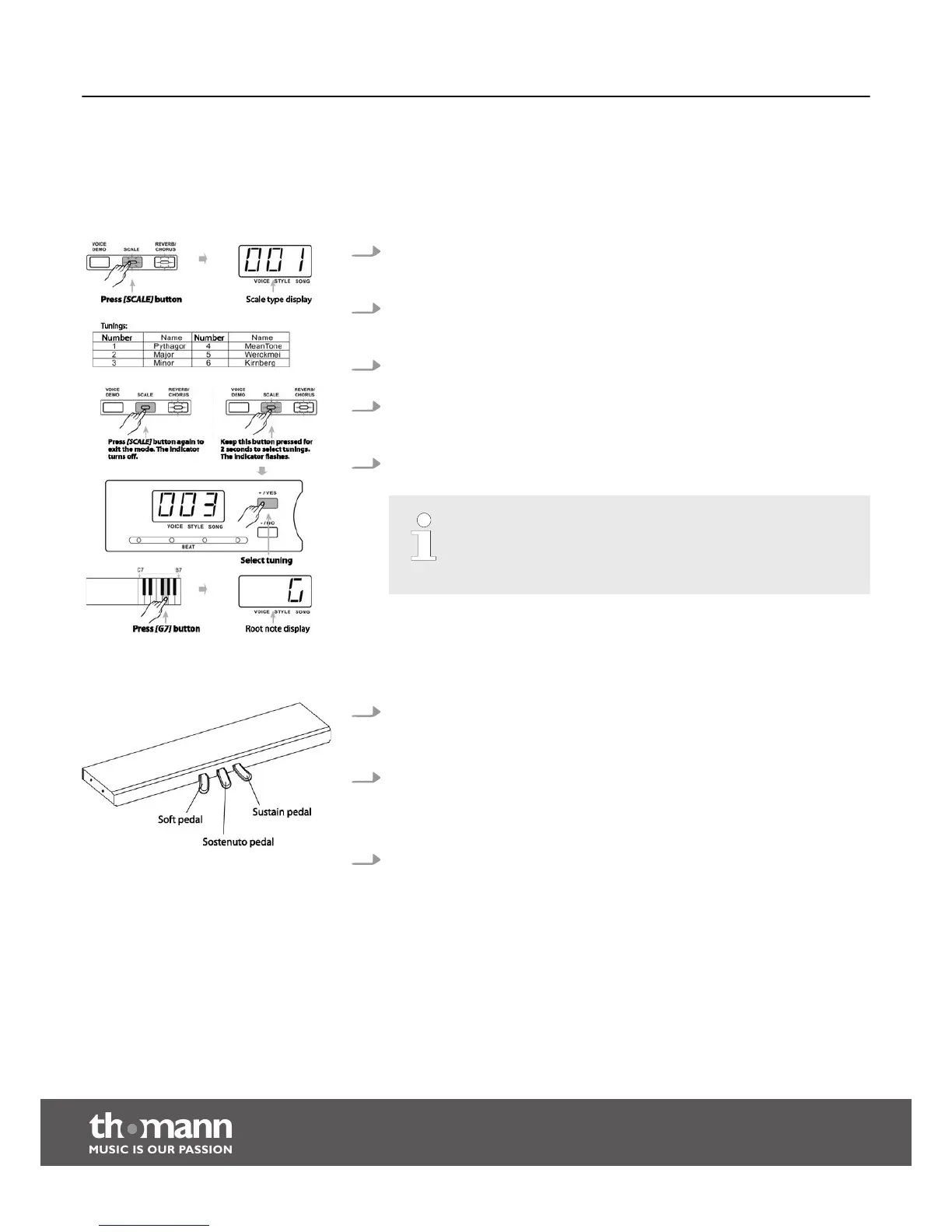
1. Press the button [SCALE] to enter the mode for historical tunings. The indicator
of the button [SCALE] lights up. By default, ‘001’ (Pythagoras) is set as historical
tuning.
2. Besides the equal temperament tuning, the following six historical tunings are
available: Pythagoras, perfect major, perfect minor, meantone, Werckmeister
and Kirnberger.
3. Press the button [SCALE] again to quit the mode for historical tunings. The indi‐
cator turns off.
4. Keep the [SCALE] button pressed for two seconds in the mode for historical
tunings to activate the selection function. The display will flash and the LED
display shows the number.
5. Use the buttons [+/YES] or [–/NO] to select the historical tunings that are
shown in the LED display. You set the root note with the piano keys C7 to B7.
For example, to select ‘perfect minor’ with the root note ‘G’, press the
[+/YES] button until ‘003’ appears briefly in the LED display. Then
press the button [G7] to select this as root note. The LED display
shows the root note ‘G’.
8.2.9
Pedals
1. Sustain pedal:
Using the Sustain pedal while playing lets the tones last - as if the keys were
held.
2. Sostenuto pedal:
When using the Sostenuto pedal while playing, only those keys are held that
are played when stepping on the pedal. The pedal has no effect on keys played
afterwards.
3. Soft pedal:
When stepping on the Soft pedal while playing, the keys sound quieter.
Functions
digital piano
24


 To Next Page