Problem: Drift
Typical Symptoms:
● Pipette tip moving after manual and piezo
adjustments are completed.
● "Losing" cells after making a seal.
♦ Also refer to the troubleshooting section,
Problem: Excess Motion of Pipette Tip During
Manual Adjustment, above.
Probable Causes
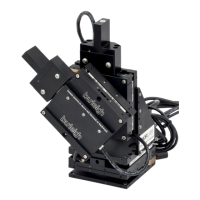
● The solid-state design of the PCS-6000 produces
negligible heat and associated internal thermal drift.
Extreme thermal drift is usually caused by thermal
changes in the lab environment. The most thermally
sensitive components are the headstage, the pipette
holder, and the pipette itself. If the PCS-6000 is not
mounted directly to the microscope, then the
mounting system also may contribute to drift.
What to Check
● Check that the unit is warmed up and stabilized (30
minutes normally or 60 minutes for drift less than 1
µm per hour.
● Check that the system (PCS-6000, mount, and
microscope) is protected from drafts.
● Check for heat sources near the system (for example:
power supplies, heaters, lamps, sunlight).
● Check for ambient temperature changes during the
experiment.
♦ For more information about minimizing thermal
drift, refer to the following Application Note
available from Thorlabs, Inc.: Pipette Drift
Sources and Solutions for Patch Clamp
Recording Experiments.
♦ Additionally, please see: Fredrick Sachs, A Low
Drift Micropipette Holder, European Journal of
Physiology (1995) 429:434-435.


 To Next Page
 Loading...