26
User
Manual
Step 8
Step 8
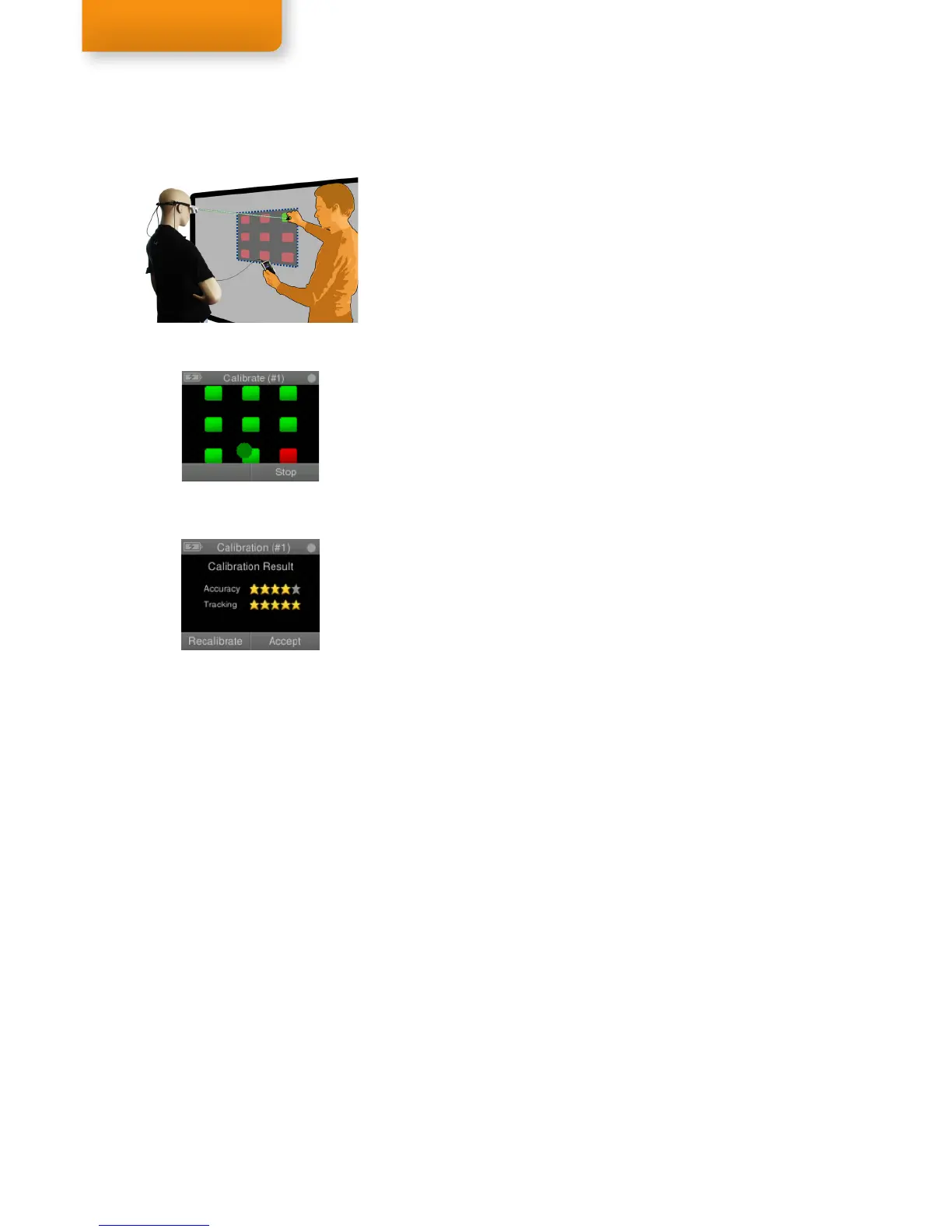
8. Watch the Recording Assistant screen while moving the IR
Marker slowly over each calibration point in the Virtual Calibration
Plane and waiting until the point turns green before continuing to
the next. Continue until each point of the calibration grid on the
Recording Assistant has turned green.
9. Select Accept to accept the calibration or Recalibrate to start a
new calibration and discard the current one.
As a result of the calibration, you see a Calibration Result message on
the screen together with a quality rating for each of the Accuracy and
Tracking (ranging from 1 to 5 stars). The lowest calibration score is
shown as one red colored star. The second to lowest score is shown as
one yellow star.
The Tracking score
The tracking score is a measure of quantity of samples captured by the
eye tracker where the features needed to perform good eye tracking
were available. To get the best results, the eye tracker needs to find as
many features as possible, but it can still track even if just one feature
was found. The score is based on a percentage of how many samples
that have been recorded during the calibration in which features for eye
tracking have been possible to be identified. This means that, if a score
of five stars is given for a calibration, more than 80% of the recorded
samples contain usable features. If only one star is given, less than 19%
of the samples contain usable features.
Therefore, the score will be lower if the eye cannot be detected at all,
i.e. if the participant blinks or looks away during calibration. That means
that a low score does not necessarily mean that the tracking will be bad
during the actual recording, but that the eye tracker did not manage to
find the features tracked at certain times during the calibration.
The Accuracy score
The tracking score indicates the level of accuracy that can be expected
during a recording. If this score is high while the Tracking score is low,
it means that the eye tracker had problems finding features in the eye
during the calibration, but when it did, the accuracy was very good. As a
result, when the recording is done, the eye tracker might not be able to
track the eye at all times, but the samples that are collected provide good
accuracy.
During the calibration, the eye tracker collects samples which it tries
to fit into a mathematical model that is then used to map the samples
collected during the recording against what is seen by the scene
camera. Because the eye tracker can assume where the participant is
looking during the calibration, it can assess how well it is able to map
the collected gaze samples against the points where the participant
is supposed to be looking after adjusting the parameters in the
mathematical model. The Accuracy score is based on an average of all
samples collected during the calibration of the offset between expected
gaze point (i.e. where the participant is expected to be looking) and
calculated gaze point (i.e. where the eye tracker has calculated that the
participant was looking). If the average is below a certain threshold, the
calibration gets a five star rating and if it is above another threshold, it
gets zero stars. Between these two extremes is a linearly proportional
scale.
Step 9


 To Next Page
 Loading...