The Tornado Model 99685 is an automatic scrubber designed for commercial use, manufactured by Tornado Industries, LLC. This operations and maintenance manual provides comprehensive instructions for its safe and effective use, as well as detailed maintenance procedures.
Function Description
The Tornado 99685 is an automatic scrubber that simultaneously performs washing and drying operations on floors. It is designed for efficient cleaning in commercial environments, utilizing brushes to scrub surfaces and a squeegee system to dry them, leaving floors clean and dry. The machine is battery-operated, providing mobility and flexibility for various cleaning tasks. It features a solution tank for detergent and a recovery tank for collecting dirty water, ensuring a thorough cleaning process. The machine is equipped with a POD (Protection from Over Discharge) device for battery management, providing audible and visual reminders when recharging is needed.
Important Technical Specifications
The Tornado 99685 has the following key technical specifications:
- Cleaning Width: 460 mm (18 inches)
- Squeegee Width: 790 mm (31 inches)
- Working Capacity: 1670 sqm/h (17975 sqft/h)
- Brush Diameter: 2 x 95 mm (2 x 3.75 inches)
- Brush RPM: 950
- Pressure on the Brush: 30/66 kg/lbs max.
- Brush Motor: 600 W / 25 A
- Type of Drive: Semi-automatic
- Maximum Gradient: 2%
- Vacuum Motor: 570 W / 24 A
- Suction Vacuum: 120 mbar (48 inches water lift)
- Solution Tank Capacity: 40 liters (11 gallons)
- Recovery Tank Capacity: 45 liters (12 gallons)
- Machine Length: 1092 mm (43 inches)
- Machine Height: 1041 mm (41 inches)
- Machine Width (without squeegee): 533 mm (21 inches)
- Weight of the Batteries: 74 kg (163 lbs)
- Battery Compartment Dimensions: 342x345x300 mm (13.5x13.4x12 inches)
- Weight of the Machine (empty and without batteries): 71 kg (157 lbs)
- Acoustic Pressure Level (IEC 704/1): <70 dB(A)
- Class: III
- Protection Level: IP X3
- Tension: 24 V
Usage Features
The machine is designed for ease of use with several operational features:
- Instrument Board and Controls: Includes a charge level display (batteries/hour meter), visualization push button, suction motor switch, solution valve open signal lamp, brush motor switch, brush activation levers, solution valve lever, squeegee lifting lever, and brush head lifting pedal.
- Battery Installation: Equipped with two 12V batteries in serial connection. Specialized staff should handle battery cable connections to prevent polarity inversion and damage to electrical components. An adjustment is necessary for AGM batteries.
- Battery Recharging: The machine has an on-board battery recharger. It should be brought to a leveled surface near a 120V 60Hz socket for recharging. The recovery tank must be lifted during this process. Users are advised to follow manufacturer instructions for battery maintenance and avoid complete discharge to prevent permanent damage.
- Squeegee Assembly and Adjustment: The squeegee slides into slots on the support and is blocked by rotating a lever. Its height can be adjusted based on rubber wear to ensure perfect drying, with a label indicating rotation sense for adjustment. The squeegee inclination can also be adjusted to increase rubber bending in specific areas.
- Brush Assembly: Brushes are inserted into their seats from the side of a hexagonal coupling after lifting the brush base group and removing the side support. Only brushes supplied by the manufacturer or indicated in the "RECOMMENDED BRUSHES" section should be used.
- Detergent Solution Tank: The tank has an inspection opening for cleaning and should be filled with clean water at a maximum temperature of 122°F (50°C). Low foam detergent is recommended, and an anti-foam product should be introduced into the recovery tank before operation to prevent excessive foam.
- Starting the Machine: Involves pressing the brush motor switch, checking the battery charge level, pressing the suction motor switch, adjusting the detergent solution quantity, lowering the brush base and squeegee, and activating the levers for forward movement.
- Brushes Pressure Adjustment: A register on the internal part of the front right wheel allows adjustment of brush pressure on the cleaned surface, enhancing cleaning efficiency on difficult surfaces.
- Overflow Device: A float system prevents serious damage to the suction motor by closing the suction hose and stopping suction when the recovery tank is full, signaling the need for emptying.
- Forward Movement and Stop: Traction is provided by the brushes. Releasing the movement lever stops brush rotation and machine movement.
- Safety: The manual emphasizes reading labels, using the machine only by authorized staff, avoiding use on high gradients or in explosive atmospheres, and not mixing different detergents. It also warns against leaving the machine on slopes as it lacks a parking brake.
Maintenance Features
The manual outlines a comprehensive maintenance schedule:
- Daily Maintenance:
- Recovery Tank Cleaning: Empty the tank, remove the suction cover, filter, and filter protection, then rinse the tank with a water jet.
- Suction Filter Cleaning: Remove the suction cover, filter, and filter protection, clean all parts with a water jet, and reassemble.
- Brush Cleaning: Disassemble and clean brushes with a water jet.
- Brush Disassembly: Lift the brush base, disconnect power, unscrew wing nuts, remove side support, and take off brushes for cleaning or replacement.
- Squeegee Cleaning: Remove the squeegee hose, disassemble the squeegee from its support, clean the internal part and rubbers, then reassemble.
- Weekly Maintenance:
- Rear Squeegee Rubber Replacement: Check for wear, uncouple the hook, release extremities, and replace or turn the rubber.
- Squeegee Hose Cleaning: Check for obstruction, remove the hose, wash with a water jet, and reassemble.
- Solution Tank and Filter Cleaning: Drain the tank, unscrew the cap and exhaust plug, rinse the tank and filter, and reassemble.
- Two-Monthly Maintenance:
- Front Squeegee Rubber Replacement: Check for wear, remove the squeegee hose, disassemble the squeegee, uncouple the hook, release extremities, and replace the rubber.
- Programmed Maintenance Chart: A detailed chart specifies daily, weekly, bi-monthly, and six-monthly tasks, including:
- Recovery Tank Cleaning (Daily)
- Suction Filter Cleaning (Daily)
- Solution Tank Filter Cleaning (Weekly)
- Brushes Cleaning (Daily)
- Brushes Disassembly (Daily)
- Squeegee Cleaning (Daily)
- Front Squeegee Rubber Replacement (Bi-monthly)
- Rear Squeegee Rubber Replacement (Weekly)
- Squeegee Adjustment Check (Weekly)
- Squeegee Hose Cleaning (Weekly)
- Solution Tank Cleaning (Weekly)
- Batteries Electrolyte Check (Weekly)
- Brushes Motor Check (Bi-monthly)
- Suction Motor Check (Bi-monthly)
- Brushes Base Group Check (Six-monthly)
- Screw Tightening (Six-monthly)
- Troubleshooting Guide: Provides solutions for common issues such as the suction motor not working, brush motor not working, insufficient water on the brush, machine not cleaning properly, squeegee not drying perfectly, and excessive foam production.
- Recommended Brushes: Lists different brush materials (PPL, Nylon) and bristly thicknesses, with guidance on selection based on floor type and dirt level.
The manual emphasizes the importance of using original spare parts and consulting authorized technical assistance for complex issues or specific adjustments. It also highlights environmental responsibility, advising on proper disposal of packaging materials, worn parts, batteries, and electronic components, and encouraging recycling.

 Need help?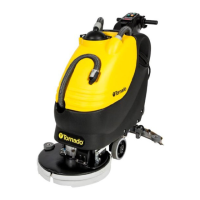



 To Next Page
 General