35
Note : The asterisk “*” indicates that this component is specially designed for use on double-action
clutch.
C. When the first of clutch pedal is depressed, the three release levers actuate the clutch pressure plate
through adjusting bolts to disengage the master clutch, interrupting power transmission to the running
system on the tractor, while the clearance (1±0.1) at the three pull-rods is eliminated and the clutch for
power take-off continues to work. Only the clutch pedal is further depressed, can the full-rod drive the
pressure plate of PTO clutch to disengage the PTO clutch. The second stage of disengagement cuts off
power transmission to power take-off shaft. As the clutch pedal is released, the PTO clutch is first
engaged and then the master clutch. The user can be trained to accurately distinguish the stage of
release. For apprentice drivers who are not skillful enough to operate the clutch and only want to
release the first working stage, a limiting mechanism on the clutch release lever can be used to control
the first stage working travel.
(3) Repair and Maintenance
A. The clutch should engage smoothly and disengage thoroughly. If any problem is found, check and
adjust relevant clearance if necessary.
B. During technical maintenance Class 111, oil in the rear of bridge casing (the same as used in the
transmission) should be changed. The oil level should be at the lower edge of the screw hole to ensure
that the oil thrower weldment can provide lubrication for bearing.
5.3 Adjustment of Transmission
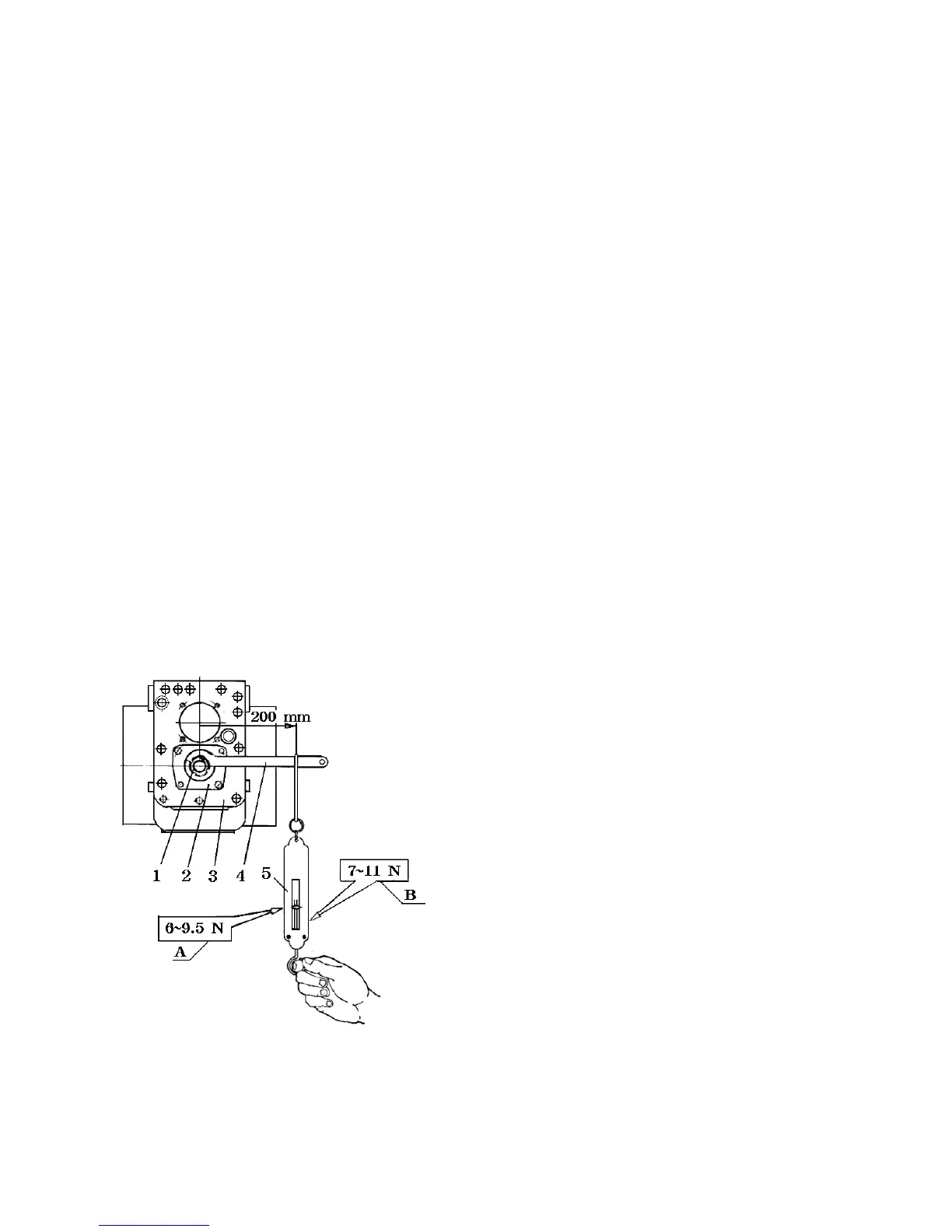
A. The spring scale reading after preloading the
front bearing of the second shaft
B. The spring scale reading after preloading the
differential bearing and that of the front bearing
of the second shaft.
1. Circular nut
2. Front bearing cover of the second shaft
3. Transmission housing 4. Special wrench
5. Spring scale
Fig. 5-2 Preloading of front bearing of the second
shaft and that of the differential bearing



 To Next Page