Chapter 2: Intended Use and General Information
UT100 Handheld Pulse Oximeter Operation Manual 2-3
1
2
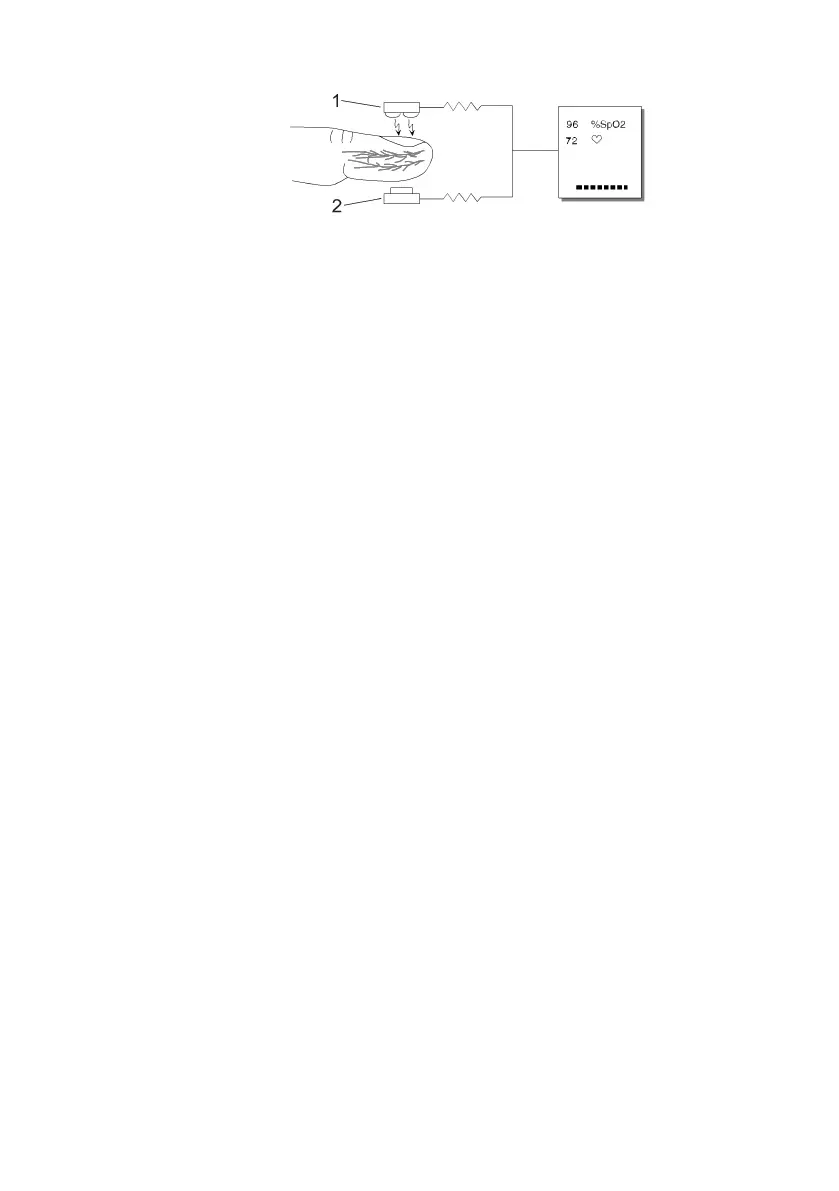
Figure
2.1:
Th
eor
y
of
Oper
ation
1. Low intensity Red and Infrared LED light sources
2. Detector
Oximetry processes these
sig
nals
,
separating
the time invariant
parameters
(tissue
thick
ness
,
skin
c
olor
,
light
in
t
ensit
y
,
and venous blood) from the time
variant
parameters
(arterial volume
and
SpO
2
)
to identify the pulses and
calculate functional oxygen saturation. Oxygen
saturation
calculations can
be performed because blood
saturated
with oxygen predictably absorbs
less
r
ed
light than
oxygen-depleted blood
.
WARNING!
Since measurement of SpO
2
depends on a pulsating vascular
bed, any condition that restricts blood flow, such as the use of
a blood pressure cuff or extremes in systemic vascular
resistance, may cause an inability to determine accurate SpO
2
and pulse rate readings.
WARNING! Under certain clinical conditions, pulse oximeters may display
dashes if unable to display SpO
2
and/or pulse rate values.
Under these conditions, pulse oximeters may also display
erroneous values. These conditions include, but are not limited
to: patient motion, low perfusion, cardiac arrhythmias, high or
low pulse rates or a combination of the above conditions.
Failure of the clinician to recognize the effects of these
conditions on pulse oximeter readings may result in patient
injury.


 To Next Page