34
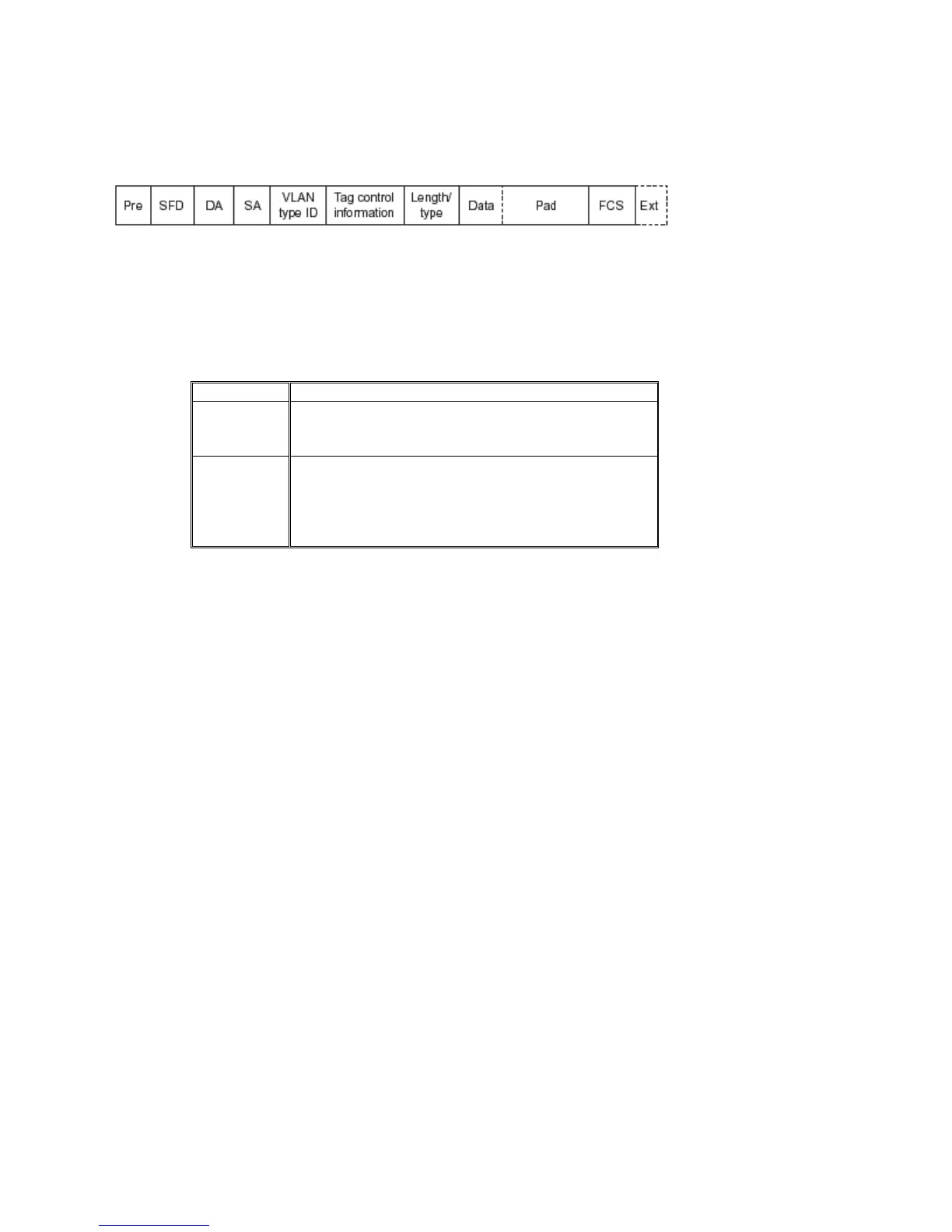
What if a VLAN tagging is applied?
VLAN tagging is a 4-byte long data immediately following the MAC source address. When tagged
VLAN is applied, the Ethernet frame structure will have a little change shown as follows.
Only two fields, VLAN ID and Tag control information are different in comparison with the basic
Ethernet frame. The rest of the fields are the same.
The first two bytes are VLAN type ID with the value of 0x8100 indicating the received frame is
tagged VLAN and the next two bytes are Tag Control Information (TCI) used to provide user priority and
VLAN ID, which are explained respectively in the following table.
Bits 15-13
User Priority 7-0, 0 is lowest priority
Bit 12
CFI (Canonical Format Indicator)
1: RIF field is present in the tag header
0: No RIF field is present
Bits 11-0
VID (VLAN Identifier)
0x000: Null VID. No VID is present and only user
priority is present.
0x001: Default VID
0xFFF: Reserved
Table 3-5
Note: RIF is used in Token Ring network to provide source routing and comprises
two fields, Routing Control and Route Descriptor.
When MAC parses the received frame and finds a reserved special value 0x8100 at the location of
the Length/Type field of the normal non-VLAN frame, it will interpret the received frame as a tagged
VLAN frame. If this happens in a switch, the MAC will forward it, according to its priority and egress rule,
to all the ports that are associated with that VID. If it happens in a network interface card, MAC will
deprive of the tag header and process it in the same way as a basic normal frame. For a VLAN-enabled
LAN, all involved devices must be equipped with VLAN optional function.
At operating speeds above 100 Mbps, the slotTime employed at slower speeds is inadequate to
accommodate network topologies of the desired physical extent. Carrier Extension provides a means by
which the slotTime can be increased to a sufficient value for the desired topologies, without increasing the
minFrameSize parameter. Nondata bits, referred to as extension bits, are appended to frames that are
less than slotTime bits in length so that the resulting transmission is at least one slotTime in duration.
Carrier Extension can be performed only if the underlying physical layer is capable of sending and
receiving symbols that are readily distinguished from data symbols, as is the case in most physical layers
that use a block encoding/decoding scheme.



 To Next Page