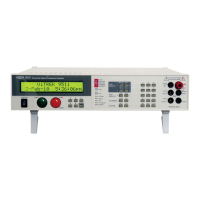
Vitrek V4 – Electrical Safety Tester USER MANUAL
31
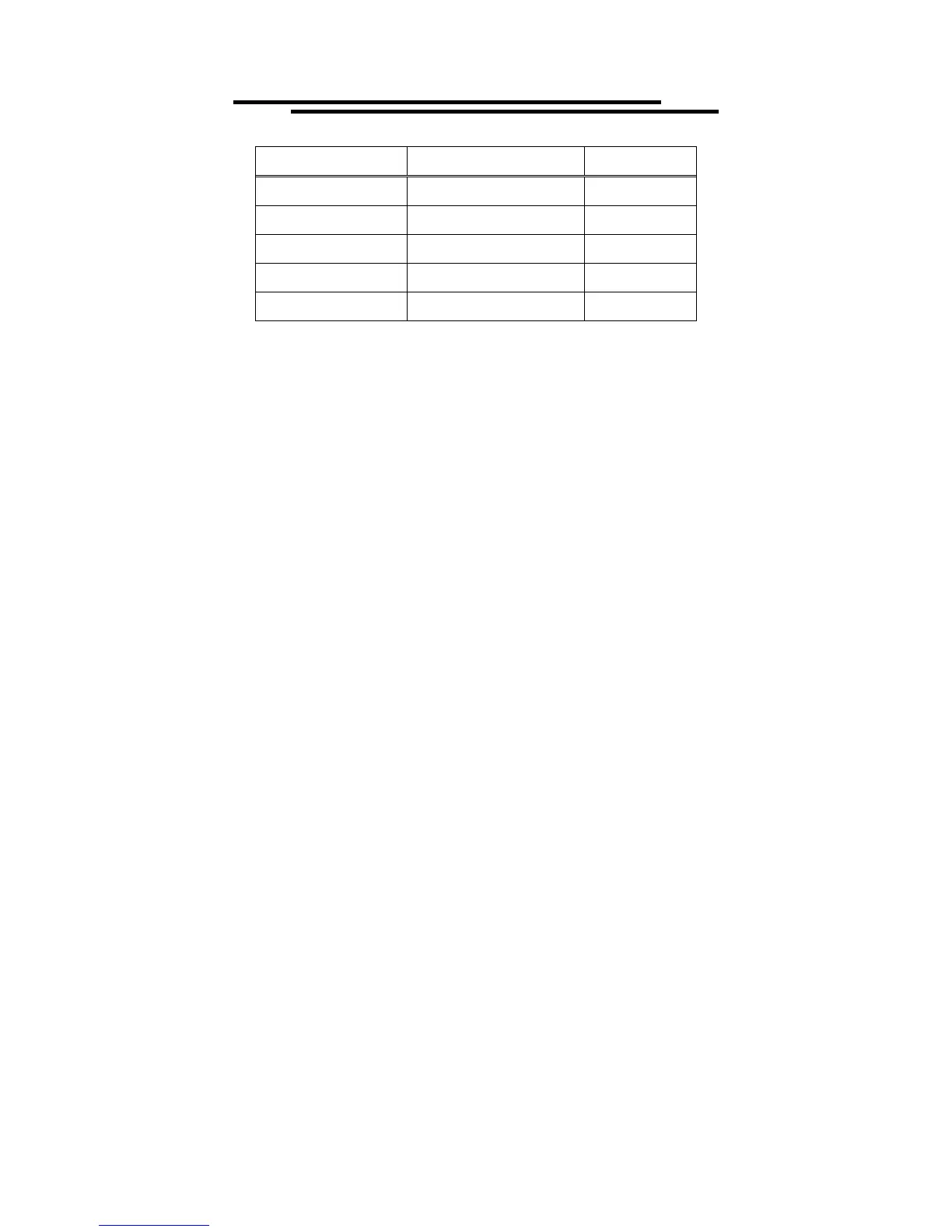
Parameter Type Description Example
Boolean Boolean numbers or values
0, 1
NR1 Integers 0, 1, 18
NR2 Decimal numbers 1.5, 3.141, 8.4
NR3 Floating point numbers 4.5E-1, 8.25E+1
String Alphanumeric characters “No error”
Table 1: Parameter Types for Syntax Descriptions
Message Terminator and Message Separator
I. GPIB message terminators
In accordance with IEEE 488.2 standard, any of the following message terminators are acceptable:
z LF
^
END Line feed code (hexadecimal 0A) with END
message
z LF Line feed code
z <dab>
^
END Last data byte with END message
These terminators are compatible with most application programs. A semicolon separates one command
from another when the commands appear on the same line.
II. RS232 message terminators
As there is no signal of end message on RS232 bus, therefore, use LF as message terminator. When a
series of commands are sent to the instrument, it must add a LF to be a judgment for message terminator.
As for query command, the return message of the instrument is also added a LF for PC to judge message
terminator.
Entering Commands
The standards that govern the command set for the V4 allow for a certain amount of flexibility when you
enter commands. For instance, you can abbreviate many commands or combine commands into one message
that you send to the V4. This flexibility, called friendly listening, saves programming time and makes the
command set easier to remember and use.
Command Characters
The V4s are not sensitive to the case of command characters. You can enter commands in either uppercase or
lowercase.
You can execute any command with white space characters. You must, however, use at least one space
between the parameter and the command header
Abbreviating Commands
Most commands have a long form and a short form. The listing for each command in this section shows the
abbreviations in uppercase. For instance, you can enter the setting : ACWStanding: VOLTage 1.000 simply
as : ACWStanding: VOLTage 1.000
Because the V4 assumes that a command starts from the root, you have the option of beginning the initial
command header with a colon (:).


 To Next Page